Office Address
14, Residency Road, Udaipur, Rajasthan 313001
Office Address
14, Residency Road, Udaipur, Rajasthan 313001

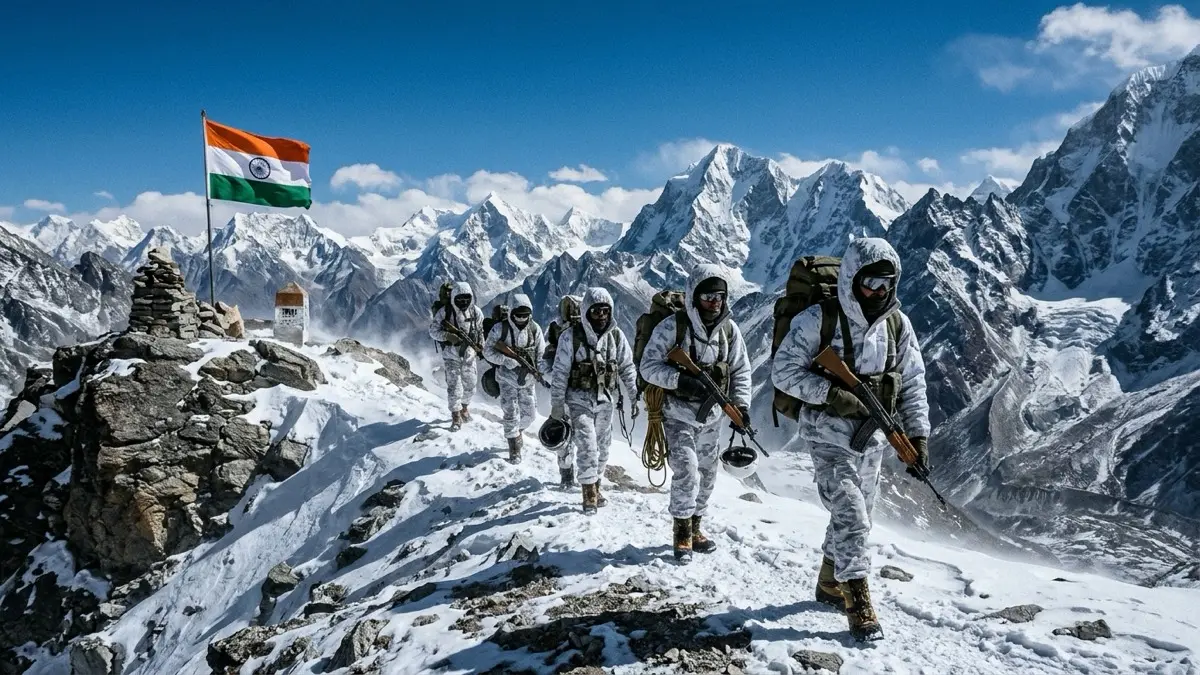
At 18,200 feet above sea level in the desolate expanses of the Karakoram range, winter does not arrive with falling leaves—it arrives with a howling, predatory gale that strips moisture from your skin within minutes. The mercury regularly plunges to minus 35 degrees Celsius, and windchill can make it feel like minus 50. Here, along the Line of Actual Control (LAC) separating India and China, every single breath yields only half the oxygen your body craves. Yet, etched onto the high-altitude forward posts of the Indo-Tibetan Border Police (ITBP), the motto never wavers: Shaurya – Dridhata – Karm Nishtha (Valour, Determination, Devotion to Duty).
While diplomatic communiqués in New Delhi and Beijing announce disengagement frameworks, patrolling protocols, and buffer zones, the ground reality of the India-China border is lived minute-by-minute by the “Himveers”—the snow warriors of the ITBP and their brothers-in-arms in the Indian Army. This is an authentic frontline account of what standing guard on the disputed frontier truly entails: the silence of the glaciated moraines, the physical friction of banner drills, the psychological toll of isolation, and the unyielding resolve that keeps the tricolor flying over India’s northernmost heights.
Civilians reading news headlines about border tensions often picture endless exchanges of artillery and gunfire. But along the LAC, the first and most relentless adversary you face every morning is nature itself. At heights exceeding 17,000 feet, high-altitude pulmonary edema (HAPE) and cerebral edema (HACE) are lethal threats that do not care about military rank.
Before any officer or jawan can step onto a forward patrol track, they must undergo three rigorous stages of acclimatization spanning nearly three weeks. Even then, normal bodily functions become an uphill struggle:
How does an actual patrol unfold when Indian and Chinese troops encounter each other? Because the Line of Actual Control is not mutually demarcated on the ground, both sides have overlapping perceptions of where the border lies. Patrol points (PPs) in sectors like the Depsang Plains, Demchok, and the north bank of Pangong Tso have historically witnessed frequent crossings.
Under the 1993 and 1996 Confidence Building Measures (CBMs), both nations agreed that neither side shall open fire or use hazardous weapons within two kilometers of the line. Consequently, confrontations take a unique, physically taxing form:
When our patrol spots a Chinese People’s Liberation Army (PLA) patrol advancing into an overlapping claim area, standard operating protocols are immediately initiated. Both formations halt at a designated distance and unfurl large fabric banners displaying bold lettering in Hindi, English, and Mandarin:
“You have crossed into Indian territory. This is sovereign Indian land. Please return to your side.”
What follows is an agonizing test of nerve. Both sides record the encounter with handheld digital cameras and drone feeds to maintain legal evidence for subsequent Border Personnel Meetings (BPMs) at Chushul or Daulat Beg Oldie. Verbal shouting matches, physical push-and-pull blockades, and attempts to out-flank each other can drag on for hours in sub-zero winds. One wrong move, one momentary lapse of discipline, can trigger a catastrophic melee.
The ITBP Himveer is specifically trained for this exact scenario: unflinching physical strength coupled with ice-cold emotional restraint. We do not yield an inch of ground, yet we do not allow an incident to escalate beyond protocol. As senior defence leadership has consistently highlighted, maintaining national sovereignty against anti-India forces and external challenges requires profound unity, tactical grit, and iron discipline.
Officers who served along the LAC fifteen years ago describe a completely different era—one where a patrol to a remote border marker involved an arduous seven-day trek over treacherous moraines, dependent on mule caravans and air-drops that frequently missed target drop zones. Today, the operational infrastructure along India’s northern frontiers has undergone a generational leap.
| Infrastructure Domain | Legacy Conditions (Pre-2015) | Modern Status (2026 Reality) |
|---|---|---|
| All-Weather Arterial Roads | Unpaved seasonal tracks cut off for 6 months | DS-DBO Highway, double-lane blacktopped border corridors |
| Mountain Tunnel Transit | Vehicles stranded at snowbound passes for weeks | Atal, Sela, and Shinku La strategic tunnel networks |
| Habitat & Energy | Drafty canvas tents, choking soot from kerosene | Pre-fabricated, solar-heated insulated composite shelters |
| Surveillance & Eyes on Border | Binoculars and manual foot reconnaissance | Long-range thermal imagers, tethered drones, satellite feeds |
| Communications | Static-heavy HF radio sets, month-long letter delays | Secure optical fibre lines, satellite data uplinks, frontline 4G towers |
In addition to heavy strategic roads, the adoption of clean energy has revolutionized remote outpost survival. Where fuel logistics previously consumed immense manpower, microgrid solar installations—similar in principle to the decentralised systems transforming home solar efficiency across civilian India—now power thermal heating and critical communication arrays at forward bases without emitting telltale noise or exhaust plumes.
Equally transformative has been the Vibrant Villages Programme. By strengthening local infrastructure, healthcare, and schools in border hamlets like Demchok, Chushul, and Kibithoo, the local civilian population remains anchored to the soil. Empowered border communities and active grassroots leadership—echoing the governance model detailed in our guide on panchayat powers and sarpanch responsibilities—form India’s indispensable first line of early warning and intelligence.
When news flashes report that diplomatic working mechanisms (such as the WMCC or high-level bilateral summits) have reached agreements to disengage from friction points in Eastern Ladakh, there is a collective sigh of relief in the cities. But on the ground, disengagement is an exacting operational science.
Every withdrawal of temporary tents, earth-movers, or vehicle convoys is verified methodically. Observation posts track every movement through high-magnification thermal optics. Joint verification patrols are scheduled where Indian and Chinese representatives walk side-by-side to confirm that buffer zones remain sterile. But disengagement does not mean lowering our guard. On the contrary, it demands heightened vigilance: ensuring that an empty ridge today is not secretly reoccupied tomorrow under the cover of a blinding snowstorm.
Behind the tactical jargon, ballistic gear, and international geopolitics lies the human heartbeat of the border. When the temperature drops below minus thirty and winds rattle the corrugated roof of a bunker, life shrinks to simple, profound essentials.
It is the warmth of a steel mug of sweet ginger tea passed from a jawan from Rajasthan to an officer from Himachal. It is the camaraderie forged when four men spend months together in a fiberglass igloo cut off from civilization. It is the brief, crackling satellite phone call home once every fortnight: “Mummy, I am healthy. It’s just a bit chilly here. Don’t worry about what you see on the news—we have everything under control.”
The men and women of the ITBP and the Indian Army do not stand on these barren, frozen heights because they hate what is in front of them. They stand there because they love what they have left behind—their families, their villages, and a billion citizens sleeping peacefully thousands of miles to the south.
Add Udaipur Mirror as a preferred source on Google to see more of our travel guides in your AI overviews.






[…] Police Constable Salary 2026: Post-Wise Pay Level, In-Hand Pay & Allowances 2 seconds ago ⚡ India Standing Guard at 18,000 Feet: An ITBP Officer on Defending the LAC Amid the India-China Bord… News Blinkit & Zepto in Udaipur: Dark Store Warehouse Locations, Delivery Infrastructure & […]