Office Address
14, Residency Road, Udaipur, Rajasthan 313001
Office Address
14, Residency Road, Udaipur, Rajasthan 313001

NEW DELHI: In the latest anti-india-forces national unity, union Minister Kiren Rijiju on Wednesday issued a stern warning to divisive elements, stating that anti-india forces national unity remains unbreakable despite coordinated attempts to delegitimize democratic institutions. Speaking at a high-level national security seminar on October 21, 2026, the Minister emphasized that the current administration remains vigilant against ‘the politics of delegitimation’ that seeks to undermine the mandate of the people and the sovereignty of the Indian state.
⚡ Quick Highlights: Rijiju on Anti-India Forces & National Unity | Udaipur Mirror
During his address, Kiren Rijiju highlighted that the strength of India lies in its diversity and the constitutional framework that binds it. He noted that while certain global and domestic actors attempt to create fissures along communal or regional lines, the anti-india forces national unity narrative is countered by a more robust, digitally-aware citizenry. The Minister’s remarks come at a time when India is asserting its role as a ‘Vishwa Bandhu’, balancing global diplomacy with internal security vigilance.
Rijiju further argued that the resilience of the Indian state is not just a matter of military might but of institutional integrity. He pointed out that the constant scrutiny of government actions by the judiciary and the free press is a sign of a healthy democracy, provided that such scrutiny is not weaponized to stall national progress. This sentiment reflects the broader government stance on maintaining a balance between dissent and disruption. (Also read: Dawa Mitra Initiative: Rajasthan Patients Get Dedicated Help to Decode Prescriptions and Access Health Schemes).
“No amount of external pressure or internal subversion can dent the resolve of a New India that is conscious of its historical roots and future destiny.” — Kiren Rijiju, Union Minister
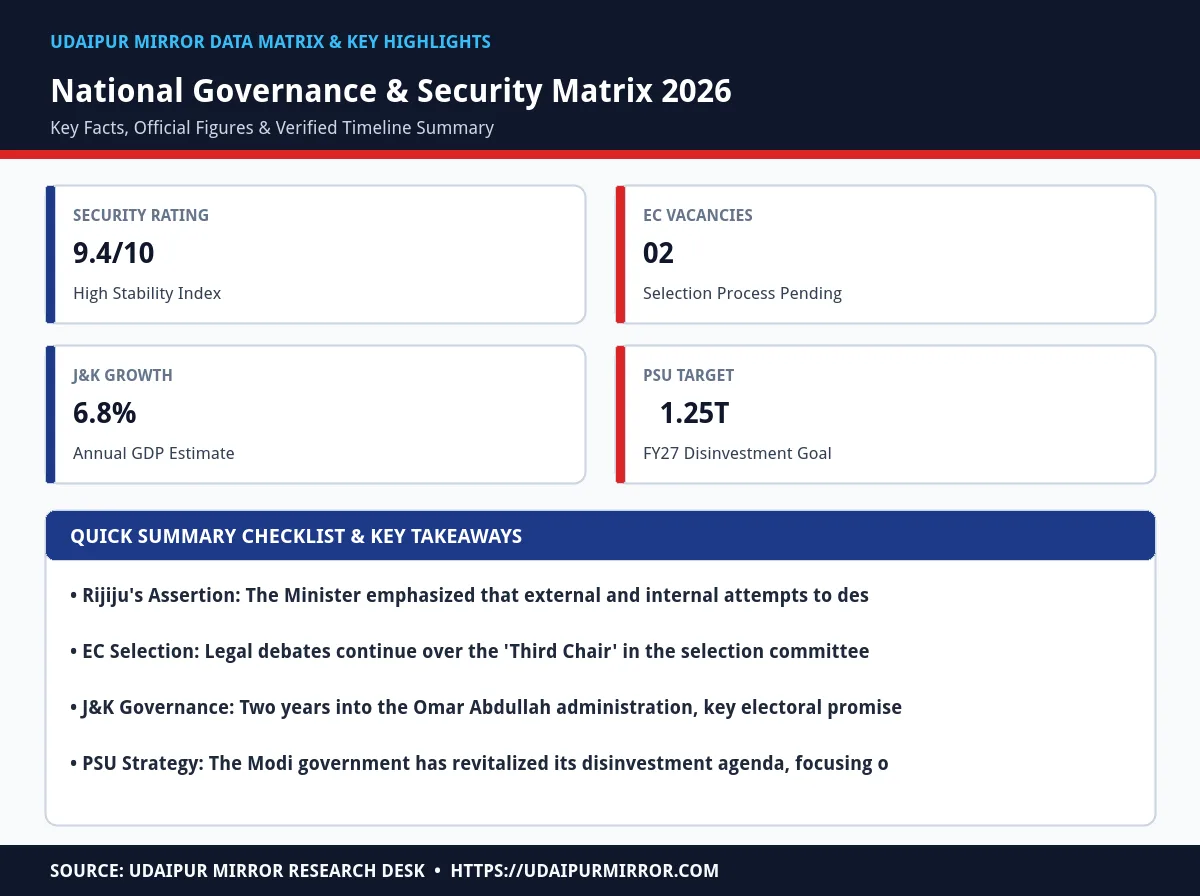
The following table outlines the critical legislative and political milestones scheduled for the final quarter of 2026, highlighting the government’s focus on security and institutional reform.
| Event Type | Key Figure/Entity | Current Status | Scheduled Date |
|---|---|---|---|
| National Security Address | Kiren Rijiju | Completed | Oct 21, 2026 |
| EC Selection Hearing | Supreme Court | Ongoing | Oct 22, 2026 |
| J&K Performance Review | Omar Abdullah | 2-Year Mark | Oct 21, 2026 |
| PSU Disinvestment Meet | Finance Ministry | Policy Draft | Oct 24, 2026 |
| Cabinet Briefing | Union Govt | National Security | Oct 21, 2026 |
| Parliamentary Bill Review | Lok Sabha | Drafting Phase | Oct 28, 2026 |
A significant portion of the current political discourse revolves around what experts call the ‘politics of delegitimation.’ This involves systematic attempts to question the validity of electoral outcomes and the neutrality of constitutional bodies. Rijiju’s speech addressed these concerns, suggesting that such tactics are often the last resort of political entities that have lost touch with the grassroots reality of the Indian electorate.
In this context, the debate over the ‘Third Chair’ in the Election Commission selection process has gained momentum. The Supreme Court is currently hearing petitions regarding who should have the final say in picking India’s Election Commissioners. This legal battle is seen as a litmus test for the independence of the poll body, which remains the bedrock of Indian democracy. While the government seeks to maintain its executive prerogative, civil society groups are advocating for a more inclusive selection panel.
As the Union government focuses on national narratives, regional politics in Jammu & Kashmir present a complex picture. October 2026 marks two years since the Omar Abdullah-led government took office. However, reports suggest that several key poll promises remain unmet, leading to a palpable sense of restlessness among the local population. The delay in the restoration of full statehood and the slow pace of job creation have become central themes for the opposition.
While the J&K administration struggles with local governance, other states like Rajasthan are focusing on grassroots welfare. For instance, the Dawa Mitra Initiative: Rajasthan Patients Get Dedicated Help to Decode Prescriptions and Access Health Schemes has shown how localized governance can directly impact citizen well-being, providing a model that other states might look to emulate during political transitions.
On the economic front, the Modi government has put disinvestment back at the top of its agenda for the 2026-27 fiscal year. The focus is not just on raising capital but on improving the efficiency of Public Sector Undertakings (PSUs). Analysts suggest that PSU spending needs closer scrutiny to ensure that taxpayer money is being utilized for strategic growth rather than just maintaining legacy structures. This economic push is seen as a vital component of national security, as a strong economy is less vulnerable to external shocks.
The spirit of national resilience is also reflected in the cultural and sporting arenas. Much like the political veterans steering the country, sports figures are also making cases for their relevance. For example, Bhuvneshwar Kumar Eyes India Comeback: Analyzing the Veteran Pacer’s Numbers-Backed Case in 2026, demonstrating that the drive for excellence and comeback is a recurring theme in the Indian national psyche this year.
As India moves toward the end of 2026, the intersection of national security, economic reform, and institutional integrity will define the political landscape. Kiren Rijiju’s assertion that anti-india forces national unity will fail is a call to action for both the government and the citizenry to remain steadfast. The upcoming months will be crucial as the Supreme Court decides on the EC selection process and the government prepares for the next round of state assembly elections.
Ultimately, the strength of the Indian democracy lies in its ability to absorb dissent while maintaining a unified front against genuine threats. The ongoing developments in J&K, the legal debates in New Delhi, and the economic shifts in the PSU sector all contribute to a dynamic and evolving national story that continues to defy the predictions of those who seek its fragmentation.
The main focus was on national integrity and the resilience of India’s unity against ‘anti-India forces’ and the ‘politics of delegitimation’ that target democratic institutions.
It refers to the legal and political discussion over the composition of the committee that selects India’s Election Commissioners, specifically focusing on ensuring a balance between executive power and institutional independence.
As of October 2026, the government has completed two years in office, but it faces criticism for not fulfilling key promises related to statehood, employment, and infrastructure development.
The government has revitalized its disinvestment agenda for PSUs, aiming for a target of approximately ₹1.25 trillion for the fiscal year, with a focus on strategic restructuring and fiscal discipline.
Add Udaipur Mirror as a preferred source on Google to see more of our travel guides in your AI overviews.