Office Address
14, Residency Road, Udaipur, Rajasthan 313001
Office Address
14, Residency Road, Udaipur, Rajasthan 313001


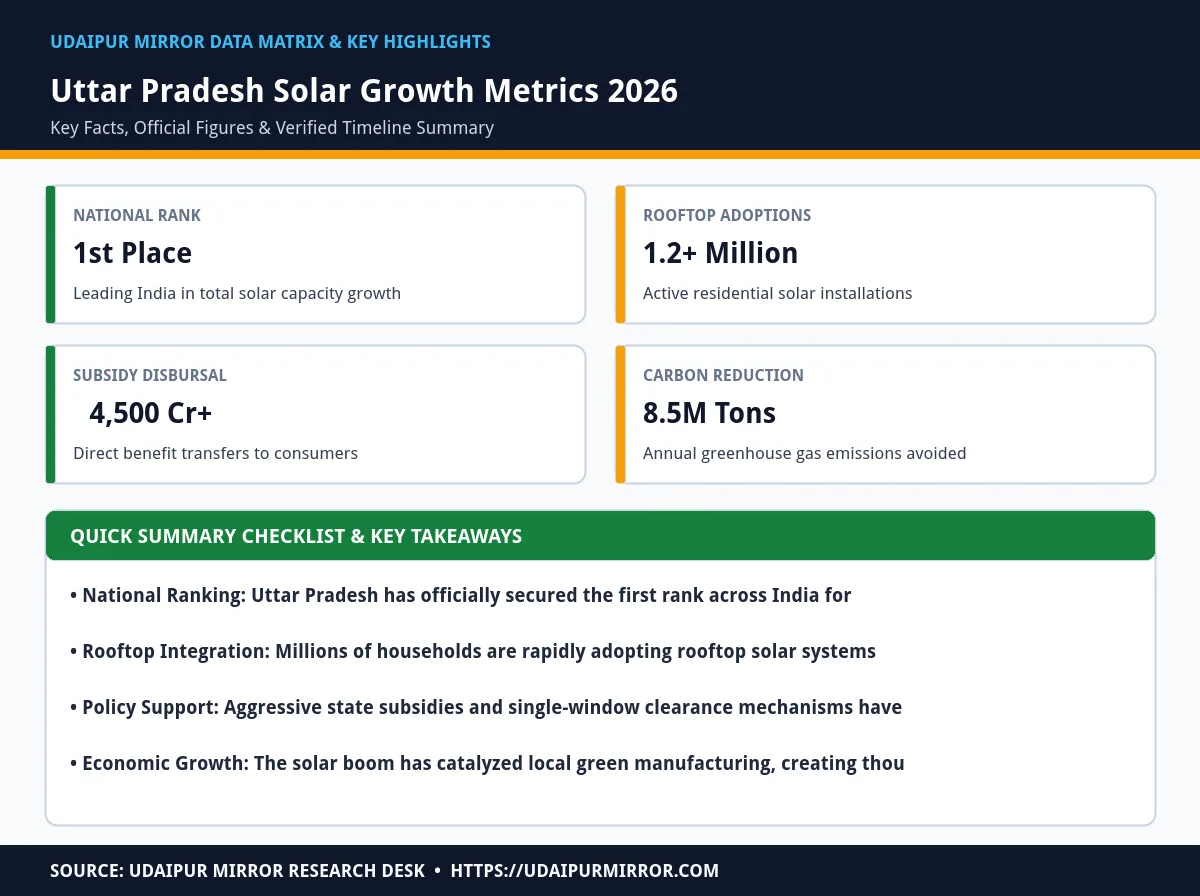
LUCKNOW: LUCKNOW — In a monumental milestone for India’s renewable energy sector, uttar pradesh solar revolution has officially reached a historic zenith as the state captured the number one rank nationwide in clean energy deployment. Propelled by aggressive state policies, massive institutional backing, and widespread citizen participation under central and state photovoltaic schemes, the most populous state in the country has successfully outpaced traditional green energy powerhouses. As electricity demand soars, this paradigm shift toward sustainable power generation highlights a comprehensive structural transformation in India’s power landscape, mirroring broader technological shifts akin to how Android smartphone prices to rise 10% across India following supply chain adjustments in consumer electronics.
⚡ Quick Highlights: Uttar Pradesh Ranks First in India's Solar Energy Revolution
The transformation of Uttar Pradesh into India’s premier solar hub is not an overnight fluke but the result of meticulous administrative planning, targeted financial incentives, and robust public-private partnerships. State DISCOMs have overhauled their technical infrastructure, making net-metering applications entirely digital and transparent. Citizens can now track their rooftop solar applications from initial submission to final meter installation through unified mobile applications.
Furthermore, industrial corridors and municipal corporations have mandated solar integration for large commercial complexes and educational institutions. This multi-pronged approach ensures that adoption is not limited to urban centers but penetrates deep into semi-urban and rural districts, stabilizing the rural grid and ensuring uninterrupted power supply for agricultural and domestic needs. (Also read: Gold, Silver Price Outlook: US-Iran Tensions and Inflation Data to Set Tone).
“Our ascent to the top rank is a testament to the vision of sustainable development. By empowering every household to become a power producer, Uttar Pradesh is leading India's green transformation.” — State Renewable Energy Minister
Review the comprehensive breakdown of rooftop solar system capacities, estimated setup costs, applicable government subsidies under national frameworks, and anticipated monthly electricity savings for residential consumers.
| System Capacity | Approx. Setup Cost | Government Subsidy | Monthly Savings | Payback Period |
|---|---|---|---|---|
| 1 kW | ₹55,000 | ₹30,000 | ₹1,200 – ₹1,500 | 3.5 Years |
| 2 kW | ₹1,10,000 | ₹60,000 | ₹2,500 – ₹3,000 | 3.2 Years |
| 3 kW | ₹1,65,000 | ₹78,000 | ₹4,000 – ₹4,800 | 3.0 Years |
| 5 kW | ₹2,75,000 | ₹78,000 (Capped) | ₹7,000 – ₹8,500 | 2.8 Years |
At the heart of Uttar Pradesh’s phenomenal solar surge is the widespread implementation of the PM Surya Ghar Muft Bijli Yojana. The scheme provides substantial financial relief directly to homeowners, bridging the initial capital gap that previously deterred middle-class families from investing in renewable tech. With direct benefit transfers hitting bank accounts swiftly after inspection, consumer trust has skyrocketed.
In tandem with shifting household dynamics, smart investors are also diversifying their portfolios into alternative wealth generators, keeping a close eye on macroeconomic trends such as gold and silver price outlook shifts driven by global geopolitical tensions.
“The synergy between central subsidies and state-level execution has made solar power not just an environmental choice, but the most financially sound investment for Indian households.” — Dr. Rameshwar Prasad, Energy Analyst
As Uttar Pradesh paves the way, other states are actively studying its decentralized governance model. The integration of advanced AI-driven inverters, smart net meters, and high-efficiency monocrystalline panels ensures minimal energy loss and maximum grid resilience. These technological leaps are critical as India scales toward its ambitious 530 GW renewable energy target by 2030, where solar power is projected to account for over 80 percent of total capacity growth.
The state’s success also serves as a beacon for industrial investors looking for stable, green-powered manufacturing ecosystems. With robust local supply chains taking root, the dependency on imported photovoltaic modules is steadily declining, fortifying India’s self-reliance in cutting-edge green technology. (Also read: Android Smartphone Prices to Rise 10% Across India Following Diwali Festive Sale Close).
“Modernizing our grid architecture with smart meters and high-efficiency solar modules ensures our infrastructure is future-proof and ready for massive load scaling.” — Chief Technical Officer, UP Renewable Agency
Uttar Pradesh secured the top rank through aggressive implementation of rooftop solar schemes, streamlined DISCOM online net-metering portals, substantial state subsidies, and widespread citizen participation under the PM Surya Ghar initiative.
Under current central and state guidelines, residential consumers receive ₹30,000 for a 1 kW system, ₹60,000 for a 2 kW system, and a maximum of ₹78,000 for systems sized 3 kW and above.
Due to government subsidies and drastic reductions in monthly electricity bills, the typical payback period for a residential solar setup ranges between 2.8 to 3.5 years.
Homeowners can apply online through the official National Portal for Rooftop Solar or the respective state DISCOM portal, submit necessary property and electricity connection details, and choose an empanelled vendor for installation.
Add Udaipur Mirror as a preferred source on Google to see more of our travel guides in your AI overviews.