Office Address
14, Residency Road, Udaipur, Rajasthan 313001
Office Address
14, Residency Road, Udaipur, Rajasthan 313001

UDAIPUR: UDAIPUR — Bullion markets across Rajasthan and major Indian trading hubs are bracing for a volatile week ahead as global macroeconomic forces and escalating geopolitical friction take center stage. Market participants are closely monitoring the gold silver price outlook, which is heavily influenced by intensifying US-Iran tensions and upcoming domestic and international inflation prints. As retail buyers in Udaipur, Jaipur, Jodhpur, and Kota evaluate safe-haven assets following the festive season, institutional analysts warn that macroeconomic headwinds will likely test key support levels across both precious metals on the Multi Commodity Exchange (MCX) and international COMEX platforms.
⚡ Quick Highlights: Gold, Silver Price Outlook: US-Iran Tensions & Inflation Data
The primary catalyst driving market sentiment this week is the sharp escalation in diplomatic and military friction between the United States and Iran. Precious metals have historically functioned as the ultimate hedge against geopolitical uncertainty, drawing substantial institutional capital whenever supply chains or regional stability in the Middle East are threatened. Analysts note that any unexpected escalation in the region immediately triggers short-covering on international COMEX bullion contracts, which subsequently spills over into domestic MCX trading sessions.
For retail investors in India, these global shifts translate directly into domestic price volatility. While short-term spikes offer tactical exit points for traders, long-term investors are advised to focus on systematic accumulation strategies. To balance your overall portfolio amidst shifting global yields, many financial planners also recommend diversifying into fixed-income instruments. You can review our detailed analysis on debt funds investment strategies to optimize your short-term versus long-term asset allocation.
“Geopolitical risk premiums are currently embedded into every bullion tick. Investors should anticipate sharp intraday swings governed by weekend headline risks.” — Senior Commodities Strategist, Mumbai Bullion Desk
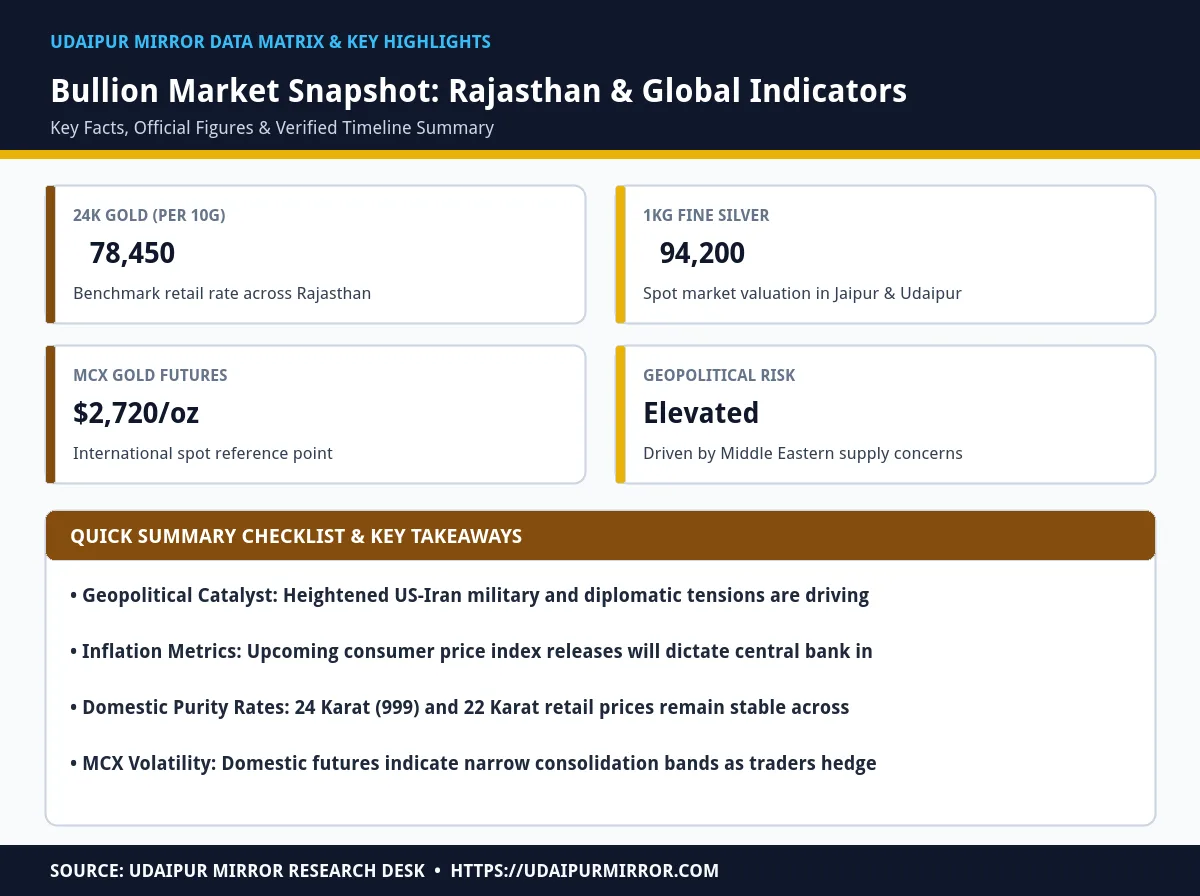
The following structured matrix compares prevailing retail bullion rates across key urban centers in Rajasthan, outlining standard purity brackets before local making charges and statutory goods and services tax applications.
| City / Hub | 24K Gold (Per 10g) | 22K Gold (Per 10g) | 18K Gold (Per 10g) | 1 KG Silver |
|---|---|---|---|---|
| Udaipur | ₹78,450 | ₹71,950 | ₹58,850 | ₹94,200 |
| Jaipur | ₹78,500 | ₹72,000 | ₹58,900 | ₹94,350 |
| Jodhpur | ₹78,400 | ₹71,900 | ₹58,800 | ₹94,100 |
| Kota | ₹78,420 | ₹71,920 | ₹58,820 | ₹94,150 |
| MCX Benchmark | ₹78,100 | ₹71,600 | ₹58,500 | ₹93,900 |
Beyond Middle Eastern geopolitics, macroeconomic fundamentals—specifically upcoming inflation prints from major global economies—will dictate interest rate cut expectations. Stubborn inflation numbers tend to strengthen the US dollar and push bond yields higher, which historically creates headwinds for non-yielding assets like gold and silver. Conversely, cooling inflation metrics cement expectations of monetary easing, providing renewed upside momentum for precious metals.
In domestic markets, retail demand has transitioned from festive buying sprees into a more calculated consolidation phase. As consumers adjust to post-festival pricing structures, technology and consumer durables sectors are also experiencing shifting cost dynamics. For instance, retail shoppers navigating household budgets should note that android smartphone prices are projected to adjust following the close of major festive sales, impacting overall discretionary spending patterns across households.
“The upcoming Consumer Price Index releases will either validate current rate-cut projections or force a hawkish re-evaluation by global central banks.” — Macroeconomic Research Lead
Navigating retail jewelry purchases in Rajasthan requires a thorough understanding of gold purity classifications. 24 Karat gold represents 99.9% purity and is primarily traded in bar and coin formats for investment purposes. Due to its softness, it is rarely used for heavy gemstone jewelry settings. Instead, 22 Karat gold (91.6% purity) and 18 Karat gold (75.0% purity) dominate the retail jewellery market, offering the necessary structural durability for intricate craftsmanship.
Buyers must insist on the Bureau of Indian Standards (BIS) Hallmark Unique Identification (HUID) number on all jewellery items. This six-digit alphanumeric code ensures complete transparency regarding metal purity, assay center verification, and jeweler registration, protecting consumers from adulteration. (Also read: Android Smartphone Prices to Rise 10% Across India Following Diwali Festive Sale Close).
“Hallmarking is not merely a regulatory formality; it is the absolute bedrock of consumer protection in the Indian retail bullion ecosystem.” — Consumer Affairs & Standards Expert
Purchasing physical gold or silver involves more than just the baseline spot rate per 10 grams or 1 kilogram. Consumers must factor in statutory obligations and manufacturing fees that influence the final invoice value at bullion counters in Udaipur and Jaipur. The standard Goods and Services Tax (GST) on precious metals stands at 3%, applicable uniformly across all commercial transactions in India.
Additionally, making charges levied by jewelers can vary significantly—ranging from 5% to over 25% depending on the intricacy of the design, machine-cut precision, or traditional handcrafted Mewari artistry. Consumers are advised to negotiate fixed making charges rather than percentage-based fees whenever possible to secure transparent pricing.
“Transparency in making charges and strict adherence to 3% GST compliance separate reputable bullion merchants from unorganized local vendors.” — Rajasthan Bullion Association Representative
The outlook is primarily driven by escalating US-Iran geopolitical tensions and upcoming global inflation data releases that influence central bank monetary policies.
24 Karat gold (99.9% purity) commands a higher rate per 10 grams compared to 22 Karat gold (91.6% purity), which is alloyed with other metals for enhanced jewelry durability.
A mandatory 3% GST is applied to the final value of all gold and silver purchases, alongside making charges set by individual jewelers.
BIS Hallmarking with a 6-digit HUID code guarantees the certified purity of the precious metal and protects consumers against fraud or sub-standard purity.
Add Udaipur Mirror as a preferred source on Google to see more of our travel guides in your AI overviews.