Office Address
14, Residency Road, Udaipur, Rajasthan 313001
Office Address
14, Residency Road, Udaipur, Rajasthan 313001


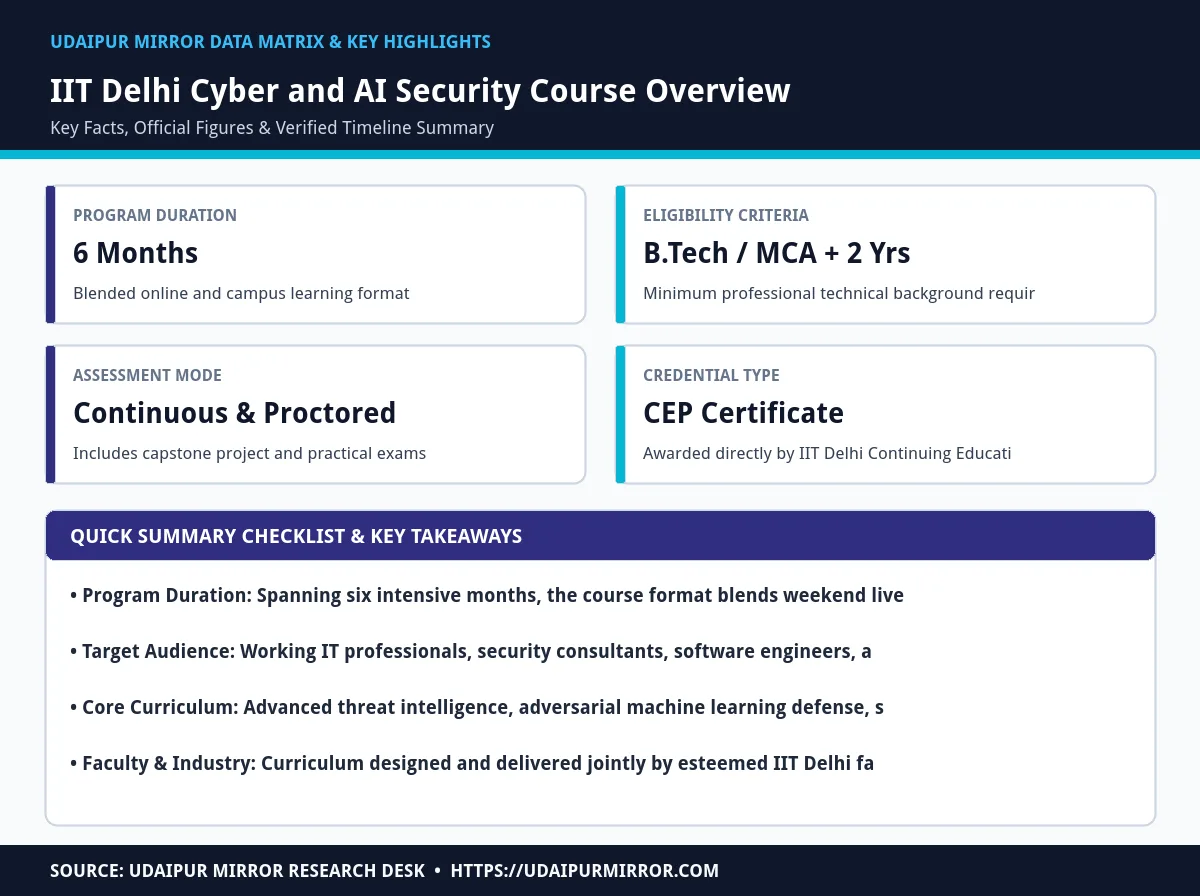
NEW DELHI: NEW DELHI — As enterprise digital infrastructure faces increasingly complex threat vectors, the Indian Institute of Technology (IIT) Delhi has officially unveiled its new iit delhi cybersecurity and ai security course. Designed to address the acute shortage of specialized talent capable of securing machine learning models and cloud networks, this intensive six-month program combines rigorous academic foundations with hands-on labs, preparing software architects, security analysts, and IT engineers for leadership roles in a rapidly evolving technological landscape.
⚡ Quick Highlights: IIT Delhi Launches 6-Month Cybersecurity and AI Security Course
The rapid acceleration of generative artificial intelligence and large-scale cloud migration has exposed severe vulnerabilities in corporate digital perimeters. Organizations across financial services, healthcare, and e-commerce are deploying autonomous systems faster than security teams can vet them. Recognizing this widening gap, academic institutions are stepping up to provide structured training. Market shifts have also impacted broader economic indices, as seen when Muhurat Trading 2026 Sees Sensex and Nifty Edge Lower in Rare Festive Loss, highlighting how macroeconomic volatility underscores the need for robust risk management at every level of enterprise operations.
IIT Delhi’s intervention is timely. By bridging theoretical computer science with applied defensive engineering, the six-month curriculum ensures that Indian engineers are equipped to safeguard next-generation computing infrastructure. Industry observers note that as state-sponsored cyberattacks and automated botnets grow more sophisticated, reliance on legacy security measures is no longer viable. (Also read: Muhurat Trading 2026 Sees Sensex and Nifty Edge Lower in Rare Festive Loss).
“Securing artificial intelligence models requires an entirely new paradigm of defensive thinking that goes far beyond traditional network perimeter defense.” — Dr. Arvind Swaminathan, Senior Cybersecurity Researcher
The comprehensive curriculum is meticulously structured across multiple sequential modules, ensuring that learners progress from fundamental cryptographic defense mechanisms to cutting-edge adversarial machine learning protection strategies. Below is a detailed breakdown of the semester layout, primary focus areas, and practical deliverables.
| Module Phase | Focus Area | Core Topics Covered | Practical Deliverable |
|---|---|---|---|
| Phase 1 (Months 1-2) | Foundational Security | Network defense, cryptography protocols, identity management, zero-trust frameworks. | Secure Network Architecture Lab |
| Phase 2 (Month 3) | Cloud & Infrastructure | AWS/Azure security auditing, container hardening, Kubernetes cluster defense. | Cloud Vulnerability Assessment |
| Phase 3 (Month 4) | AI Model Security | Adversarial attacks on neural networks, data poisoning, model inversion defense. | Robust AI Pipeline Audit |
| Phase 4 (Month 5) | Incident Response & Ops | SOC operations, threat hunting, automated incident playbooks, forensics. | Simulated Breach Exercise |
| Phase 5 (Month 6) | Capstone Project | Real-world enterprise security problem solving under industry mentor guidance. | Live Capston Presentation |
Unlike generic certification programs that rely solely on recorded video lectures, the IIT Delhi course emphasizes experiential learning through live interactive sessions, sandbox environments, and rigorous peer-reviewed capstone projects. Participants will gain direct exposure to adversarial testing tools used by elite red teams globally.
Furthermore, macroeconomic stability in technology investments often mirrors national infrastructure spending. Similar to how Uttar Pradesh Achieves Top Rank in India’s Solar Revolution with Record Capacity Additions demonstrates long-term strategic execution, building a secure national digital backbone requires sustained, structured institutional commitment.
“Our objective is to transform experienced software professionals into frontline defenders capable of protecting critical national digital assets.” — Program Coordinator, Continuing Education Programme, IIT Delhi
To maintain high academic rigor, admissions for the upcoming cohort are subject to a multi-stage screening process. Candidates must possess a Bachelor’s degree in Engineering, Technology, Computer Applications, or related fields, alongside a minimum of two years of professional experience in software development, IT infrastructure, or information security.
Financial considerations and global economic markers, such as how Gold, Silver Price Outlook: US-Iran Tensions and Inflation Data to Set Tone, remind investors and professionals alike that upskilling remains one of the safest inflation-proof investments an individual can make in their career.
“Continuous professional education is no longer optional for tech workers; it is the fundamental currency of career sustainability.” — Tech Industry Human Resources Director
The program is structured to run for six intensive months, combining weekend online sessions with mandatory campus immersion modules.
Working professionals holding a degree in engineering, computer applications, or science with at least two years of experience in IT or software development are eligible.
Yes, successful candidates who clear all assessments and the capstone project receive a professional certificate from the Continuing Education Programme (CEP) office of IIT Delhi.
Yes, the curriculum specifically covers adversarial machine learning defense, model protection, and secure AI pipeline implementation alongside traditional network and cloud security.
Add Udaipur Mirror as a preferred source on Google to see more of our travel guides in your AI overviews.