Office Address
14, Residency Road, Udaipur, Rajasthan 313001
Office Address
14, Residency Road, Udaipur, Rajasthan 313001


BENGALURU: BENGALURU — State administrative authorities in Karnataka are scheduled to release a high-stakes inquiry report regarding the karnataka excess ethanol petrol report on Monday, sparking intense discussions across the energy sector. The investigation, triggered by consumer grievances and vehicle performance complaints related to fuel consistency, has placed Oil Marketing Companies (OMCs) under immediate regulatory scrutiny. As automotive engine systems and fuel injector assemblies face potential wear risks from unverified chemical composition thresholds, state regulators are pushing for strict compliance. This regulatory development mirrors broader industrial shifts seen elsewhere, much like how Uttar Pradesh achieves top rank in India’s solar revolution by implementing rigorous state-level green energy capacity addition benchmarks and monitoring frameworks.
⚡ Quick Highlights: Karnataka Ethanol Report in Petrol: OMCs Push for Joint Testing
The investigation commenced following a surge in consumer complaints in urban centers like Bengaluru and Mysuru, where motorists cited sudden drops in fuel mileage and abnormal engine sputtering. State consumer affairs and legal metrology departments responded by dispatching flying squads to collect random fuel nozzle samples from retail outlets operated by Indian Oil Corporation (IOC), Hindustan Petroleum Corporation (HPCL), and Bharat Petroleum Corporation (BPCL).
Initial preliminary screenings reportedly indicated instances where ethanol content drifted beyond the permissible regulatory threshold of standard automotive specifications. While India continues to aggressively champion green fuel adoption to cut crude import bills, the logistical challenge of maintaining homogenous blending across extensive supply chains remains a formidable hurdle. Technical specialists emphasize that rigorous digital training and upskilling in refinery diagnostics are vital, paralleling modern initiatives like when IIT Delhi launches 6-month cybersecurity and AI security course to bridge critical technical gaps across industrial sectors.
“Maintaining precise chemical equilibrium in high-blend fuels is paramount. Any deviation without adequate technical oversight risks damaging millions of consumer engines.” — Senior Consumer Affairs Official, Government of Karnataka
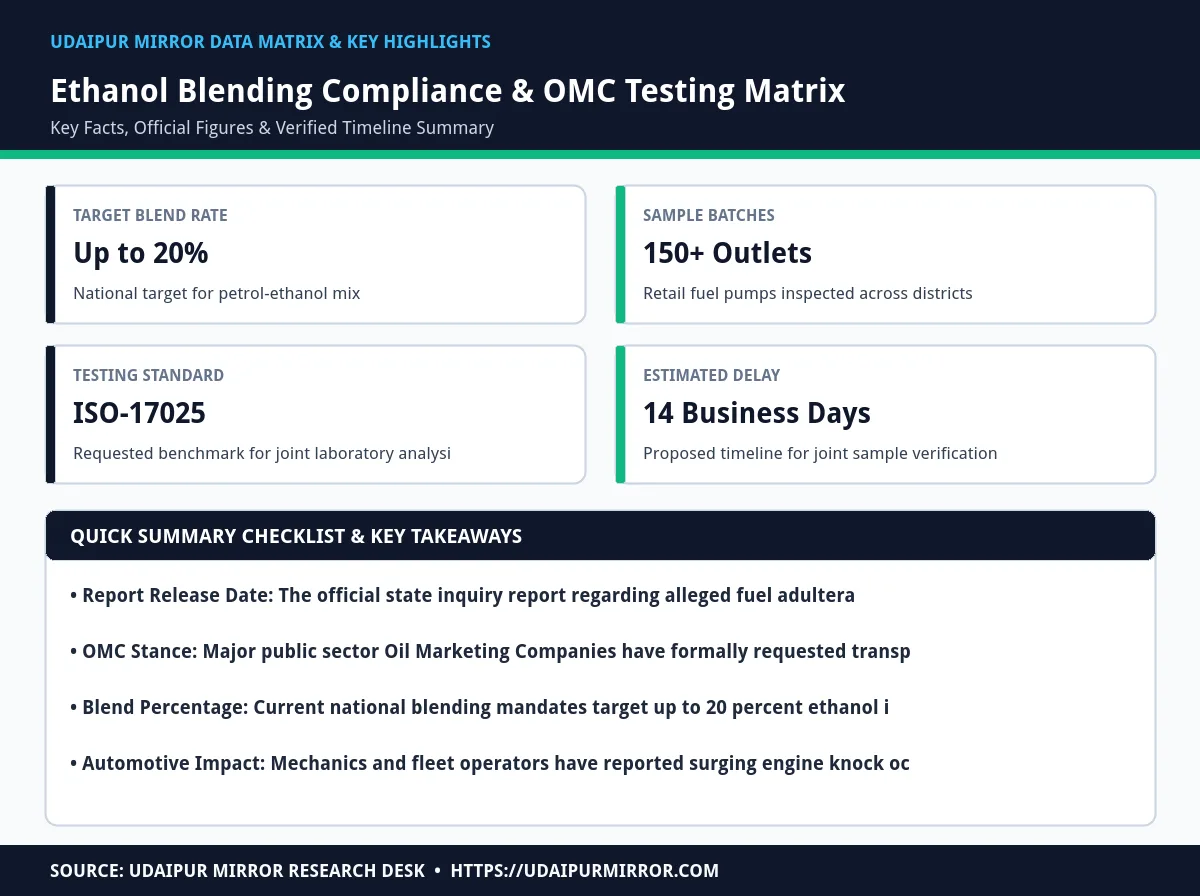
The following matrix outlines the key testing parameters, current regulatory discrepancies, and proposed joint verification methodologies agreed upon by state inspectors and public sector oil marketing representatives.
| Parameter | State Findings | OMC Position | Proposed Resolution |
|---|---|---|---|
| Ethanol Concentration | Exceeds standard limits in 12% of tested samples | Maintains blending occurs within allowable tolerance band | Conduct blind tests in accredited central labs |
| Moisture Absorption | Higher phase separation observed in monsoon storage | Denies storage tank water contamination at retail sites | Mandatory daily underground tank dip checks |
| Vapor Pressure | Deviations noted in volatile organic compound limits | Asserts fuel meets Bureau of Indian Standards (BIS) | Calibrate terminal dispensing meters bi-weekly |
| Sample Custody | Sealed containers held solely by state authorities | Demands multi-party witness during sample collection | Implement tripartite chain-of-custody documentation |
In response to the impending report release, a collective of public sector Oil Marketing Companies has formally petitioned the state government for a comprehensive joint testing procedure. OMCs argue that single-agency testing conducted without refinery representatives present violates standard operating procedures and fails to account for secondary factors such as underground storage tank humidity and post-dispensing phase separation.
Industry leaders stress that unilateral findings could cause unwarranted panic among retail consumers and disrupt fuel distribution logistics. By demanding accredited third-party laboratory verification, OMCs hope to establish a bulletproof evidentiary trail that protects both brand integrity and consumer trust while addressing legitimate technical anomalies.
“We welcome transparent quality checks, but scientific rigor requires joint sampling and independent laboratory validation before public disclosures are finalized.” — OMC Industry Representative
India’s aggressive push toward E20 (20 percent ethanol-blended petrol) is a cornerstone of the nation’s energy security architecture, designed to reduce foreign exchange outflows on crude oil imports and support domestic sugarcane and grain farmers. However, friction between state-level consumer watchdogs and federal fuel distributors highlights the delicate balancing act required during large-scale macro transitions.
Investors and automotive manufacturers are closely monitoring the Karnataka developments as a potential precedent for other states. Any mandated slowdown in blending or retroactive penalties could impact distillery revenues and sugarcane procurement cycles. Policymakers must carefully calibrate quality enforcement to protect vehicle owners without derailing the overarching national green energy transition. (Also read: Muhurat Trading 2026 Sees Sensex and Nifty Edge Lower in Rare Festive Loss).
“The ethanol blending program is vital for India's farm economy and fiscal health, but flawless supply chain quality control is non-negotiable for long-term success.” — Energy Market Analyst
The report is expected to detail findings on alleged excess ethanol concentration and blending discrepancies found in retail petrol samples across various districts.
OMCs are requesting joint testing to ensure transparency, verify sample integrity in the presence of refinery representatives, and rule out post-dispensing environmental contamination.
India aims to achieve widespread distribution of E20 petrol, which contains up to 20 percent ethanol blended with fossil fuel, as part of its green energy transition.
Higher-than-recommended ethanol concentrations can cause phase separation, moisture accumulation, corrosion of fuel system components, and noticeable engine knocking.
Add Udaipur Mirror as a preferred source on Google to see more of our travel guides in your AI overviews.