Office Address
14, Residency Road, Udaipur, Rajasthan 313001
Office Address
14, Residency Road, Udaipur, Rajasthan 313001


SAN FRANCISCO / NEW DELHI: San Francisco and New Delhi — The escalating nvidia scandal risks ai industry stability worldwide, as financial analysts and market regulators examine deep structural dependencies within the artificial intelligence hardware and software supply chains. What began as corporate governance scrutiny has swiftly broadened into a complex crisis involving silicon manufacturing, data center infrastructure, and massive venture capital allocations. Industry watchdogs note that because modern generative artificial intelligence models rely heavily on Nvidia’s specialized graphics processing units and proprietary CUDA software architecture, any major disruption or regulatory fallout impacting the chipmaker threatens to stall innovation runways across global tech hubs from Silicon Valley to Bangalore. As financial markets digest these unfolding revelations, broader macroeconomic indicators have experienced volatility, with investors drawing parallels to shifts seen when Nifty reclaims 25,000 milestone as bank stocks play catch-up in Tuesday trading during previous periods of high institutional re-allocation.
⚡ Quick Highlights: Nvidia Scandal Creates Risk for Entire AI Industry: Analysts
The modern artificial intelligence boom has been constructed on an exceptionally narrow foundation. For the past four years, enterprises and research laboratories alike have funneled hundreds of billions of dollars into accelerated computing infrastructure, overwhelmingly centered on hardware produced by a single dominant manufacturer. When governance questions or compliance scandals touch the linchpin of an entire industrial ecosystem, the shockwaves do not remain isolated within corporate boardrooms. Instead, they cascade downward into cloud service providers, enterprise software developers, and early-stage startups that rely entirely on rented computing power to train next-generation foundational models.
Market strategists point out that the current crisis underscores the dangers of technological monoculture. Without diversified hardware alternatives that offer seamless software compatibility, companies find themselves incapable of pivoting away from compromised supply chains without suffering catastrophic delays in product rollouts. Meanwhile, secondary infrastructure sectors—ranging from advanced liquid cooling manufacturers to renewable and fossil fuel energy providers—are forced to recalibrate their multi-year capacity projections as enterprise customers pause capital expenditure approvals. (Also read: Nifty Reclaims 25,000 Milestone as Bank Stocks Play Catch-Up in Tuesday Trading).
“When the foundational pillar of an entire technological revolution faces systemic questions, every dependent industry must immediately audit its risk exposure.” — Senior Technology Market Analyst, global financial consultancy
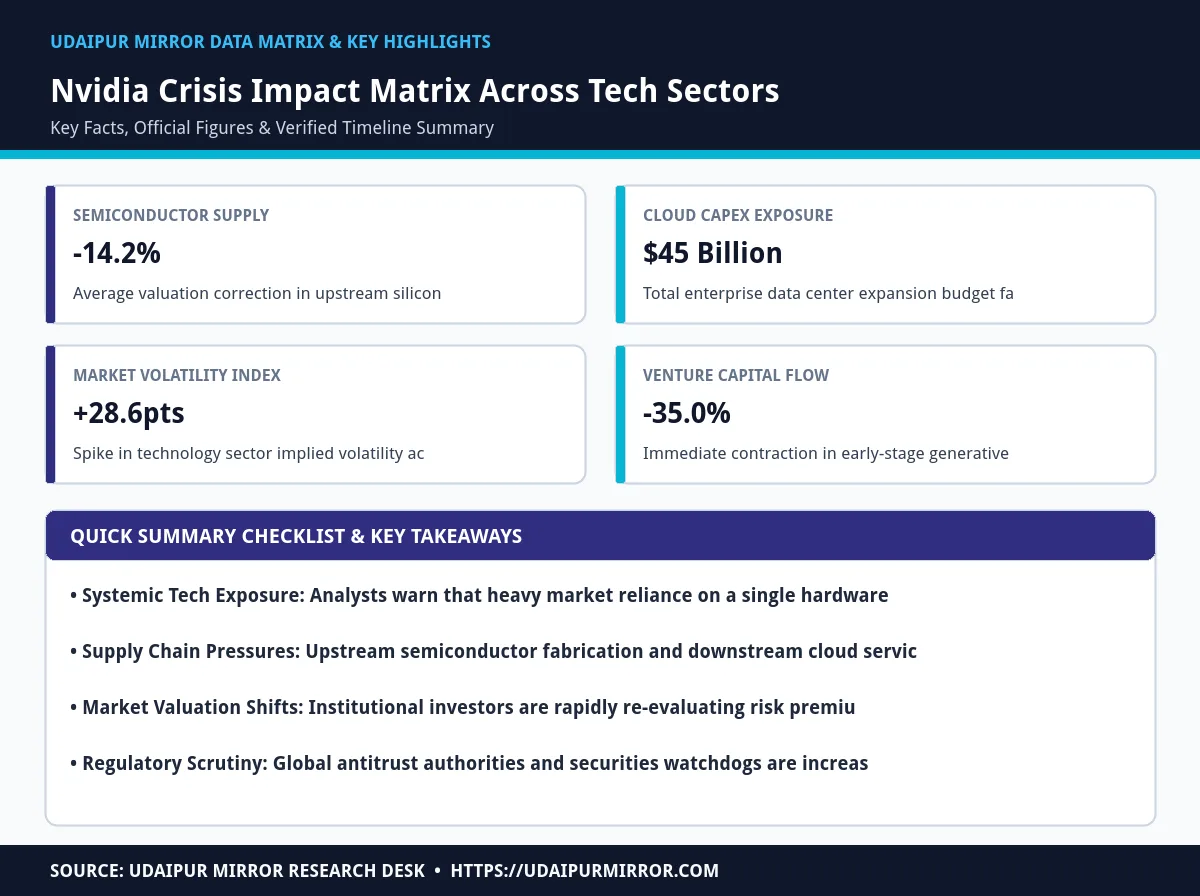
The following data table outlines the direct exposure levels, primary operational bottlenecks, and projected recovery timelines across various segments of the technology and financial sectors following the recent disclosures.
| Sector / Segment | Exposure Level | Primary Vulnerability | Projected Recovery Horizon |
|---|---|---|---|
| Hardware & Silicon | Critical | Manufacturing bottlenecks & supply concentration | 6 to 12 Months |
| Cloud Infrastructure | High | Delayed GPU deliveries & power constraints | 3 to 6 Months |
| Enterprise Software | Moderate | Proprietary ecosystem lock-in dependencies | 1 to 3 Months |
| Venture Capital & Startups | High | Valuation re-adjustments & tighter funding | 6 to 9 Months |
| Global Financial Markets | Moderate | Broad equity index drag & sector rotation | Immediate to 30 Days |
For chief information officers and technology executives across global enterprises, the primary lesson from the ongoing Nvidia scandal is the urgent need for supply chain diversification. Enterprises that had previously committed entirely to proprietary hardware stacks are now actively exploring alternative accelerators, custom application-specific integrated circuits (ASICs), and open-source software integration frameworks. This strategic shift is expected to level the playing field over the medium term, allowing rival semiconductor designers and cloud giants developing proprietary silicon to capture meaningful market share.
Furthermore, this market correction coincides with critical domestic infrastructure pushes in emerging technology hubs. As governments worldwide emphasize technological self-reliance—similar to recent national clean energy and grid storage initiatives, such as when India approves $1.5 billion grid storage push to power clean energy drive—local technology ecosystems are increasingly prioritizing sovereign compute capabilities. Policymakers are realizing that resilient artificial intelligence deployment requires not only software talent and capital but also an uninterrupted, diversified domestic supply of advanced computing hardware.
“Diversification is no longer a theoretical optimization exercise for procurement departments; it is an existential business continuity requirement.” — Enterprise Cloud Architecture Director
The venture capital landscape, particularly within the generative artificial intelligence and deep-tech sectors, is undergoing a painful but necessary reality check. Investors who previously wrote massive checks based solely on pitch decks promising exponential model scaling are now demanding rigorous compliance audits, hardware independence roadmaps, and clear paths to profitability. The realization that upstream hardware bottlenecks can cripple downstream software startups overnight has introduced a new level of risk aversion among institutional limited partners.
Despite these near-term headwinds, market observers believe that capital will ultimately flow back into the ecosystem, albeit with more disciplined valuation multiples. Startups focusing on optimization efficiency—those capable of running advanced models on less hardware or utilizing energy-efficient edge computing devices—are attracting renewed interest. As the broader market absorbs the fallout from the semiconductor sector’s governance crisis, founders are being pushed to build leaner, more resilient business models that can withstand macroeconomic and supply chain volatility. (Also read: India Approves .5 Billion Grid Storage Push to Power Clean Energy Drive).
“The era of unchecked capital deployment into AI startups without hardware contingency planning has officially come to an end.” — Managing Partner at a leading tech venture capital firm
The artificial intelligence industry relies heavily on Nvidia’s specialized graphics processing units and proprietary software architecture. Any disruption or regulatory fallout affecting the company impacts downstream cloud providers, software developers, and enterprise deployments that lack immediate hardware alternatives.
Chief information officers and enterprise buyers are actively reviewing their vendor dependencies, exploring multi-vendor hardware strategies, and investing in custom ASICs or alternative accelerators to mitigate single-supplier risk.
Venture capital firms are implementing stricter due diligence, demanding hardware independence roadmaps, and prioritizing startups that focus on computational efficiency and lower hardware consumption.
Yes, governments worldwide are accelerating domestic semiconductor manufacturing initiatives and sovereign compute programs to reduce reliance on single-region or single-vendor supply chains.
Add Udaipur Mirror as a preferred source on Google to see more of our travel guides in your AI overviews.






[…] to Rise 4.4% Despite Global Dip: New Study Highlights Economic Trade-offs 3 seconds ago ⚡ Apps Nvidia Scandal Creates Severe Risk for Entire AI Industry, Analysts Warn 3 minutes ago ⚡ News Udaipur Observes 40-Year-Old Govardhan Tradition: 12-Foot Cow Dung Mountain and Cattle Run […]
[…] to Rise 4.4% Despite Global Dip: New Study Highlights Economic Trade-offs 13 minutes ago ⚡ Apps Nvidia Scandal Creates Severe Risk for Entire AI Industry, Analysts Warn 16 minutes ago ⚡ News Udaipur Observes 40-Year-Old Govardhan Tradition: 12-Foot Cow Dung Mountain and Cattle Run […]