Office Address
14, Residency Road, Udaipur, Rajasthan 313001
Office Address
14, Residency Road, Udaipur, Rajasthan 313001


NEW DELHI: NEW DELHI — In a decisive move to accelerate the country’s green transition and eliminate grid bottlenecks, the Indian government has officially greenlit a massive india grid storage push valued at $1.5 billion. Announced on Monday, November 9, 2026, this landmark financial allocation is designed to deploy cutting-edge battery energy storage systems (BESS) and pumped-storage hydropower capacity across multiple states, ensuring uninterrupted power supply as renewable integration scales up exponentially. While industrial consumers navigate market shifts—much like retail investors tracking gold price trend updates amid festive economic adjustments—the country’s energy sector is undergoing a massive infrastructural overhaul.
⚡ Quick Highlights: India Approves $1.5B Grid Storage Push for Clean Energy
As India rapidly expands its photovoltaic and wind generation capacities, managing generation intermittency has emerged as the single biggest technical challenge for national grid operators. Solar farms generate massive power surges during peak daylight hours, which often leads to forced curtailment when local demand cannot absorb the output. The newly approved $1.5 billion fund acts as a vital power reset, ensuring that excess green electrons are captured efficiently rather than wasted. Just as professionals use smart device comparison tools to optimize daily utility, grid planners are deploying analytics-driven storage mechanisms to balance supply and demand in real time.
Battery energy storage systems (BESS) deployed under this initiative will act as rapid-response shock absorbers. When cloud cover suddenly reduces solar generation or evening demand spikes, stored energy can be dispatched onto the transmission lines within milliseconds, preventing frequency drops and potential grid instability. (Also read: Gold Price Today: 1 नवंबर से 9 नवंबर तक कितना महंगा हुआ सोना? पिछले 10 दिनों का हिसाब).
“Grid storage is no longer an optional luxury for our power sector; it is the absolute backbone required to sustain our aggressive clean energy expansion.” — Ministry of Power Technical Advisor
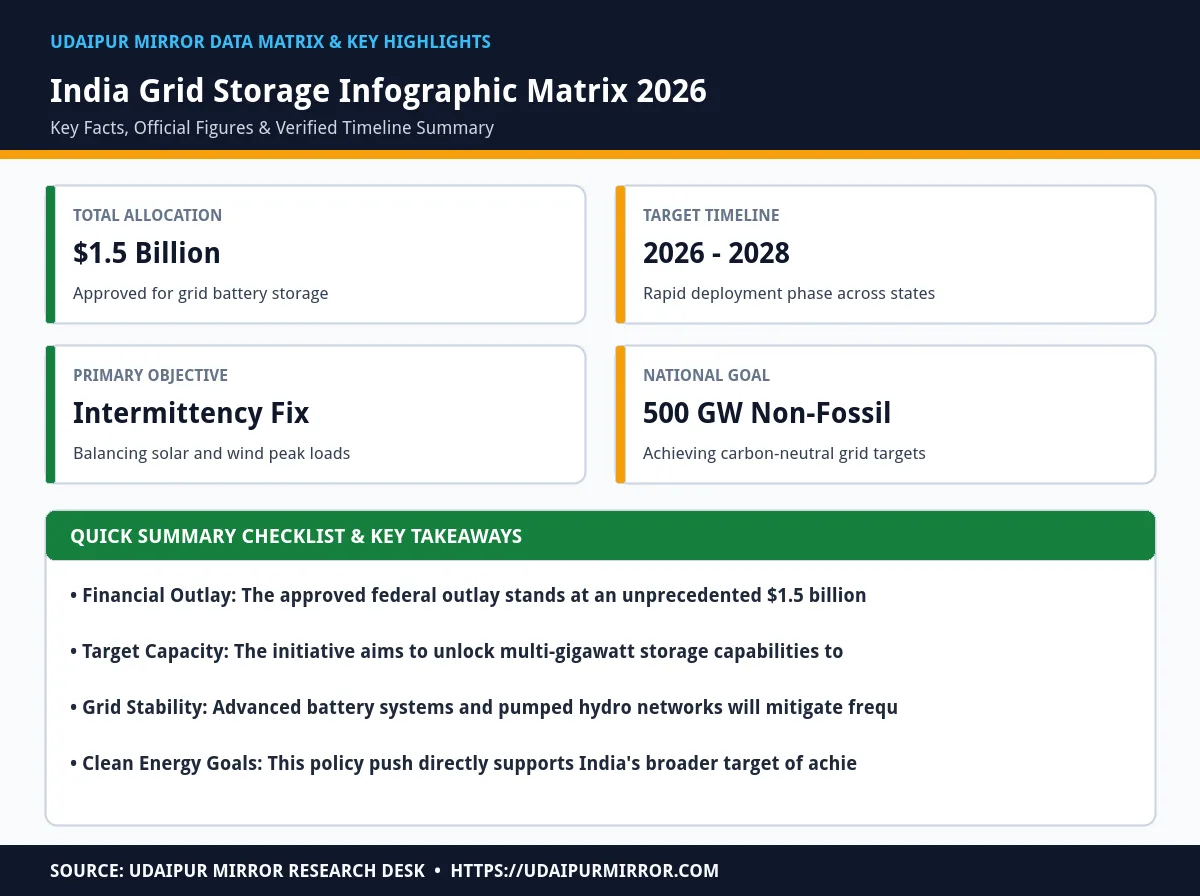
The $1.5 billion financial outlay is strategically divided across several technological verticals and geographic corridors to maximize grid resilience and efficiency.
| Storage Technology | Allocated Share (%) | Target Capacity | Primary Deployment Region |
|---|---|---|---|
| Utility Lithium-ion BESS | 55% | 4,000 MWh | Western & Northern Grids |
| Pumped-Storage Hydro | 30% | 2,500 MW | Southern & Eastern Corridors |
| Advanced Flow Batteries | 10% | 500 MWh | R&D and Pilot Zones |
| Grid Transmission Upgrades | 5% | Inter-state lines | Nationwide Hubs |
Western India—anchored by vast solar parks in Rajasthan and Gujarat—generates a disproportionately high share of the nation’s renewable electricity. However, moving this power safely to urban consumption centers hundreds of kilometers away requires robust transmission and intermediate storage. A substantial portion of the $1.5 billion grid storage push will be funneled into establishing mega battery farms adjacent to major pooling stations in the Thar Desert region.
DISCOMs and transmission utilities will coordinate closely with central agencies to integrate these storage assets seamlessly into existing green energy corridors, minimizing transmission losses and lowering overall balancing costs for commercial and industrial end-users.
“Placing utility-scale storage directly beside our largest solar generation hubs ensures maximum efficiency and zero wasted generation.” — State Renewable Energy Directorate Official
Beyond technical stability, the federal storage push carries profound economic implications for debt-laden state distribution companies. Historically, DISCOMs faced heavy financial penalties for power imbalances and had to rely on expensive peaking thermal power plants to meet evening demand spikes. By utilizing stored solar energy procured at lower daytime tariffs, utilities can significantly cut their power purchase costs.
Market analysts note that falling battery pack prices globally, combined with this federal capital injection, will shorten the payback period for utility-scale storage projects, making private sector co-investment increasingly attractive. (Also read: RPSC Protection Officer Exam City Slip 2026 Released: Direct Download Guide via SSO Portal).
“Lower storage costs combined with federal capital support will transform DISCOM balance sheets by replacing costly peak thermal power with cheap stored solar.” — Energy Economics Analyst
This decisive $1.5 billion funding approval reinforces India’s standing as a proactive leader in the global energy transition. Having recently been re-elected to leadership positions in international solar alliances, India is setting a benchmark for emerging economies attempting to reconcile rapid industrial growth with aggressive decarbonization commitments.
By proving that multi-gigawatt grids can be successfully managed with high penetrations of variable renewable energy backed by advanced storage, India provides a scalable blueprint for the Global South.
“India is demonstrating to the world that rapid economic growth and aggressive climate action can go hand in hand when backed by smart infrastructure investments.” — International Clean Energy Forum Delegate
The federal government has approved a dedicated financial outlay of $1.5 billion specifically for grid-scale energy storage infrastructure.
Grid storage is essential to solve renewable energy intermittency, allowing utilities to capture surplus solar and wind power during peak generation hours and dispatch it during evening demand spikes.
The funding primarily covers utility-scale lithium-ion battery energy storage systems (BESS), pumped-storage hydropower, and advanced flow battery pilot projects.
It will help DISCOMs lower power purchase costs by replacing expensive peak thermal power with cheap stored solar energy, thereby improving financial stability.
Add Udaipur Mirror as a preferred source on Google to see more of our travel guides in your AI overviews.