Office Address
14, Residency Road, Udaipur, Rajasthan 313001
Office Address
14, Residency Road, Udaipur, Rajasthan 313001


NEW DELHI / NEW YORK: Global energy markets are facing intense turmoil as oil prices soar 14 percent in October, reaching a six-month high following reports that Washington is weighing fresh military strikes against Iran in the wake of the midterm elections. This dramatic escalation has sent shockwaves through international financial systems, compounding pressures on Wall Street and amplifying fears of a 1970s-style stagflation cycle. As crude benchmarks climb past critical psychological thresholds, energy-importing economies like India find themselves particularly vulnerable to imported inflation, currency depreciation, and tightening monetary conditions.
⚡ Quick Highlights: Oil Prices Soar 14% to 6-Month High on Potential US Iran Strikes
The sharp upward trajectory in energy commodities stems directly from fears of supply disruptions in the Persian Gulf. With geopolitical risk premiums baked into daily trading, market analysts note that oil prices soar 14 percent primarily due to speculation surrounding potential military actions. Strategic analysts point out that any disruption to the Strait of Hormuz could choke off nearly a fifth of the world’s petroleum flow, sending shockwaves through tanker freight rates and refining margins.
As global leaders monitor developments following the US midterm elections, the threat of fresh kinetic interventions has forced energy traders to reprice risk aggressively. While enterprise software and advanced technology sectors—such as those utilizing innovations highlighted in Mistral AI Publicly Releases Large 4 Model—grapple with independent secular trends, traditional energy markets remain entirely tethered to Middle Eastern headlines.
Governments across Asia are already contingency-planning for sustained high crude prices. For India, which imports over 80 percent of its crude requirements, a prolonged spike above key resistance levels directly undermines macroeconomic stability, inflating the import bill and putting pressure on foreign exchange reserves. (Also read: Mistral AI Publicly Releases Large 4 Model, Targeting Advanced Cybersecurity Users).
“The confluence of geopolitical flashpoints and tightening physical supply means energy markets are pricing in worst-case scenarios far quicker than central banks can react.” — Global Macro Strategist, Wall Street
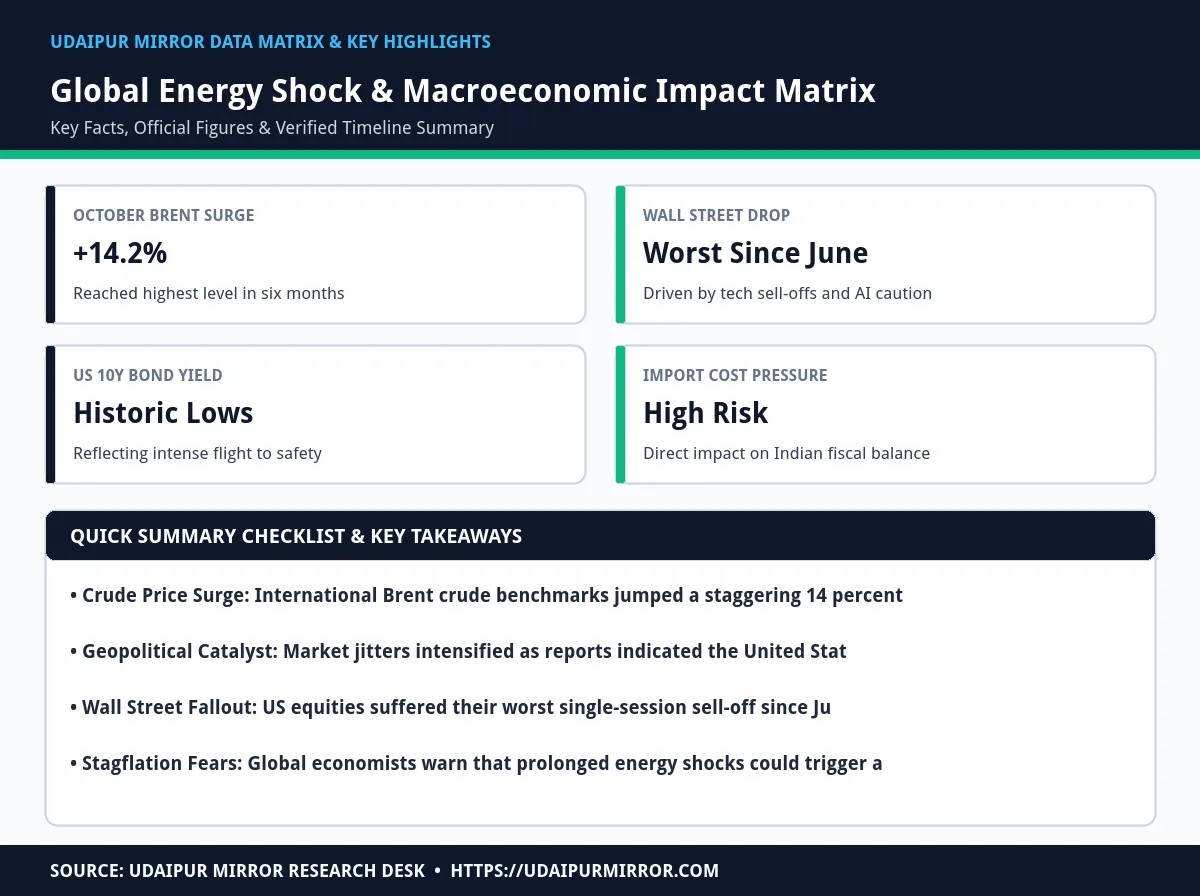
The convergence of geopolitical conflicts, central bank rate trajectories, and volatile energy commodities has reshaped asset allocations worldwide. The following matrix illustrates key performance metrics across major global markets.
| Asset / Market | October Trend | Key Driver | Impact on India |
|---|---|---|---|
| Brent Crude Oil | Up 14% to 6-mo high | Potential US-Iran strikes | Higher import bills & inflation |
| Wall Street (S&P/Nasdaq) | Sharp Sell-off | AI-wary sentiment & tech correction | Spillover to domestic IT & midcaps |
| US Treasury Yields | Historic Volatility | Bond market crash & safety bids | FII outflows & currency pressure |
| Gold Rates | Strong Bull Run | Safe-haven buying & stagflation fears | Domestic bullion price appreciation |
| Corporate Earnings | Mixed Outlook | Midterm uncertainty & cost pressures | Earnings growth normalization |
The broader financial ecosystem is feeling the heat as Wall Street experienced its worst single-session sell-off since June. Artificial intelligence and high-valuation technology stocks bore the brunt of the correction, as institutional investors grew increasingly wary of lofty multiples in an environment of sticky inflation and high interest rates. Compounding equity woes, the US bond market witnessed dramatic fluctuations, with 2-year, 10-year, and 30-year yield notes tumbling to historic lows amid aggressive safe-haven demand.
Investors are also weighing how fiscal policies and upcoming jobs data will shape the Federal Reserve’s next monetary policy steps. Stagflation worries—reminiscent of the economic shocks of the 1970s—have resurfaced in investor discourse, as stagnant economic growth pairs uncomfortably with surging energy costs. Domestic market participants observing these global cues can also analyze how local adjustments, such as those discussed in How India’s Income Tax Slabs For FY 2026-27 Directly Shape Your Strategic Investment Planning, help safeguard individual portfolios against imported macroeconomic volatility.
“We are witnessing a classic multi-asset repricing where equities, bonds, and commodities are simultaneously reacting to stagflationary ghosts of the past.” — Chief Investment Officer, Global Asset Management
When global oil benchmarks rally aggressively, the macroeconomic ripples reach Indian shores almost immediately. A higher crude oil import bill widens the current account deficit (CAD) and places downward pressure on the Indian Rupee against the US Dollar. Furthermore, retail fuel pricing mechanisms and downstream petrochemical industries face severe margin contractions unless state-run marketers pass on costs to consumers.
Despite these external headwinds, Indian domestic indices have shown resilience supported by robust domestic inflows. As noted in recent trends where Sensex, Nifty Rise; IT & Pharma Lift Markets as Midcaps Slide, sector-specific rotation has helped cushion institutional portfolios against global sell-offs. However, sustained high energy prices risk spilling over into transportation, manufacturing, and food logistics, complicating the Reserve Bank of India’s inflation management mandate.
“India's macroeconomic fundamentals remain robust, but a sustained spike in imported energy costs requires active fiscal vigilance and strategic reserve management.” — Senior Economic Advisor, New Delhi
As financial markets traverse this turbulent period through the end of October 2026, wealth managers advise a defensive yet flexible asset allocation strategy. Diversifying away from over-concentrated tech equities into defensive sectors such as healthcare, pharmaceuticals, and gold can insulate portfolios from geopolitical shocks. Precious metals continue to act as an effective hedge against currency devaluation and escalating global conflict.
Investors must maintain a close watch on upcoming US employment reports, central bank commentary, and developments in the Middle East. Avoiding panic selling while systematically rebalancing portfolios toward cash and high-dividend-yielding assets will remain the prudent approach for navigating the remainder of the fourth quarter.
Oil prices surged 14 percent to a six-month high primarily due to escalating geopolitical tensions in the Middle East, specifically reports that the United States is weighing fresh military strikes against Iran following the midterm elections.
Higher crude oil prices increase India’s import bill, widen the current account deficit, put downward pressure on the Indian Rupee, and stoke imported inflation across transport and manufacturing sectors.
Wall Street experienced its worst drop since June due to a combination of AI and tech stock corrections, midterm election uncertainty, bond market volatility, and growing fears of stagflation.
Investors can safeguard their portfolios by diversifying into defensive sectors like healthcare and pharmaceuticals, holding gold as a safe-haven asset, maintaining cash liquidity, and focusing on companies with strong pricing power.
Add Udaipur Mirror as a preferred source on Google to see more of our travel guides in your AI overviews.






[…] में शत-प्रतिशत पंजीकरण करें 39 minutes ago ⚡ Business Oil Prices Soar 14% in October to 6-Month High as US Weighs Fresh Iran Strikes 1 hour ago … Education माय भारत केंद्र के तत्वावधान में […]