Office Address
14, Residency Road, Udaipur, Rajasthan 313001
Office Address
14, Residency Road, Udaipur, Rajasthan 313001

NEW DELHI: NEW DELHI — As institutional integrity takes center stage in Indian democratic discourse, political analysts and constitutional experts emphasize that maintaining a fair election is national concern that extends far beyond partisan agendas. Recent developments surrounding the Election Commission of India (ECI), legal interventions by senior jurists, and intense debates over software transparency have reignited critical conversations regarding the accountability of autonomous constitutional bodies. Rather than viewing electoral reforms through the narrow lens of opposition versus ruling alignments, civil society organizations argue that absolute transparency in voter verification mechanisms is vital for safeguarding the foundational pillars of the world’s largest democracy.
⚡ Quick Highlights: Fair Election is National Concern Amid ECI Software Row
In a robust democracy, the integrity of the ballot box is the bedrock upon which all governmental legitimacy rests. Recent political commentary has rightly pointed out that reducing electoral scrutiny to a mere squabble between political factions diminishes its gravity. Ensuring a transparent voting system is not just an opposition talking point; it is an absolute national imperative. Citizens across urban centers and rural hinterlands alike rely on the absolute neutrality of electoral management bodies.
As administrative mechanisms become increasingly digitized, questions surrounding proprietary source codes, digital verification tools, and database management have gained paramount significance. While managing these daily national political developments, readers should also remain vigilant against emerging digital threats; for instance, digital security awareness remains vital, much like guarding against local financial scams as seen in recent reports of Udaipur cyber fraud cases affecting senior citizens. Ultimately, safeguarding election mechanics requires vigilance from every stakeholder in the democratic ecosystem.
“Electoral democracy cannot survive in the shadows of administrative opacity; public trust requires uncompromised institutional visibility.” — Constitutional Law Expert
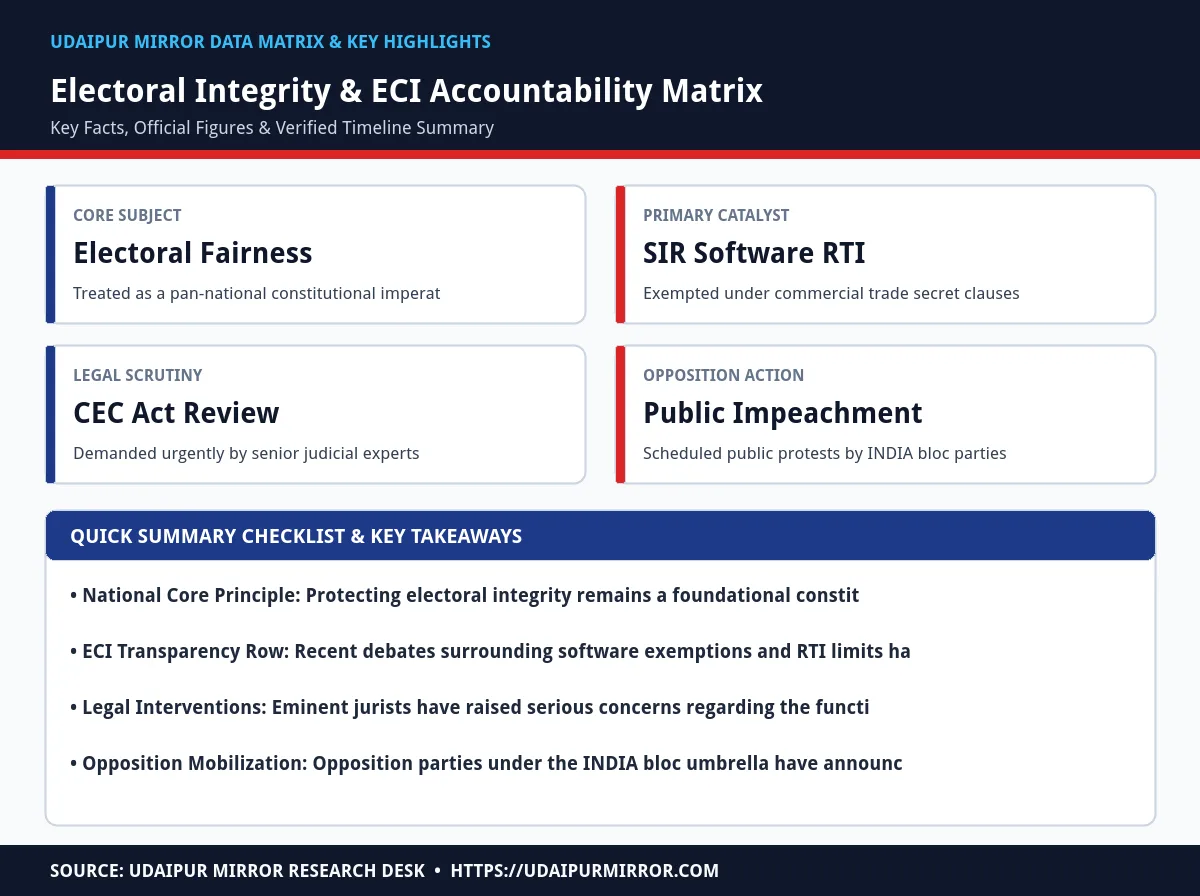
The following chronological table outlines the key events, institutional rulings, and political reactions that have brought questions of election transparency and ECI accountability to the forefront of national politics through October 2026.
| Date | Development Sector | Key Institution | Primary Implication |
|---|---|---|---|
| Oct 24, 2026 | Judicial Commentary | Supreme Court / Jurists | Justice Nariman urges urgent judicial review of the CEC Act framework. |
| Oct 24, 2026 | Information Rights | Election Commission | ECI cites trade secrets, exempting SIR software architecture from RTI. |
| Oct 24, 2026 | Opposition Strategy | INDIA Bloc | Announcement of planned public oversight and accountability actions. |
| Oct 25, 2026 | National Discourse | Media & Civil Society | Consensus emerges that fair elections are a collective national priority. |
| Oct 30, 2026 | Scheduled Protest | Civil/Political Front | INDIA bloc scheduled to hold public accountability meet against CEC. |
A major flashpoint in the current political debate involves the Election Commission’s stance on the software utilized for Special Information Registration (SIR) processes. By invoking trade secret exemptions under the Right to Information (RTI) framework, the poll panel has shielded critical backend technical details from public disclosure. This decision has drawn sharp rebukes from transparency advocates, software engineers, and political parties who argue that public elections cannot rely on black-box proprietary algorithms without independent oversight.
When key infrastructural elements of vote compilation and voter verification remain shielded behind corporate confidentiality agreements, public skepticism naturally escalates. Critics argue that transparency is the most effective antidote to conspiracy theories or doubts regarding election credibility. Meanwhile, as the national capital grapples with these high-level governance debates, other administrative sectors continue vital expansions; travelers monitoring regional transit should note updates such as the Udaipur airport winter schedule introducing new direct connections.
“Trade secrets cannot supersede the fundamental right of citizens to verify the integrity of their democratic mandate.” — Senior Transparency Activist
The debate received further legal momentum when prominent legal luminaries, including former Supreme Court judges, openly criticized current administrative malfunctions within the poll watchdog. Expressing deep concern over the statutory appointments process under the Chief Election Commissioner (CEC) Act, legal experts have urged the Supreme Court to expedite pending constitutional challenges. The core of the legal argument rests on ensuring that the selection panel for election commissioners remains insulated from executive dominance, thereby preserving the perception and reality of absolute independence.
Without structural safeguards that guarantee bipartisan consensus in appointing election regulators, public faith in the electoral referee faces continuous strain. The judiciary’s willingness to examine these legislative frameworks will be decisive in determining whether institutional autonomy can be insulated from partisan pressures in future electoral cycles. (Also read: Udaipur Airport Winter Schedule 2026-27: Direct Dehradun Flights Added, 18 Regular Services Operational Till March | उदयपुर एयरपोर्ट पर विंटर शेड्यूल लागू).
“An independent Election Commission is the ultimate guardian of constitutional democracy; its appointment process must be beyond reproach.” — Retired Supreme Court Judge
On the political front, opposition parties under the banner of the INDIA bloc have ratcheted up pressure, announcing plans for a high-profile public accountability event directed at the Chief Election Commissioner. Scheduled for late October, this move signifies a shift from parliamentary memorandums to direct public mobilization on institutional governance. While ruling coalition representatives have dismissed these protests as politically motivated maneuvers designed to undermine constitutional authorities, opposition leaders maintain that peaceful democratic dissent is essential when institutional channels appear unresponsive.
This escalating friction highlights a deeper systemic challenge: how to establish a universally accepted mechanism for grievance redressal when questions are raised against constitutional functionaries. As political lines harden, statesmen across the spectrum are being urged to foster dialogue rather than deepening institutional fractures.
“Holding constitutional authorities accountable through peaceful public discourse is a recognized democratic right.” — INDIA Bloc Floor Leader
As India navigates this complex intersection of technology, law, and politics, the path forward requires a collaborative commitment to institutional strengthening. Restoring complete public confidence in the electoral machinery necessitates greater openness from regulatory bodies, receptive engagement with judicial recommendations, and a shared political understanding that fair elections transcend narrow partisan gains. Protecting democracy is an ongoing task that requires constant vigilance, legislative refinement, and unyielding respect for constitutional values.
“Democracy thrives not when institutions are infallible, but when they are transparent enough to correct their flaws openly.” — Political Science Researcher
Because the integrity of elections is the foundational pillar of India’s democratic framework, affecting every citizen’s constitutional right to choose their governance, independent of partisan politics.
The Election Commission has exempted details of the software used in Special Information Registration (SIR) from RTI disclosures, citing ‘trade secrets’, which has sparked criticism from transparency advocates and political parties.
Eminent jurists have criticized perceived institutional malfunctions and urged the Supreme Court to expedite rulings on the Chief Election Commissioner (CEC) Act to ensure absolute independence in poll body appointments.
Parties under the INDIA bloc have announced plans to hold a public accountability meet and mobilization event concerning CEC Gyanesh Kumar.
Add Udaipur Mirror as a preferred source on Google to see more of our travel guides in your AI overviews.




[…] से 31 उड़ानों का विंटर शेड्यूल 2 seconds ago ⚡ Elections Fair Election is National, Not Congress’s, Concern: Political Landscape Erupts 16 minut… News Udaipur Cyber Fraud: Senior Citizen Loses Rs 1.73 Lakh via Fake TV Social Media Link | […]