Office Address
14, Residency Road, Udaipur, Rajasthan 313001
Office Address
14, Residency Road, Udaipur, Rajasthan 313001

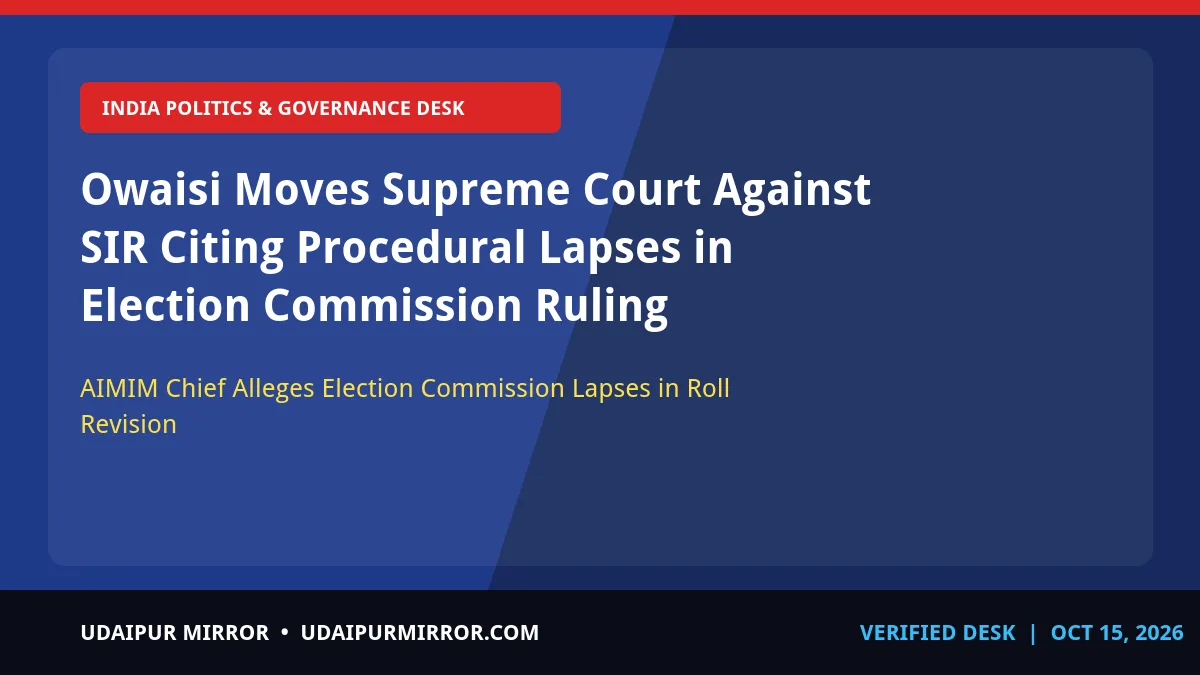
NEW DELHI: All India Majlis-e-Ittehadul Muslimeen (AIMIM) President and Hyderabad MP Asaduddin owaisi moves supreme court against sir (Special Intensive Revision), challenging the statutory validity of the Election Commission of India’s latest electoral roll revision directives and alleging grave procedural irregularities in the poll body’s executive decision-making architecture.
⚡ Quick Highlights: Owaisi Moves Supreme Court Against SIR Over EC Decision
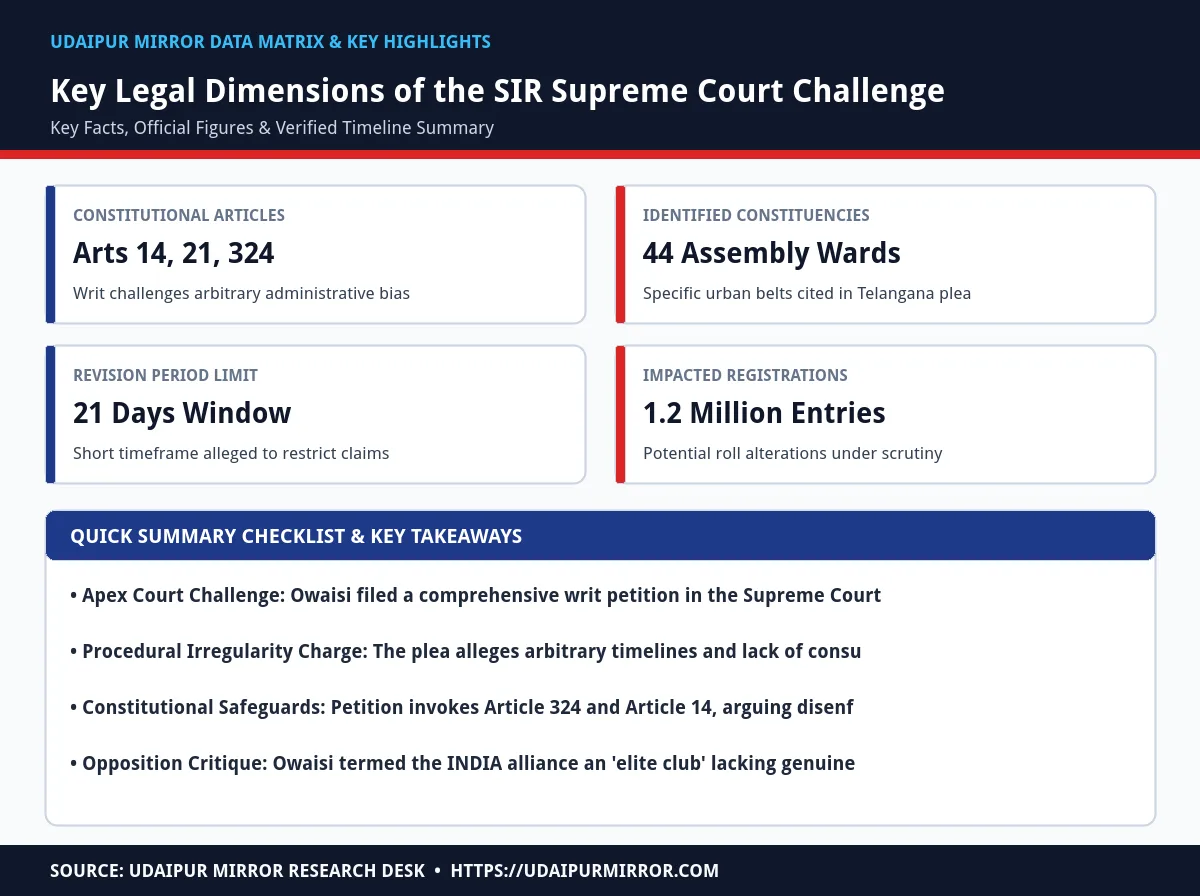
In the petition filed under Article 32 of the Constitution, Asaduddin Owaisi contended that the Election Commission executed its Special Intensive Revision (SIR) without establishing transparent objective criteria or offering adequate opportunities for registered voters to contest summary removals. The plea underscores that the truncated window of three weeks for verifying identity and residence documentation disproportionately impacts socio-economically marginalized voters, migrant daily-wage earners, and minority pockets.
The petitioner asserted that institutional safeguards were systematically diluted when municipal registration officers initiated field deletions without serving individual physical notices. As institutional credibility comes under focus, civic transparency frameworks remain vital; this principle mirrors wider reforms examined in our report where Rajasthan Workshop Integrates Heritage Conservation with Ethical AI Frameworks for Transparent Governance across public administrative systems.
“Electoral rolls cannot be revised behind closed doors under opaque bureaucratic decrees. The vote is the bedrock of democracy, and every citizen is entitled to transparent due process.” — Asaduddin Owaisi, AIMIM President & MP
The legal standoff regarding electoral roll revision and institutional autonomy has evolved through multiple milestones leading up to the current petition filed before the Supreme Court.
| Date | Forum / Agency | Legal Action / Order | Primary Operational Impact |
|---|---|---|---|
| March 2024 | Parliament of India | Chief Election Commissioner Act Notified | Altered composition of selection panel for commissioners |
| August 2026 | Election Commission of India | Notification on Special Intensive Revision (SIR) | Mandated biometric matching & field audit in high-density areas |
| September 2026 | Telangana State EC | Draft Verification Field Orders Issued | Identified 44 municipal blocks for expedited re-verification |
| October 04, 2026 | AIMIM Legal Cell | Formal Representation to ECI | Demanded 60-day extension and door-to-door physical notices |
| October 14, 2026 | Supreme Court Registry | Article 32 Writ Petition Lodged | Challenges unilateral revision rules and procedural deviations |
| October 15, 2026 | CJI Mentioning Bench | Urgent Listing Motion | Court reserves scheduling decision for early hearing |
The legal confrontation directly intersects with escalating national debates regarding the institutional independence of the poll panel. Legal analysts note that recent legislative updates governing the appointment of the Chief Election Commissioner and other Election Commissioners have re-opened fundamental questions about executive predominance in constitutional authorities.
Constitutional jurists have continually stressed the necessity of independent checks within poll governance bodies. This perspective is closely aligned with the legal observations detailed in Election Commission Integrity Essential for Democracy: Justice Kurian Joseph Demands Stronger Safeguards, where the boundary between administrative autonomy and executive oversight remains critically evaluated.
“Dissent and judicial review of administrative action are fundamental constitutional entitlements, but procedural fidelity inside watchdog bodies must be absolute.” — Senior Supreme Court Advocate
Beyond the legal contours of the petition, Owaisi launched a scathing political attack on mainstream opposition parties. Speaking outside Parliament complex following the petition’s submission, the Hyderabad parliamentarian asserted that “nobody holds a monopoly over constitutional issues” and characterized the opposition INDIA bloc as an “elite club” that limits its institutional resistance to social media campaigns while abandoning grassroots litigation.
Owaisi highlighted that while national opposition alliances claim to defend constitutional bodies during prime-time debates, AIMIM has consistently led actionable court battles against administrative disenfranchisement, whether concerning citizenship verifications, legislative delimitation, or targeted municipal roll purges. The comments underscore deep tactical fractures within non-ruling parties ahead of crucial assembly and civic polls. (Also read: Udaipur to Ahmedabad Mercedes S-Class Drive Showcases NH-48 Mewar Corridor and Luxury Endurance).
“Certain political parties operate like an elite club. They want our support on their terms, yet when the democratic rights of ordinary citizens are attacked on the ground, their legal leadership goes missing.” — Asaduddin Owaisi, addressing reporters in New Delhi
The petition seeks immediate interim reliefs, notably the suspension of final publication dates for the revised electoral rolls in disputed districts until an independent court-supervised audit panel scrutinizes the algorithmic filters applied by the Election Commission. AIMIM advocates are preparing to mention the petition before a bench led by the Chief Justice of India for urgent consideration before statutory publication deadlines lapse.
Legal observers point out that previous rulings by the apex court, including Lakshmi Charan Sen v. A.K.M. Hassan Uzzaman, have acknowledged the court’s jurisdiction to intervene when roll revision exercises exhibit patent arbitrariness or infringe on fundamental rights under Article 14. If admitted, the matter could set significant legal boundaries for digital and biometric roll purges across all Indian states.
“When statutory discretion risks systemic exclusion, constitutional courts hold the unassailable power to enforce procedural equity.” — Legal counsel representing the petitioner
Owaisi filed an Article 32 writ petition challenging the Election Commission’s Special Intensive Revision (SIR), alleging arbitrary procedures, compressed timelines, and lack of adequate notice that risk disenfranchising minority and underprivileged urban voters.
SIR is an accelerated electoral roll verification drive intended to eliminate duplicate, deceased, and shifted entries through algorithmic checks and targeted door-to-door field audits before major election cycles.
Owaisi criticized the national opposition alliance for claiming a monopoly over defending democracy while failing to undertake substantive grassroots legal battles against administrative roll exclusions.
The petition seeks an interim stay on the final publication of revised rolls, mandatory physical notice serving before voter deletion, and an independent judicial audit of the revision methodology.
Add Udaipur Mirror as a preferred source on Google to see more of our travel guides in your AI overviews.