Office Address
14, Residency Road, Udaipur, Rajasthan 313001
Office Address
14, Residency Road, Udaipur, Rajasthan 313001


MUMBAI: MUMBAI — Facing mounting macroeconomic pressures and persistent capital flight, India’s mutual fund and asset management industry tax cuts advocacy has entered a decisive phase. Leading industry voices and market executives are formally urging federal policymakers to rationalize capital gains and corporate taxation frameworks. This concerted push aims to stem the ongoing foreign portfolio investor exodus, stabilize domestic equity valuations, and maintain India’s position as a premier destination for global capital deployment amidst shifting geopolitical and monetary cycles.
⚡ Quick Highlights: Asset Management Industry Push for Tax Cuts to Stem Foreign Exodus
The Indian capital market has experienced a noticeable cooling off period characterized by sustained foreign institutional investor outflows. Global macroeconomic headwinds, fluctuating US Treasury yields, and tighter liquidity conditions have prompted institutional desks to rebalance portfolios away from emerging markets. In response, domestic fund houses and asset management companies are actively engaging with regulatory authorities. They contend that high domestic tax friction on capital gains acts as a deterrent for foreign funds seeking optimal risk-adjusted returns.
As part of ongoing efforts to bolster domestic resilience, retail investors are also exploring diversified avenues. For instance, many are evaluating alternative pension frameworks such as the initiatives highlighted in reports on the NPS Bharat Fund of Funds, which continues to channel massive corpus toward startups and deeptech infrastructure. Nonetheless, institutional leaders maintain that resolving foreign outflows requires direct intervention in tax policy.
“High tax burdens on capital gains risk shifting global institutional liquidity away from Indian equities toward competing jurisdictions.” — Senior Asset Management Executive
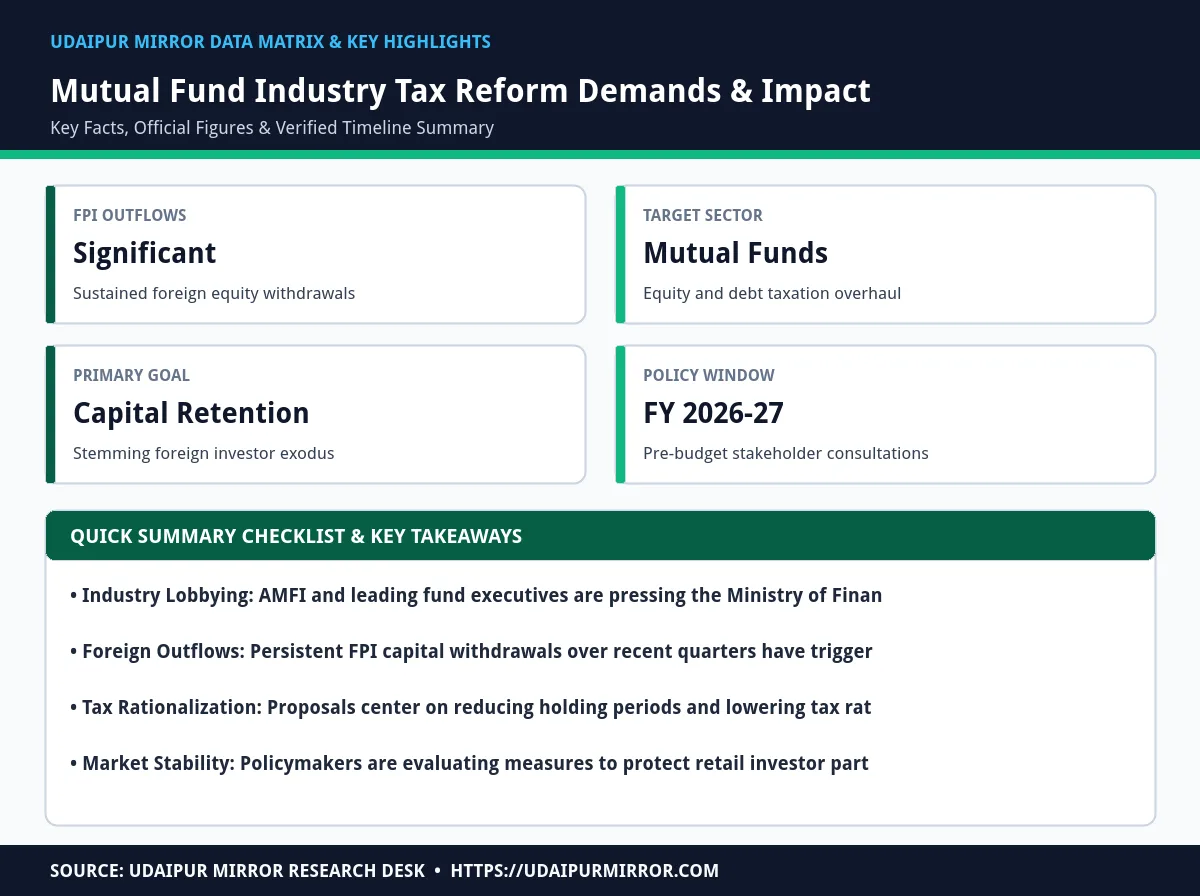
The following matrix outlines the key structural changes requested by the asset management sector compared against the prevailing taxation rules under the Income Tax Act.
| Tax Category | Current FY 2026-27 Rule | Industry Proposed Change | Expected Economic Impact |
|---|---|---|---|
| Equity LTCG | 12.5% above Rs 1.25 Lakh | Reduction to pre-budget levels | Boost long-term equity holding |
| Debt Mutual Funds | Taxed at applicable slab rates | Reintroduction of indexation benefits | Revive institutional bond interest |
| FPI Withholding Tax | Standardized withholding levies | Targeted exemptions for long holds | Stem foreign capital exodus |
| ELSS Lock-in | 3-year mandatory lock-in period | Streamlined compliance framework | Encourage retail tax-saver flows |
| Surcharge Caps | Capped at 15% to 25% tiers | Uniform ceiling across categories | Attract ultra-high-net-worth funds |
Representing the collective voice of fund houses, industry bodies have submitted comprehensive memorandums to the Ministry of Finance. These proposals focus on rationalizing the tax treatment of both equity and debt mutual funds. By reducing the long-term capital gains tax burden and streamlining holding periods, the industry believes that foreign institutional investors will find renewed incentive to anchor their capital in Indian public markets.
Furthermore, structural adjustments in taxation are expected to cascade into allied industrial and technological ecosystems. Similar regulatory reviews are currently being witnessed across multiple sectors, including energy compliance such as monitoring measures detailed in updates on Karnataka’s ethanol reporting. Clear, predictable tax policies remain foundational for sustainable economic growth.
“Tax certainty and competitive structures are the twin pillars required to attract and retain sticky foreign capital in India.” — Financial Policy Analyst
While the asset management industry lobbies aggressively for tax concessions, fiscal policymakers face the complex task of balancing revenue collections with market stimulus. Government revenues depend heavily on direct tax collections, where capital gains have emerged as a significant contributor in recent fiscal years. Treasury officials are carefully weighing whether immediate tax cuts will generate sufficient transaction volume and capital formation to offset short-term revenue losses.
Market observers suggest a phased approach might be adopted. By targeting specific relief toward long-term institutional investors and foreign portfolio managers, the government could stem the exodus without disrupting overall fiscal consolidation targets. As technical upskilling continues to drive professional competencies—echoed by initiatives like the IIT Delhi cybersecurity and AI course—the financial sector is also optimizing its analytical models to navigate these policy shifts.
“Policymakers must delicately balance fiscal deficit targets with the urgent necessity of maintaining vibrant capital markets.” — Macroeconomic Strategist
For retail participants and institutional allocators alike, the coming months will be critical in shaping investment strategies for the remainder of FY 2026-27. If regulatory authorities heed the asset management industry’s recommendations, market sentiment could experience a strong bullish reversal. Investors are advised to maintain diversified portfolios and monitor upcoming pre-budget announcements closely for definitive cues on tax reforms.
Ultimately, the health of India’s mutual fund industry depends on its ability to attract global pools of capital while nurturing domestic retail participation. A cooperative dialogue between the government and fund houses will determine whether India can successfully reverse the foreign exodus and re-establish robust upward momentum across its public equities.
“Disciplined asset allocation combined with progressive tax policy will define the next phase of India's financial market expansion.” — Investment Portfolio Manager
The asset management industry is pushing for tax cuts to stem a persistent foreign portfolio investor exodus, revive market liquidity, and improve the global competitiveness of Indian capital markets.
Fund managers are requesting the rationalization of long-term capital gains (LTCG) taxes on equities, the reintroduction of indexation benefits for debt mutual funds, and simplified compliance for foreign investors.
Sustained foreign outflows can pressure equity valuations, increase market volatility, and tighten domestic liquidity, which in turn affects corporate fundraising and capital expenditure.
Retail investors should maintain disciplined asset allocations, focus on long-term financial goals, and stay informed about upcoming tax and regulatory announcements for FY 2026-27.
Add Udaipur Mirror as a preferred source on Google to see more of our travel guides in your AI overviews.






[…] Senior Citizen FD Rates in November 2026: Banks Offering Up to 8.60% Interest 4 seconds ago ⚡ Articles Asset Management Industry Push for Tax Cuts to Stem Foreign Exodus 10 minutes ago ⚡ Apple iPhones Fitness Band vs Smartwatch: Why the Amazon Great Indian Festival Sale Makes Fitness […]