Office Address
14, Residency Road, Udaipur, Rajasthan 313001
Office Address
14, Residency Road, Udaipur, Rajasthan 313001


NEW DELHI: NEW DELHI — As economic volatility prompts a closer look at guaranteed fixed-income returns, commercial lenders have revised their retail deposit structures, making senior citizen fd rates a vital focal point for conservative retirees. With retail inflation stabilizing and credit demand remaining robust across corporate India, multiple scheduled commercial banks and small finance institutions have rolled out special tenure offerings. Retirees seeking predictable, risk-free cash flows can secure lucrative yields touching up to 8.60 percent per annum on specific medium-to-long term buckets, offering a strong cushion against cost-of-living pressures.
⚡ Quick Highlights: Senior Citizen FD Rates November 2026: Up to 8.60% Returns
The macroeconomic environment in late 2026 has provided a stable platform for fixed-income investors. While corporate capital expenditure cycles and equity valuations face regular fluctuations, commercial lenders continue to compete aggressively for granular retail deposits. This environment has kept senior citizen fd rates at remarkably resilient levels compared to previous tightening phases.
For risk-averse individuals who depend entirely on fixed periodic payouts for livelihood and medical expenses, locking into these elevated yields serves as an effective hedge against future monetary policy shifts. Financial planners suggest laddering deposit maturities across different blocks to maintain optimal liquidity.
As institutional investors reallocate portfolios, broader discussions regarding regulatory hurdles have also emerged, echoing concerns noted in reports covering the asset management industry push for tax cuts to stem capital outflows. However, traditional retail savers remain steadfastly anchored to fixed deposits for guaranteed capital preservation.
“Fixed deposits remain the bedrock of retirement financial planning, offering uncompromising safety and predictable cash flow for senior citizens navigating inflationary cycles.” — Rameshwar Prasad, Senior Retail Wealth Advisor
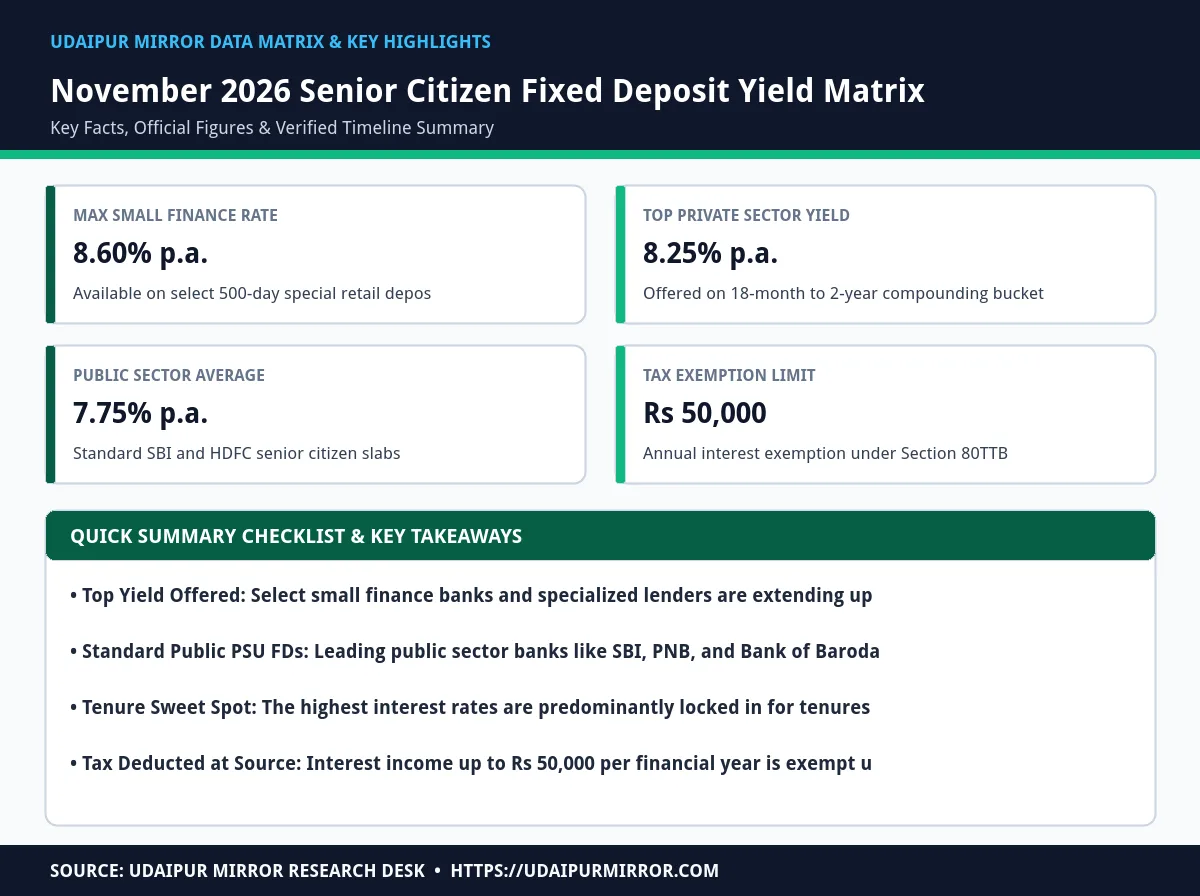
The following structured rate card outlines the peak interest rates offered across major scheduled commercial and small finance banks for senior citizen depositors in November 2026. Rates vary depending on the chosen maturity bucket and cumulative versus non-cumulative payout preferences.
| Bank Name | Regular FD Rate | Senior Citizen Rate | Special Tenure Sweet Spot |
|---|---|---|---|
| State Bank of India (SBI) | 7.10% | 7.60% | 400 Days (Amrit Vrishti) |
| HDFC Bank | 7.25% | 7.75% | 55 Months |
| ICICI Bank | 7.20% | 7.70% | 15 Months to 2 Years |
| Axis Bank | 7.20% | 7.75% | 17 Months to Less than 2 Years |
| Utkarsh Small Finance Bank | 8.10% | 8.60% | 1000 Days |
| Ujjivan Small Finance Bank | 7.90% | 8.40% | 12 Months |
When evaluating where to park retirement savings, depositors must weigh the marginal yield advantage offered by smaller institutions against the systemic safety associated with public sector giants. While state-owned lenders like SBI and Punjab National Bank cap senior citizen returns around 7.60% to 7.80%, small finance banks frequently push boundaries up to 8.60%.
Under current banking regulations, deposits across all scheduled commercial banks—including small finance institutions—are insured up to Rs 5 lakh per depositor by the Deposit Insurance and Credit Guarantee Corporation (DICGC). Savvy investors often split lump-sum retirement corpuses across multiple institutions to stay safely within this insured ceiling.
Furthermore, broader economic frameworks and developmental funds continue to channel capital into productive sectors, paralleling initiatives like the Karnataka report on excess ethanol in petrol where industrial financing intersects with government-backed monetary policies.
“Spreading deposits across multiple scheduled banks ensures complete insurance coverage while maximizing the blended portfolio yield for senior investors.” — Sunita Aggarwal, Consumer Banking Analyst
Understanding the tax liabilities on fixed deposit interest is crucial to calculating real net returns. Under Section 80TTB of the Income Tax Act, resident senior citizens aged 60 years or older are entitled to a deduction of up to Rs 50,000 per financial year on interest earned from bank deposits, cooperative societies, and post offices.
If total interest income exceeds this Rs 50,000 threshold, banks are mandated to deduct Tax Deducted at Source (TDS) at the applicable slab rate. To prevent unnecessary TDS deductions when total taxable income remains below the basic exemption limit, senior citizens should submit Form 15H to their respective banking branches at the beginning of each financial year.
Proper documentation ensures that retirees do not face cash flow pinches while waiting for tax refunds, allowing seamless management of household and healthcare expenses throughout the year. (Also read: NPS Bharat Fund of Funds: Rs 17,000 Crore Pension Savings Power Viksit Bharat Through Startups & Deeptech).
“Timely submission of Form 15H is essential for senior citizens to avoid automatic TDS deductions on their fixed deposit interest earnings.” — CA Rajesh Sharma, Tax Practitioner
Select small finance banks are offering up to 8.60 percent per annum on specific medium-term special deposit schemes for senior citizens.
Yes, deposits up to Rs 5 lakh per bank are fully insured by the DICGC, making scheduled small finance banks secure for retail savings.
Under Section 80TTB, resident senior citizens can claim a deduction of up to Rs 50,000 per financial year on total bank deposit interest.
Form 15H is a self-declaration form submitted by senior citizens to banks confirming that their total taxable income is below the taxable limit, preventing TDS deduction.
Add Udaipur Mirror as a preferred source on Google to see more of our travel guides in your AI overviews.