Office Address
14, Residency Road, Udaipur, Rajasthan 313001
Office Address
14, Residency Road, Udaipur, Rajasthan 313001


UDAIPUR: Udaipur: With the official recruitment cycle gaining momentum, candidates preparing for upcoming state and national education board eligibility tests must acquaint themselves thoroughly with the revised tgtet syllabus 2027. Understanding the exact exam blueprint, sectional weightage, and marking scheme is crucial for clearing the written screening efficiently. Education boards have recently updated the core guidelines, making it vital for aspirants to review the official syllabus PDF before finalizing their daily study routines.
⚡ Quick Highlights: TGTET Syllabus 2027: Check Section-wise Latest Syllabus PDF
The release of the updated curriculum framework serves as a roadmap for thousands of candidates aspiring to secure teaching positions in government and aided schools. The evaluation format tests both theoretical comprehension and practical teaching aptitude. Candidates must analyze previous examination trends alongside the current notification to identify recurring high-yield topics.
As educational standards evolve, staying updated with administrative announcements ensures that candidates do not waste time on obsolete curriculum items. Meanwhile, as administrative bodies streamline processes, recent discussions also highlight parallel concerns in public accountability, such as Justice Gopala Gowda Criticises ECI Over Voter List Deletions and Transparency Concerns, which underscore the broader importance of procedural clarity across all public institutions.
“A structured approach to the syllabus is the bedrock of competitive exam success. Aspirants must prioritize conceptual clarity over rote memorization.” — Senior Curriculum Analyst
The structure of the test is divided into multiple pedagogical and subject-specific modules. Review the detailed breakdown below to allocate your preparation hours effectively across each domain.
| Section Name | Key Focus Areas | Number of Questions | Marks Allocated |
|---|---|---|---|
| Child Development & Pedagogy | Learning theories, child psychology, inclusive education | 30 Questions | 30 Marks |
| Language I (Primary) | Grammar, comprehension, unseen passage, verbal ability | 30 Questions | 30 Marks |
| Language II (Secondary) | Linguistic proficiency, grammar rules, vocabulary | 30 Questions | 30 Marks |
| Subject Specialization | In-depth domain knowledge (Maths/Science or Social Studies) | 60 Questions | 60 Marks |
The examination is meticulously structured to evaluate a candidate’s grasp of child psychology, linguistic competence, and specialized subject expertise. The Child Development and Pedagogy section focuses heavily on understanding diverse learner needs, cognitive development stages, and effective classroom management strategies.
In addition to academic preparation, keeping track of cultural and industrial developments can provide a well-rounded perspective for interview rounds. For instance, local cultural showcases like the Udaipur Municipal Corporation Allots 18,000 Sq Ft Land for Khadi Mela, Generates ₹54.90 Lakh Revenue reflect how community initiatives and local administration drive regional engagement and economic activity.
“Pedagogy forms the core of teacher eligibility tests. Mastering psychological frameworks allows educators to handle diverse classroom environments seamlessly.” — Teacher Training Expert
Accessing the official notification and syllabus document requires visiting the designated recruitment portal. Candidates are advised to download the PDF directly from verified official sources to avoid misleading or outdated curriculum copies circulating on unverified websites.
Once downloaded, candidates should print a physical copy and stick it near their study desk. Marking off completed chapters helps maintain psychological momentum and ensures complete syllabus coverage without missing critical sub-topics. (Also read: Cricket Photos – NZ vs IND, 1st Test Pictures Showcase Action from Wellington).
A disciplined daily timetable is essential for mastering an extensive syllabus. Candidates should dedicate the morning hours to rigorous subject specialization study, when concentration levels are optimal, while reserving evening hours for practicing pedagogy MCQs and language exercises.
Consistency, revision cycles, and health management during the final weeks leading up to the exam are critical for peak performance on test day.
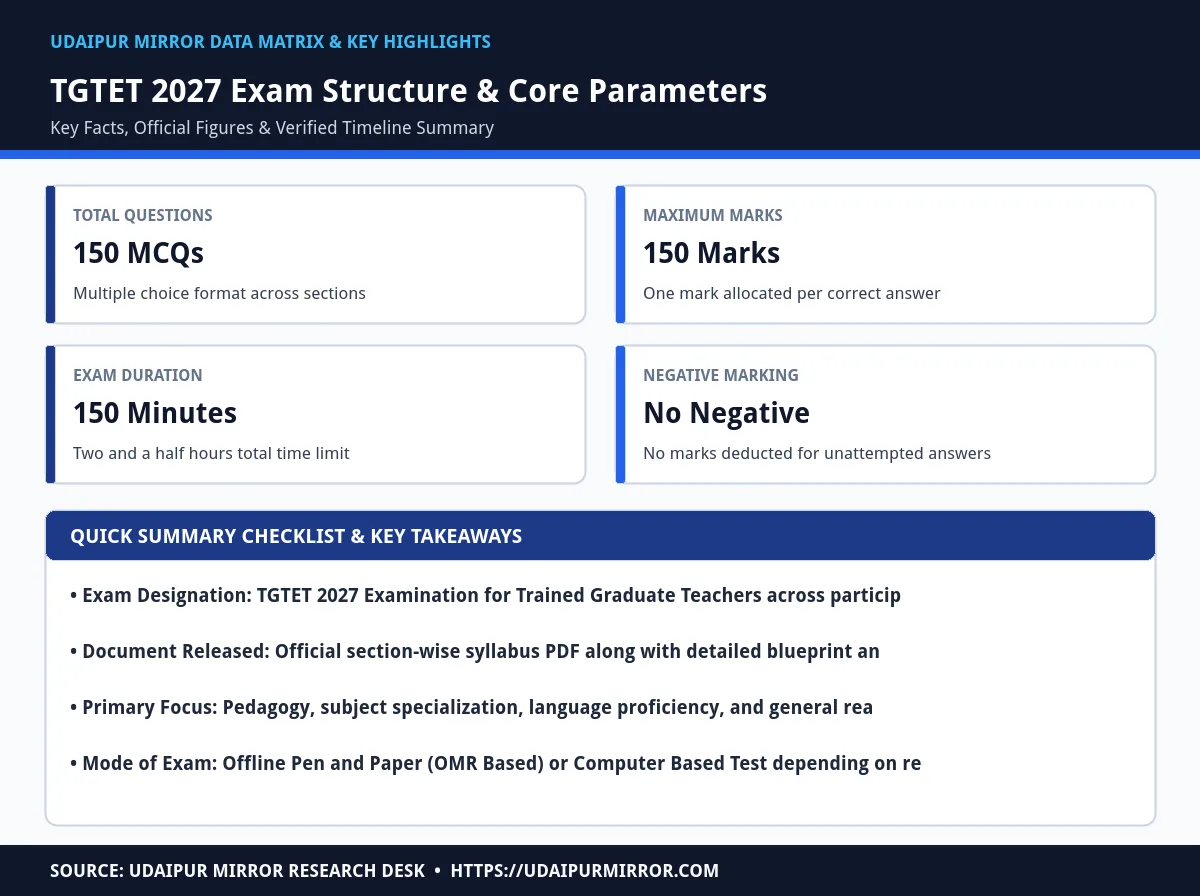
The TGTET 2027 examination comprises a total of 150 multiple-choice questions carrying 150 marks, with no negative marking for incorrect answers.
You can download the official syllabus PDF by visiting the respective board’s recruitment portal, navigating to the notifications section, and clicking on the syllabus download link.
No, there is no negative marking for incorrect or unattempted answers in the TGTET 2027 examination.
General category candidates generally need to score a minimum of 60% aggregate to qualify, with permissible relaxations for reserved categories as per government norms.
Add Udaipur Mirror as a preferred source on Google to see more of our travel guides in your AI overviews.