Office Address
14, Residency Road, Udaipur, Rajasthan 313001
Office Address
14, Residency Road, Udaipur, Rajasthan 313001

UDAIPUR: UDAIPUR — Devotees across the country are observing strict spiritual disciplines and fasts as the festive calendar progresses following major observances like Papankusha Ekadashi. Keeping track of regional lunar alignments, the upcoming october 2026 sankashti chaturthi brings a sacred opportunity for followers of Lord Ganesha to seek divine blessings, remove obstacles, and perform evening rituals. As millions prepare for the dusk-to-moonrise fast, understanding the exact timings becomes essential for completing the vrat vidhi correctly according to the Hindu Panchang.
⚡ Quick Highlights: October 2026 Sankashti Chaturthi: Date, Moonrise & Muhurat
The observance of Sankashti Chaturthi holds immense spiritual importance for millions of Hindus worldwide. Falling immediately after major festive milestones like Papankusha Ekadashi, this sacred day provides an opportunity for introspection and spiritual cleansing. Devotees dedicate the entire day to chanting mantras, reciting the Ganesha Stotra, and keeping worldly distractions at bay. Pilgrims planning temple travels during this festive season often review the Shreenathji Nathdwara Pashankusha Ekadashi Darshan Timings to coordinate their spiritual itinerary effectively.
According to Vedic astrology and panchang calculations, praying to Lord Ganesha on Chaturthi helps clear obstacles (‘Sankashti’) from personal and professional spheres. Temples dedicated to Ganapati witness massive footfall from early morning through late evening, where priests perform elaborate Abhishek ceremonies using milk, honey, and gangajal. (Also read: Shreenathji Nathdwara Pashankusha Ekadashi Darshan Timings: Special Shringar and 8-Jhanki Schedule for October 21, 2026).
“Seeking the grace of Vakratunda on Chaturthi fortifies the mind against negative energies and brings unwavering resolve.” — Acharya Pt. Rameshwar Shastri, Vedic Scholar
The month of October 2026 features a series of prominent Hindu festivals, vrat days, and celestial alignments. Vratis often plan their temple visits and fasting schedules by cross-referencing regional panchang listings. For comprehensive guidance on temple traditions across Mewar, visitors often refer to the Shreenathji Nathdwara and Mewar Temple Darshan Guide 2026.
| Festival / Vrat Event | Hindu Calendar Tithi | Primary Focus / Deity | Observance Guidelines |
|---|---|---|---|
| Papankusha Ekadashi | Shukla Paksh 11 | Lord Vishnu | Fasting and night vigil |
| Sankashti Chaturthi | Krishna Paksh 4 | Lord Ganesha | Moonrise sighting & evening puja |
| Pradosh Vrat | Trayodashi Tithi | Lord Shiva | Dusk worship and meditation |
| Sharad Purnima | Ashwin Purnima | Lakshmi & Chandra | Kheer preparation under moonlight |
| Karwa Chauth | Kartik Krishna 4 | Siv-Parvati & Moon | Nirjala fast for marital harmony |
The defining aspect of any Sankashti Chaturthi fast is the sighting of the moon. Unlike standard calendar fasts that conclude at sunset, the vrat remains active until the moon breaks the horizon. Vratis prepare a clean platform, place an idol or portrait of Lord Ganesha, and adorn it with fresh vermilion (roli), yellow flowers, and twenty-one strands of durva grass.
As the moon rises in the evening sky, devotees offer ‘Arghya’—a mixture of water, milk, and raw sugar—from a traditional copper vessel. Only after this ritual can the day-long fast be broken by partaking in sattvic prasad, prominently featuring sweet modaks and coconut laddoos.
“Observing the moon with reverence completes the cycle of austerity, inviting peace and prosperity into the household.” — Pandit Suresh Sharma, Temple Priest
Performing the puja with precision ensures the fulfillment of one’s spiritual vows. The ritual begins with a morning bath, wearing clean traditional attire, and taking a formal Sankalp (pledge) to maintain the fast with devotion. Throughout the day, continuous chanting of ‘Om Gan Ganapataye Namaha’ keeps the atmosphere spiritually charged.
In many households, special family gatherings take place in the evening where the Katha (sacred story) of Sankashti Chaturthi is read aloud, detailing the historical tales of devotion associated with Lord Ganesha and his divine vehicle, the mouse. (Also read: Shreenathji Nathdwara and Mewar Temple Darshan Guide 2026: Timings, VIP Rules, and Travel Routes).
“True fasting is not merely abstaining from food, but steering the senses toward divine contemplation.” — Spiritual Discourse Excerpt
Temples across Rajasthan, Uttar Pradesh, and Madhya Pradesh are witnessing vibrant gatherings. From prominent urban shrines to local neighborhood temples, special lighting and floral decorations mark the occasion. Pilgrims traveling through Rajasthan frequently combine their Sankashti visits with regional heritage tours, experiencing the rich spiritual heritage preserved across Mewar.
Local authorities and temple trusts have made elaborate arrangements to manage pilgrim influx, ensuring smooth queue management, drinking water stations, and dedicated parking zones for visitors arriving from neighboring districts.
“The collective devotion during festive Chaturthi days reinforces our cultural fabric and shared heritage.” — Temple Management Committee Statement
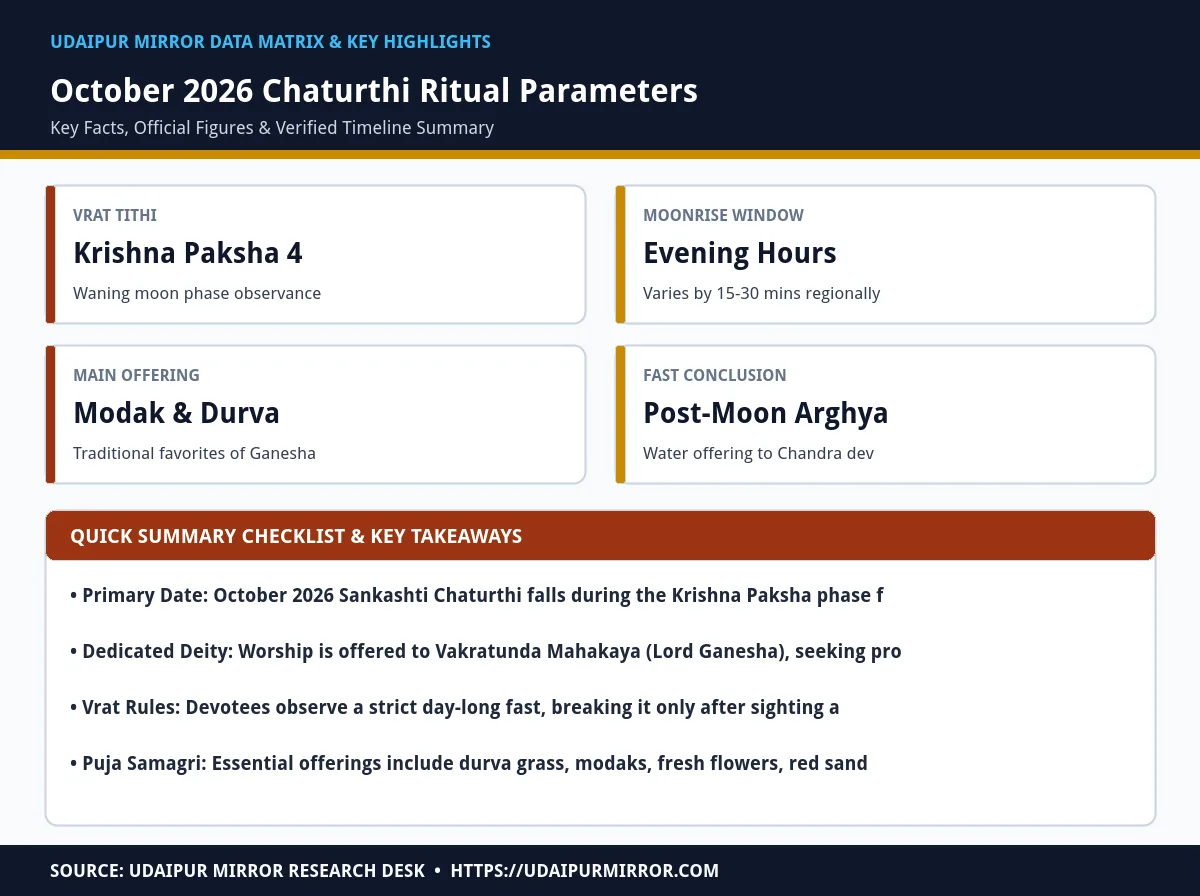
Sankashti Chaturthi is dedicated to Lord Ganesha, observed during the waning phase of the moon to seek protection from obstacles and invite prosperity.
The fast is broken only after sighting the moon in the evening, offering Arghya to Chandra dev, and performing the evening puja.
Essential items include durva grass, fresh flowers, red sandalwood, incense sticks, ghee diyas, and sweets like modaks or laddoos.
Yes, moonrise timings vary slightly depending on geographical coordinates and longitudes across various states, requiring local panchang verification.
Add Udaipur Mirror as a preferred source on Google to see more of our travel guides in your AI overviews.