Office Address
14, Residency Road, Udaipur, Rajasthan 313001
Office Address
14, Residency Road, Udaipur, Rajasthan 313001

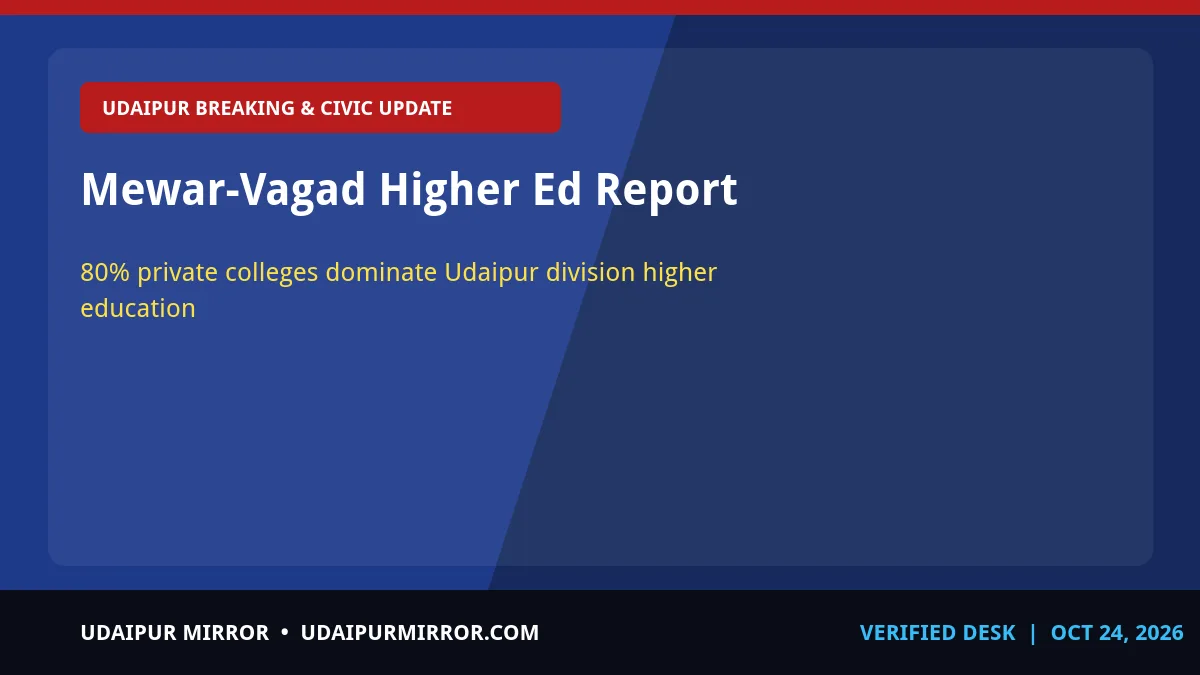
UDAIPUR: Udaipur — A comprehensive analysis of the latest mewar vagad higher education aishe report has brought to light a stark institutional imbalance plaguing the southern districts of Rajasthan. According to the nationwide survey data released by administrative authorities, approximately 80 percent of all higher education institutions across the Mewar and Vagad regions—encompassing Udaipur, Rajsamand, Chittorgarh, Banswara, Dungarpur, and Pratapgarh—operate under private management, leaving aspiring students heavily reliant on non-state facilities amidst acute infrastructural and faculty shortages in public universities.
⚡ Quick Highlights: AISHE Report: 80% Private Colleges in Mewar-Vagad Raise Cost Concerns
The administrative boundaries of Udaipur, Chittorgarh, Rajsamand, Banswara, Dungarpur, and Pratapgarh exhibit a deeply fragmented institutional density. While urban centres like Udaipur city feature a concentrated cluster of higher educational establishments, remote rural and Scheduled Tribe (ST) dominated pockets suffer from a severe scarcity of degree colleges. According to the empirical data published in Table 5 of the All India Survey on Higher Education (AISHE), the state of Rajasthan counts a total of 4,130 colleges, out of which a staggering 3,288 are managed by private operators. This leaves a meagre 842 institutions under direct governmental oversight to cater to underprivileged student cohorts.
The enrollment statistics further amplify this systemic gap. Statewide figures indicate that 18,65,750 scholars are currently enrolled in private higher education institutions, whereas public-sector colleges accommodate only 6,32,322 students. In developing regions like Mewar and Vagad, where per capita income lags behind major metropolitan hubs, this heavy reliance on private infrastructure forces ordinary families into insurmountable financial distress. Students who fail to secure admissions in limited-capacity government colleges are routinely pushed toward private institutions with exorbitant fee structures, affecting their pursuit of higher learning. For further context on institutional equity and admission frameworks, readers may review related analyses such as the IIT gender neutral quota analysis published by our desk.
“The skewed distribution of educational institutions between urban centres and tribal areas demands urgent administrative intervention to ensure equitable access for every student.” — Senior Higher Education Analyst, Udaipur Division
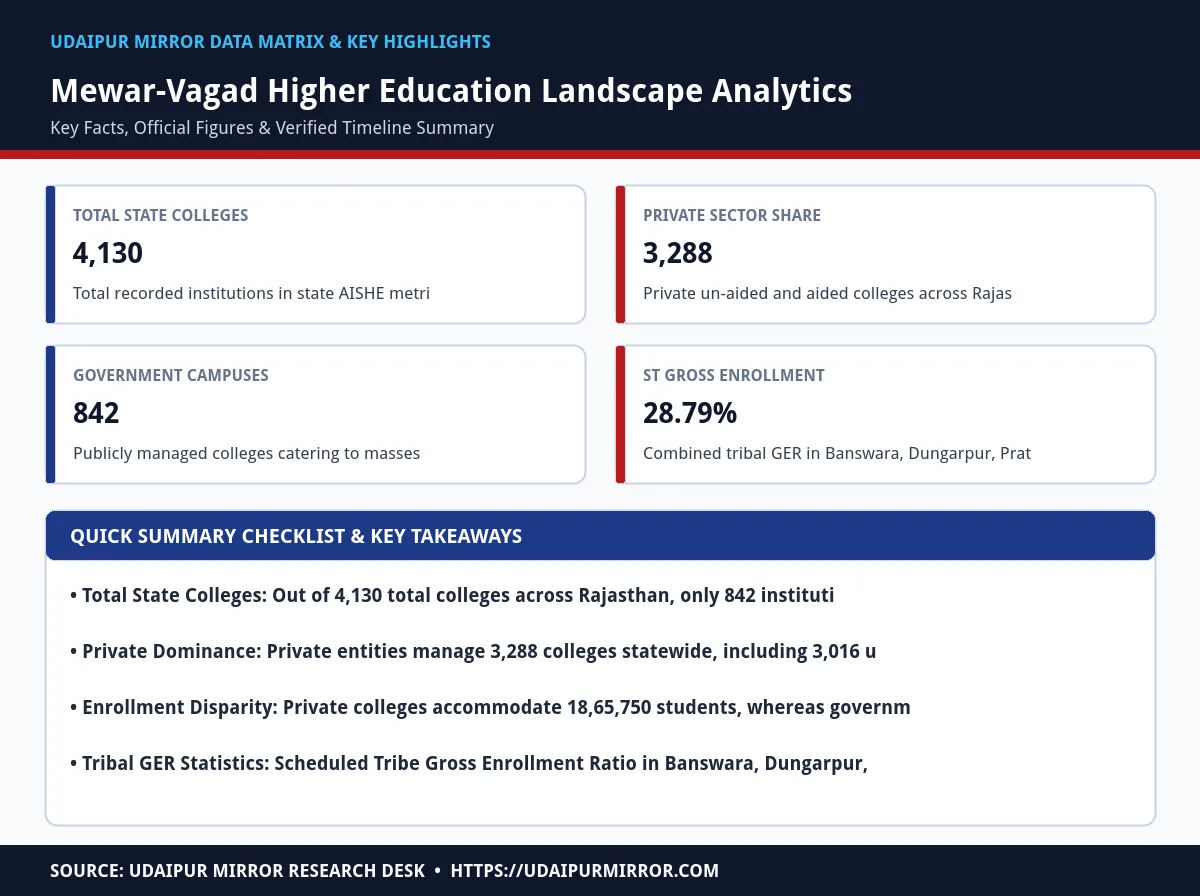
The institutional distribution highlighted in Table 5 of the recent AISHE report demonstrates a profound structural skew toward the private sector, significantly impacting enrollment patterns, infrastructural availability, and out-of-pocket expenses for families across Udaipur division and neighboring districts.
| Institutional Sector | Total Colleges | Enrolled Student Count | Primary Operational Challenge |
|---|---|---|---|
| Private Un-Aided Colleges | 3,016 | High (Bulk of 18.65L) | High fee burden on students |
| Private Aided Colleges | 272 | Moderate | Compliance & grant restrictions |
| Government Colleges | 842 | 6,32,322 Students | Severe faculty & seat shortages |
| Tribal Belt Campuses | Varies | Low Regional GER | Vacant labs and regular posts |
In the predominantly tribal districts of Banswara, Dungarpur, and Pratapgarh, administrative data indicates that the state Scheduled Tribe Gross Enrollment Ratio (GER) stands at 28.79 percent, with male enrollment at 27.93 percent and female enrollment slightly higher at 30.68 percent. However, these promising participation metrics mask deep-seated operational deficiencies. Public colleges across these tribal zones are crippled by prolonged vacancies of regular teaching faculties, inadequate library infrastructure, and a near-total absence of advanced scientific laboratories.
Local academic circles and civil society organizations have repeatedly petitioned the Department of Higher Education in Jaipur to fast-track faculty recruitment drives and allocate special grants for laboratory upgrades in tribal colleges. Without robust state backing, students in Banswara and Pratapgarh are compelled to travel long distances or settle for under-resourced local study centres. Similar civic engagement remains crucial across regional sectors, mirroring participation trends observed during local administrative milestones such as the Udaipur panchayat elections first phase voting across rural blocks.
“Higher education in tribal pockets cannot thrive on statistical enrollment alone; we need immediate deployment of qualified regular faculty and modern laboratory facilities.” — Mewar Regional Academic Council Member
मेवाड़ और वागड़ अंचल (उदयपुर, राजसमंद, चित्तौड़गढ़, बांसवाड़ा, डूंगरपुर और प्रतापगढ़) में उच्च शिक्षा की स्थिति गंभीर चिंता का विषय बन गई है। हाल ही में जारी ऑल इंडिया सर्वे ऑन हायर एजुकेशन (AISHE) की रिपोर्ट के अनुसार, संभाग में संस्थागत घनत्व बेहद विषम है। शहरी क्षेत्रों में निजी और सरकारी कॉलेजों का जमावड़ा है, जबकि दूरस्थ जनजातीय क्षेत्रों में उच्च शिक्षा संस्थानों की भारी कमी है। आंकड़े बताते हैं कि प्रदेश के कुल 4,130 महाविद्यालयों में से 3,288 कॉलेज निजी क्षेत्र के अंतर्गत संचालित हो रहे हैं, जिनमें 3,016 अन-एडेड और 272 एडेड संस्थान शामिल हैं। इसके विपरीत, सरकारी कॉलेजों की संख्या मात्र 842 है।
उदयपुर संभाग के चित्तौड़गढ़, राजसमंद और उदयपुर जिलों में भी यही असंतुलन स्पष्ट रूप से दिखाई दे रहा है। रिपोर्ट के अनुसार, राज्य के प्राइवेट कॉलेजों में 18,65,750 छात्र नामांकित हैं, जबकि सरकारी कॉलेजों में केवल 6,32,322 छात्र ही अध्ययन कर रहे हैं। इस वजह से जनजातीय और मध्यमवर्गीय परिवारों के लिए प्राइवेट कॉलेजों की भारी-भरकम फीस का बोझ उठाना बेहद कठिन हो गया है। परिणामस्वरूप, छात्र सीमित सीटों वाले सरकारी कॉलेजों के चक्कर काटने या कम सुविधाओं वाले संस्थानों में प्रवेश लेने को विवश हो रहे हैं।
बांसवाड़ा, डूंगरपुर और प्रतापगढ़ जैसे अनुसूचित जनजाति (एसटी) बहुल जिलों में राज्य का एसटी जीईआर (ग्रॉस एनरोलमेंट रेशियो) 28.79% दर्ज किया गया है, जिसमें पुरुष साक्षरता सहभागिता 27.93% और महिला सहभागिता 30.68% है। हालांकि, इन आंकड़ों के बावजूद धरातल पर स्थिति यह है कि सरकारी संस्थानों में नियमित शिक्षकों के पद वर्षों से खाली पड़े हैं और विज्ञान प्रयोगशालाओं का भी भारी अभाव है। शिक्षाविदों ने सरकार से मांग की है कि जनजातीय अंचल में रिक्त पदों को जल्द भरा जाए और बुनियादी ढांचे को मजबूत किया जाए। (Also read: Udaipur Panchayat Elections 2026: Voting Begins Across 284 Gram Panchayats in Phase One | उदयपुर में 284 पंचायतों में मतदान).
“जनजातीय क्षेत्रों के विद्यार्थियों को उच्च शिक्षा में समान अवसर दिलाने के लिए सरकारी कॉलेजों में शिक्षकों की कमी को तुरंत दूर करना होगा और निजी संस्थानों की फीस पर नियंत्रण जरूरी है।” — स्थानीय शिक्षा विशेषज्ञ एवं विश्लेषक
Addressing the widening gap between private and public higher education in southern Rajasthan requires a coordinated policy framework involving the Udaipur District Administration, state higher education directorates, and affiliating bodies like Mohanlal Sukhadia University. Experts emphasize that unless public capital investment is channelized into upgrading infrastructure in peripheral blocks like Mavli, Salumbar, and Kotra, educational equity will remain elusive.
Furthermore, state regulators must enforce stringent quality assurance and fee-capping guidelines across private institutions to protect students from economic exploitation. As urban infrastructure continues to expand—supplemented by civic upgrades such as AVVNL maintenance schedules—educational planners must prioritize rural student welfare, ensuring that the next generation of Mewar and Vagad youth is equipped with accessible, high-quality, and affordable higher education opportunities.
“A sustainable academic ecosystem in Mewar requires a strategic partnership between state funding and regulatory oversight to bridge the urban-rural divide.” — District Administrative Observer
The AISHE report reveals that out of 4,130 total colleges in Rajasthan, 3,288 are in the private sector while only 842 are government-run. In Mewar-Vagad, this creates heavy dependency on private institutions, straining student finances.
Private colleges across Rajasthan accommodate 18,65,750 students, whereas government colleges manage only 6,32,322 students due to limited seat capacities.
बांसवाड़ा, डूंगरपुर और प्रतापगढ़ जैसे एसटी बहुल जिलों में सरकारी कॉलेजों में नियमित शिक्षकों के भारी पद खाली हैं और विज्ञान प्रयोगशालाओं का अभाव है, जिससे छात्रों को कठिनाई होती है।
हाँ, लगभग 80 प्रतिशत कॉलेज निजी क्षेत्र में होने के कारण मध्यमवर्गीय और जनजातीय परिवारों को भारी फीस का आर्थिक बोझ उठाना पड़ रहा है, जिससे उच्च शिक्षा तक पहुंच सीमित हो रही है।
Add Udaipur Mirror as a preferred source on Google to see more of our travel guides in your AI overviews.


Comments are closed.

[…] […]
[…] […]