Office Address
14, Residency Road, Udaipur, Rajasthan 313001
Office Address
14, Residency Road, Udaipur, Rajasthan 313001

NEW DELHI: NEW DELHI — In a significant legal development impacting the real estate and development sector, the Supreme Court of India has formally dismissed appeals filed by Uttar Pradesh authorities, ensuring that the gaursons 388 crore demand quashed verdict remains legally binding. Delivered on Tuesday, November 17, 2026, the apex court’s ruling brings immense relief to developers grappling with legacy financial liabilities and arbitrary state demands. Meanwhile, institutional developers nationwide are closely observing these legal benchmarks as broader infrastructural policies evolve, such as the Rajasthan Prepares ₹12,500 Crore Roadmap for Govt School Infrastructure Development, which highlights parallel state-level administrative investments.
⚡ Quick Highlights: Gaursons ₹388 Crore Demand Quashed by Supreme Court
The Supreme Court’s decision to dismiss the appeals brought forth by Uttar Pradesh authorities marks a decisive conclusion to a high-stakes legal battle. The core of the controversy revolved around supplementary financial levies and retrospective demands slapped on housing projects. With the apex court stepping in, the gaursons 388 crore demand quashed ruling reinforces the principle that state agencies cannot arbitrarily impose retrospective financial burdens without statutory backing.
Industry analysts have welcomed the order, noting that protracted disputes between regulatory bodies and private developers often stall urban housing delivery. By bringing legal certainty to this dispute, the judiciary has paved the way for smoother project completions. In a separate domain of administrative oversight, consumers and citizens continue to navigate regulatory hurdles, as seen in recent local consumer vigilance matters like the Udaipur Titarri Supermarket Sells Fungus-Infested Kaju Katli: Customer Flags Food Safety Hazard, Store Refuses Exchange report.
“Arbitrary financial demands without robust statutory backing undermine the stability of the housing sector and penalize lawful developers.” — Senior Real Estate Legal Counsel
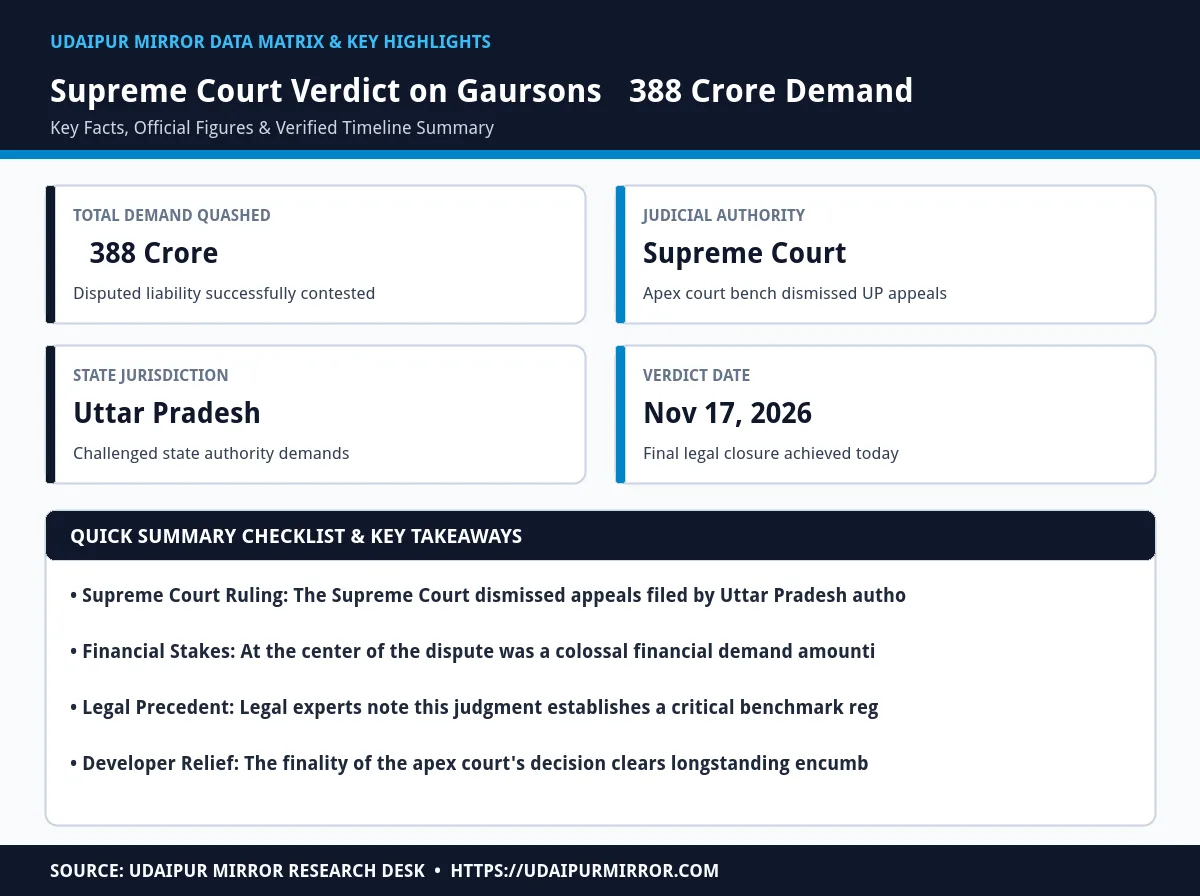
The following matrix outlines the key phases of the litigation, state authority claims, and the definitive relief secured through the Supreme Court judgment.
| Litigation Phase | Litigating Parties | Disputed Amount | Judicial Outcome |
|---|---|---|---|
| Initial State Notice | UP Authorities vs Gaursons | ₹388 Crore | Demand Notice Issued |
| High Court Challenge | Developer vs State Agency | ₹388 Crore | Favorable Ruling for Builder |
| Supreme Court Appeal | UP State vs Developer | ₹388 Crore | Appeals Filed in Apex Court |
| Final Judgment | Supreme Court Bench | ₹388 Crore | Appeals Dismissed, Demand Quashed |
| Post-Verdict Status | Industry Stakeholders | Nil Liability | Immediate Financial Relief |
The removal of a ₹388 crore liability fundamentally alters the balance sheet of the developer, freeing up capital that can be redirected toward finishing stalled construction projects. Homebuyers who had invested in projects tied up by this litigation can now expect expedited delivery timelines without the threat of secondary cost escalations.
Furthermore, this legal outcome serves as a cautionary tale for municipal and state housing authorities across India regarding the limits of administrative overreach. Regulatory bodies must ensure complete adherence to statutory frameworks when issuing development or land-use charges.
“Capital relief of this magnitude allows developers to refocus entirely on execution quality and timely handover to end consumers.” — Housing Sector Financial Analyst
As urban centers expand, the interface between state development authorities and private real estate enterprises remains fraught with friction. The Supreme Court’s intervention underscores the judiciary’s role as a vital balancer in safeguarding contractual integrity and preventing arbitrary state actions.
Legal experts anticipate that corporate legal teams will leverage this precedent in ongoing disputes concerning land acquisition costs, external development charges (EDC), and internal development charges (IDC) levied by various state boards. (Also read: Udaipur Titarri Supermarket Sells Fungus-Infested Kaju Katli: Customer Flags Food Safety Hazard, Store Refuses Exchange | तीतरड़ी सुपरमार्केट लापरवाही).
“Contractual sanctity between state entities and private builders is essential for maintaining robust economic momentum.” — Constitutional Law Expert
The core issue involved a ₹388 crore financial demand raised by Uttar Pradesh authorities against the developer, which the Supreme Court ultimately quashed by dismissing state appeals.
The apex court delivered its final verdict dismissing the UP appeals on Tuesday, November 17, 2026.
Homebuyers benefit directly as the removal of this massive financial liability clears the path for faster project completion and eliminates risks of secondary cost burdens.
The ruling sets a strong legal precedent limiting the ability of state agencies to levy arbitrary or retrospective charges on residential and commercial real estate projects.
Add Udaipur Mirror as a preferred source on Google to see more of our travel guides in your AI overviews.