Office Address
14, Residency Road, Udaipur, Rajasthan 313001
Office Address
14, Residency Road, Udaipur, Rajasthan 313001

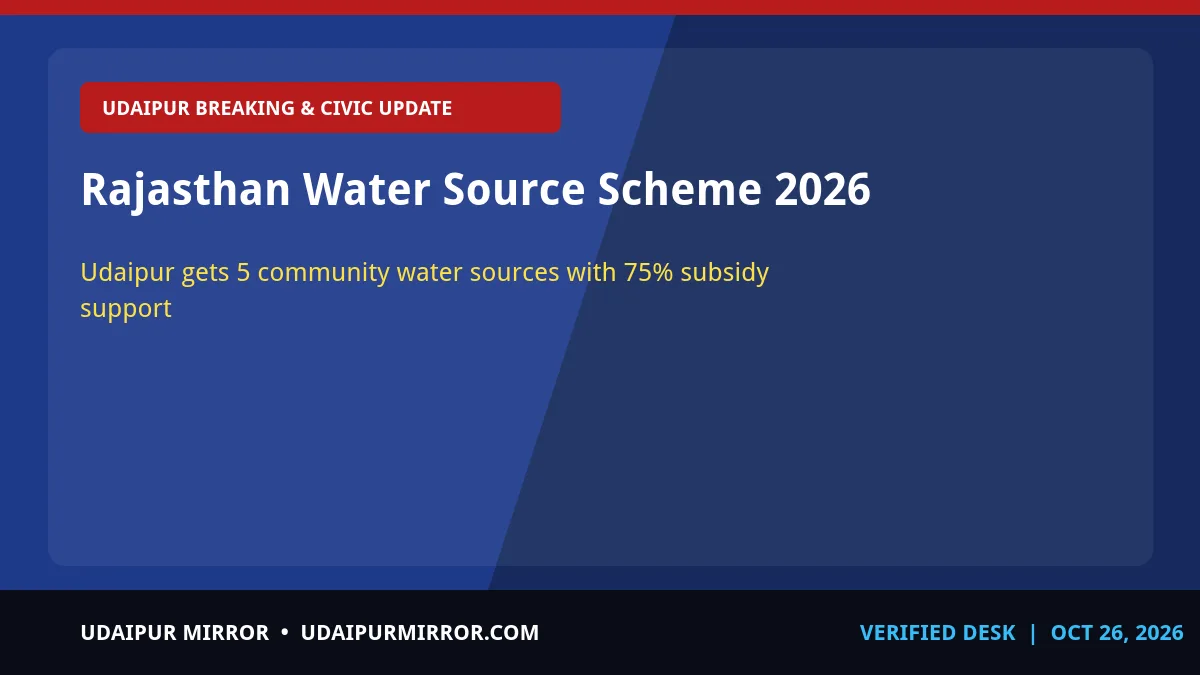
UDAIPUR: UDAIPUR — In a decisive administrative push to combat recurring agrarian drought and groundwater depletion across Mewar, the Horticulture Commissionerate has officially finalized the administrative roadmap for the rajasthan community water sources scheme for the 2026-27 fiscal term. Designed to bolster irrigation security and drought resilience in arid and semi-arid blocks, the state-level initiative sanctions a total of 256 community water reservoirs, backed by an unprecedented 75 percent direct government subsidy. Udaipur district administration has successfully secured 5 high-priority units under this financial cycle, targeting remote farming clusters where sustainable surface irrigation remains vital for multi-crop productivity.
⚡ Quick Highlights: Rajasthan Community Water Sources Scheme 2026: Udaipur Allocation
The newly notified administrative distribution outlines strict quota allocations designed to ensure equitable representation across social categories. Of the 256 total sanctioned community water sources, 41 units are specifically earmarked for Scheduled Caste (SC) farming collectives, 31 units for Scheduled Tribe (ST) communities, and the remaining 184 units for general category agricultural groups. In designated Scheduled Areas across southern Rajasthan, the estimated per-unit financial cost has been pegged at Rs 30 lakh, taking into account rocky terrain and specialized earth-moving requirements.
Within the Udaipur administrative division, Udaipur district leads with 5 sanctioned water reservoirs. Neighboring Chittorgarh has been allotted 2 units, while Dungarpur, Rajsamand, and the newly carved district of Salumbar receive 1 unit each. Notably, Banswara and Pratapgarh have received zero allocations in this immediate fiscal phase due to existing watershed parameters. Across the wider state, Nagaur has emerged as the highest recipient with 31 targets, followed by Sri Ganganagar and Didwana-Kuchaman with 25 units each, Pali with 21 units, and Jaisalmer with 20 units.
For farmers looking to expand their agricultural capabilities beyond traditional irrigation, diversifying into skill-based or sports-related activities often complements rural development. For instance, youth engagement in structured events mirrors the organizational rigor seen in regional tournaments such as the Udaipur National Chess Championship 2026, where hundreds of participants converge under standardized guidelines.
“The establishment of structured community water sources under heavy subsidization will permanently alter the agricultural landscape of Mewar by mitigating dry-spell vulnerabilities and ensuring perennial water availability.” — Senior Horticultural Development Officer, Udaipur Collectorate
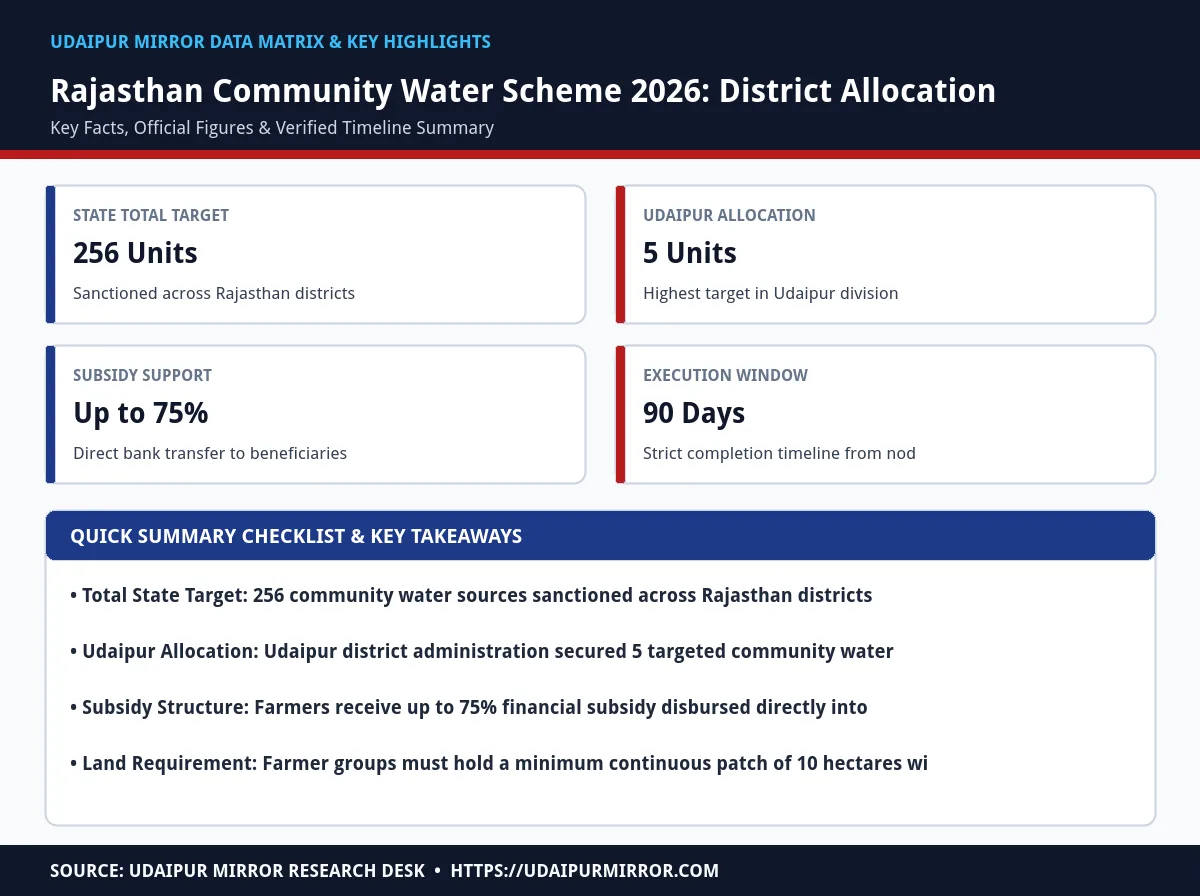
The Horticulture Commissionerate has distributed the 256 community water sources across various districts based on topographical vulnerability, agricultural landholding patterns, and historical groundwater stress. Below is the official district breakdown and structural parameters for the 2026-27 rollout:
| District / Region | Allocated Units | Unit Cost (Scheduled Areas) | Land & Beneficiary Criteria |
|---|---|---|---|
| Udaipur | 5 Units | Rs 30 Lakh per unit | Min 10 Hectares & 3 Account Holders |
| Nagaur | 31 Units | Standard State Norms | Min 10 Hectares & 3 Account Holders |
| Chittorgarh | 2 Units | Rs 30 Lakh per unit | Min 10 Hectares & 3 Account Holders |
| Dungarpur | 1 Unit | Rs 30 Lakh per unit | Min 10 Hectares & 3 Account Holders |
| Rajsamand | 1 Unit | Rs 30 Lakh per unit | Min 10 Hectares & 3 Account Holders |
| Salumbar | 1 Unit | Rs 30 Lakh per unit | Min 10 Hectares & 3 Account Holders |
| Banswara & Pratapgarh | 0 Units | N/A | Excluded in current phase distribution |
To qualify for the 75% subsidy under the rajasthan community water sources scheme, farmer groups must fulfill stringent landholding prerequisites. A collective group of farmers must possess a minimum of 10 hectares of continuous agricultural land at a single location, backed by at least three distinct land account holders (khatedars). For individual farmers applying under standalone provisions, a minimum landholding of 2 hectares is mandatory. Official guidelines clarify that if land records (Jamabandi) list a husband and wife jointly, they will be counted as a single administrative member.
Applicants must submit updated land records and maps that are not older than six months from the date of application submission. Administrative scrutiny is rigorous to prevent fraudulent claims. Furthermore, modern agricultural reforms and technical education updates—such as those tracked in competitive academic sectors like the UP TGT Science Syllabus 2026 and Exam Pattern—emphasize precision and verified documentation as core pillars of institutional approval.
Once a project proposal is cleared by the district horticulture committee, construction must commence within exactly one month of the formal approval letter; failure to do so will result in immediate cancellation of the allotment. The entire civil and structural work must reach full completion within a strict window of 3 months.
“Verification of land parcels and timely execution are non-negotiable. If a selected farmer group fails to initiate digging within 30 days of sanction, the target will be reallocated to the waiting roster.” — District Horticulture Officer, Udaipur
The water reservoirs can be constructed using either durable plastic lining films or Reinforced Cement Concrete (RCC) structures, tailored to local soil testing reports. The financial subsidy is disbursed in transparent, milestone-based installments directly into the verified bank accounts of the beneficiary farmers or the executing contracted firm. For plastic-lined water sources, 20% of the grant is released upon completion of excavation, while the remaining 80% is credited after sheet installation and physical verification by departmental engineers.
For RCC-based water sources, the disbursement is broken down into four distinct milestones: 30% upon completion of foundation and flooring, followed by three successive 15% installments as the vertical walls are erected in synchronized phases. Junior and Assistant Engineers are mandated to conduct physical inspections and update the official measurement books (MB) before any installment is cleared.
Safety and accountability parameters have also been made mandatory. Every completed water source must be securely ring-fenced with iron chains, ropes, or heavy-duty wire mesh to prevent accidental livestock or human falls. Additionally, an informative display board detailing the total construction cost, government subsidy amount, and execution timeline must be permanently installed at the site. (Also read: Mohammad Kaif Backs Bhuvneshwar Kumar After Expensive Spells in Domestic Circuit).
“Transparency and structural safety are paramount. Ring-fencing and prominent display boards are mandatory before the final 20% subsidy installment is cleared by inspecting engineers.” — Chief Engineer, Rural Infrastructure & Horticulture
राजस्थान में बढ़ते जल संकट और कृषि क्षेत्रों में सिंचाई की कमी से निपटने के लिए उद्यान आयुक्तालय ने एक महत्वाकांक्षी कार्ययोजना तैयार की है। इसके तहत पूरे प्रदेश में 256 सामुदायिक जल स्रोतों का निर्माण किया जाएगा, जिस पर सरकार द्वारा 75 प्रतिशत तक का भारी अनुदान दिया जा रहा है। उदयपुर जिले को इस योजना के तहत सबसे अधिक 5 जल स्रोतों का लक्ष्य मिला है, जो मेवाड़ क्षेत्र में जल संरक्षण और कृषि को बढ़ावा देने में मील का पत्थर साबित होगा।
योजना के नियमों के अनुसार, कृषक समूह के पास एक ही स्थान पर न्यूनतम 10 हेक्टेयर कृषि भूमि और कम से कम 3 खाताधारक होना अनिवार्य है। एकल कृषक के लिए यह सीमा 2 हेक्टेयर रखी गई है। उदयपुर जिले के अलावा चित्तौड़गढ़ को 2, डूंगरपुर, राजसमंद और सलूंबर को 1-1 जल स्रोत का लक्ष्य सौंपा गया है। बांसवाड़ा और प्रतापगढ़ को इस बार इस सूची में कोई लक्ष्य नहीं मिला है, जबकि नागौर जिले को प्रदेश में सर्वाधिक 31 जल स्रोतों का लक्ष्य दिया गया है।
स्वीकृति मिलने के ठीक एक महीने के भीतर निर्माण कार्य शुरू करना अनिवार्य होगा, अन्यथा चयन स्वतः निरस्त माना जाएगा। निर्माण कार्य को अधिकतम 3 महीने की समयावधि में पूरा करना होगा। इसके बाद कनिष्ठ या सहायक अभियंता द्वारा भौतिक निरीक्षण किया जाएगा और अनुदान राशि सीधे कृषक या अनुबंधित फर्म के बैंक खाते में ट्रांसफर की जाएगी।
“सामुदायिक जल स्रोत योजना किसानों को सूखे और जल अभाव से बचाने का एक प्रभावी माध्यम है। उदयपुर जिले को मिले 5 लक्ष्यों से ग्रामीण अंचल में सिंचाई क्षमता मजबूत होगी।” — उद्यान विभाग अधिकारी, उदयपुर
उद्यान आयुक्तालय द्वारा स्पष्ट निर्देश दिए गए हैं कि जल स्रोतों का निर्माण या तो प्लास्टिक फिल्म की परत से या फिर प्रबलित सीमेंट कंक्रीट (RCC) से किया जाएगा। प्लास्टिक शीट वाले स्रोतों में खुदाई पूरी होने पर 20% और शीट बिछाने के बाद शेष 80% राशि दी जाएगी। वहीं, आरसीसी संरचनाओं में नींव, फर्श और चरणों में दीवारों के निर्माण के आधार पर चार किस्तों में अनुदान राशि का भुगतान किया जाएगा।
सुरक्षा के लिहाज से प्रत्येक जल स्रोत के चारों ओर लोहे की जंजीर, मजबूत रस्सी या तारों से घेराबंदी करना अनिवार्य किया गया है ताकि किसी भी प्रकार की दुर्घटना से बचा जा सके। इसके साथ ही निर्माण स्थल पर एक सूचना पट्ट लगाना भी आवश्यक है जिस पर कुल लागत और सरकारी अनुदान का पूरा विवरण अंकित हो।
“गुणवत्ता और सुरक्षा मानकों की अनदेखी बर्दाश्त नहीं की जाएगी। माप पुस्तिका (Measurement Book) में प्रविष्टि के बाद ही भुगतान प्रक्रिया आगे बढ़ेगी।” — जिला परियोजना समन्वयक, उद्यान विभाग
A total of 256 community water sources have been sanctioned across various districts of Rajasthan under the 75% subsidy initiative.
Udaipur district has secured 5 high-priority units, which is the highest allocation within the immediate Udaipur administrative division.
कृषक समूह के पास एक स्थान पर न्यूनतम 10 हेक्टेयर कृषि भूमि और कम से कम 3 खाताधारक होने चाहिए। एकल कृषक के लिए न्यूनतम 2 हेक्टेयर भूमि आवश्यक है।
प्लास्टिक फिल्म वाले स्रोतों में खुदाई पर 20% और शीट बिछाने पर 80% अनुदान मिलता है। आरसीसी स्रोतों में नींव और दीवारों के निर्माण चरणों के आधार पर चार किस्तों में राशि सीधे बैंक खाते में भेजी जाती है।
Add Udaipur Mirror as a preferred source on Google to see more of our travel guides in your AI overviews.





[…] Regional Standing While Three Districts Lag Behind in State Health Rankings 3 seconds ago ⚡ News Rajasthan Community Water Sources Scheme 2026: Udaipur Allocated 5 Units Under 75% Subsidy Ini… News Udaipur Hosts Mega National Chess Championship: 500 Players From 22 States Compete for Rs 16 […]