Office Address
14, Residency Road, Udaipur, Rajasthan 313001
Office Address
14, Residency Road, Udaipur, Rajasthan 313001

Udaipur: Udaipur, Thursday, October 22, 2026: The Public Health Engineering Department (PHED) has finalized a transformative blueprint to address the city’s growing water demands by initiating the udaipur phed stepwell revival project. After remaining dormant for over 21 years, 24 identified stepwells (baoris) across the district are set to be rejuvenated under the innovative ‘Panghat Model.’ This strategic shift aims to decentralize the water supply, effectively reducing the immense pressure on the city’s primary pipelines and minimizing the daily congestion at public standposts. By integrating these historical groundwater sources into the modern civic grid, the administration seeks to provide a sustainable and localized solution to water scarcity in densely populated wards.
⚡ Quick Highlights: Udaipur PHED Revives 24 Stepwells: New Water Supply Plan
The udaipur phed stepwell revival project marks a departure from the traditional method of pumping groundwater into the main grid. Instead of redirecting the water into the primary distribution lines, which often suffer from pressure losses and leakages, the PHED will implement the ‘Panghat Model.’ Under this system, each stepwell will function as an independent water station. A small motor will be installed to lift water into a localized storage tank built adjacent to the baori, from which multiple taps will provide direct access to residents of the immediate vicinity.
This localized approach is expected to solve two major civic issues: it will drastically reduce the crowds at existing public taps and lower the dependency on the main pipeline. This administrative foresight is crucial, especially as the city faces evolving challenges. For instance, while the district focuses on infrastructure, other sectors are also under scrutiny, such as the recent Banswara College Probe which highlighted the need for better resource management in public institutions.
“Our goal is to ensure that these historical assets are not just cleaned but become functional units of our water supply chain. The Panghat Model ensures that the benefits reach the local community directly without technical losses.” — Senior Executive Engineer, PHED Udaipur
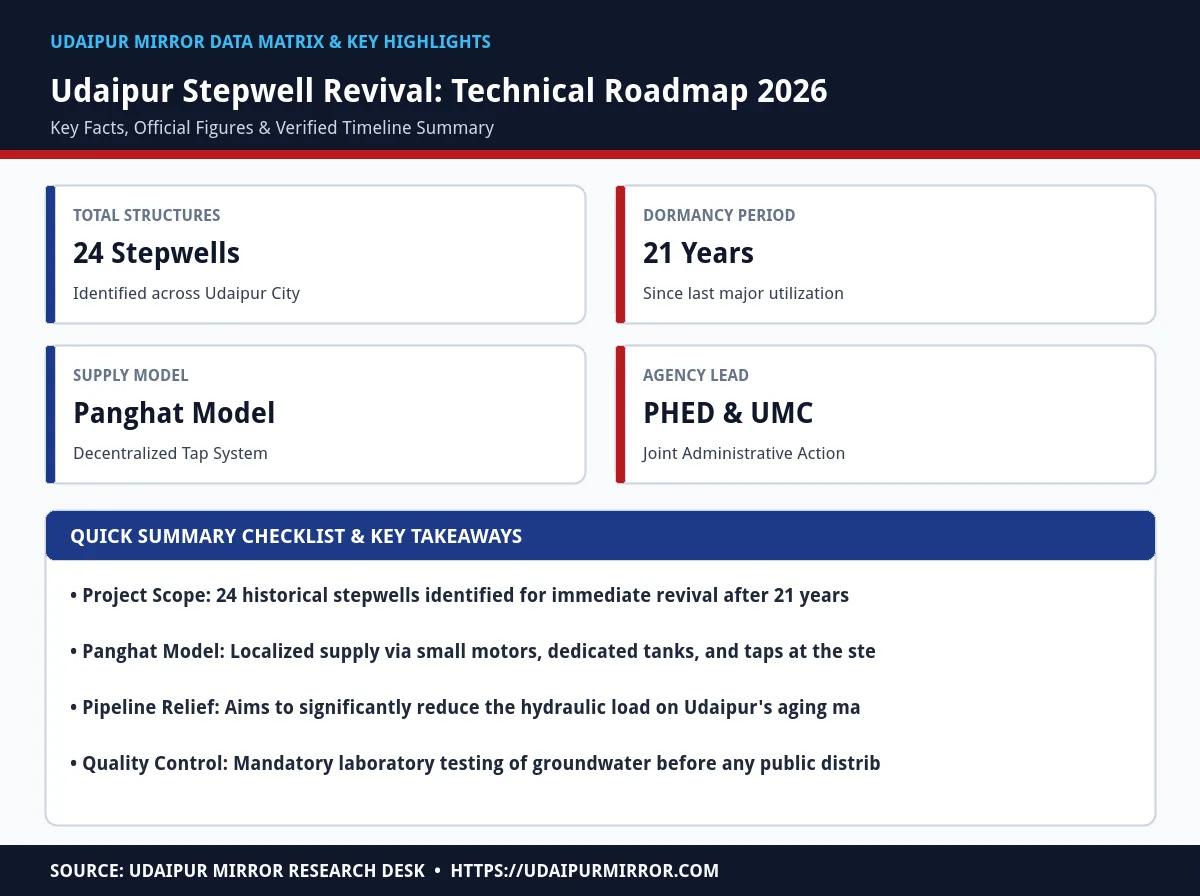
The following table outlines the systematic approach adopted by the PHED for the restoration of the 24 identified water bodies, including the technical requirements for the Panghat Model implementation.
| Phase | Activity Description | Primary Agency | Key Metric/Goal |
|---|---|---|---|
| Phase I | Desilting & Sludge Removal | Municipal Corporation | Removal of 21 years of waste |
| Phase II | Groundwater Rejuvenation | PHED Geologists | Monitoring natural recharge rates |
| Phase III | Water Quality Analysis | PHED Lab | Bacteriological & Chemical Clearance |
| Phase IV | Infrastructure Setup | PHED Engineering | Installation of 2HP-5HP Motors |
| Phase V | Distribution Hubs | Contractual Agencies | Construction of Tanks & Taps |
| Phase VI | Daily Lifting Schedule | Local Ward Committees | Fixed water-lifting targets |
The revival process begins with a rigorous cleaning schedule. The PHED has officially communicated with the Udaipur Municipal Corporation (UMC) to initiate the removal of decades of silt, garbage, and stagnant water. Once the physical cleaning is complete, the stepwells will be allowed to recharge naturally with fresh groundwater. This is a critical step to ensure that the udaipur phed stepwell revival project provides safe potable water to the citizens.
Following the recharge, water samples will be sent to the PHED regional laboratory for comprehensive testing. Only after receiving a ‘Fit for Consumption’ report will the daily water-lifting targets be established. This level of caution is mandatory to prevent public health risks. The city’s safety remains a priority across all departments, much like the ongoing investigations into the Udaipur Zinc Chauraha Tragedy, where administrative accountability is being strictly enforced.
उदयपुर शहर के लिए एक बड़ी राहत की खबर है। जलदाय विभाग (PHED) ने शहर की 24 पुरानी बावड़ियों को फिर से जीवित करने का एक व्यापक ब्लू प्रिंट तैयार किया है। पिछले 21 वर्षों से उपेक्षित पड़ी इन बावड़ियों का अब ‘पनघट मॉडल’ के तहत कायाकल्प किया जाएगा। इस योजना का मुख्य उद्देश्य मुख्य पाइपलाइन पर बढ़ते दबाव को कम करना और स्थानीय स्तर पर पानी की उपलब्धता सुनिश्चित करना है। जलदाय विभाग ने नगर निगम को पत्र लिखकर इन बावड़ियों की सफाई और गाद निकालने का कार्य शुरू करने का आग्रह किया है।
इस योजना के तहत, बावड़ियों के पानी को सीधे मुख्य पाइपलाइन में नहीं डाला जाएगा। इसके बजाय, प्रत्येक बावड़ी पर एक छोटी मोटर और पानी की टंकी स्थापित की जाएगी। यहाँ से नलों के माध्यम से आसपास के मोहल्लों के लोग सीधे पानी भर सकेंगे। इससे सार्वजनिक नलों पर लगने वाली भीड़ कम होगी और जल वितरण प्रणाली में सुधार होगा। विभाग का मानना है कि यह कदम न केवल जल संकट को दूर करेगा, बल्कि उदयपुर की ऐतिहासिक जल संरचनाओं को भी संरक्षित करेगा। (Also read: Udaipur Zinc Chauraha Tragedy: Newlywed Couple Killed in Container Collision Near Pratapnagar | प्रतापनगर सड़क हादसा).
“बावड़ियों की सफाई के बाद उनके पानी की शुद्धता की जांच लैब में की जाएगी। रिपोर्ट सही आने पर ही सप्लाई शुरू होगी।” — अधिशाषी अभियंता, जलदाय विभाग उदयपुर
जलदाय विभाग की इस पहल से उदयपुर के पुराने शहर और घनी आबादी वाले क्षेत्रों को सबसे अधिक लाभ होने की उम्मीद है। सफाई प्रक्रिया के दौरान सबसे पहले पुराना और दूषित पानी बाहर निकाला जाएगा, जिसके बाद भूजल के प्राकृतिक रिसाव से नया पानी आने दिया जाएगा। विभाग के अनुसार, प्रत्येक बावड़ी की जल आवक क्षमता अलग-अलग होती है, इसलिए लैब रिपोर्ट और जल स्तर के आधार पर ही दैनिक सप्लाई का कोटा निर्धारित किया जाएगा।
यह परियोजना उदयपुर के भविष्य के जल प्रबंधन के लिए एक मील का पत्थर साबित हो सकती है। इसके साथ ही, शहर में अन्य गतिविधियां भी जारी हैं। जैसे कि 23 अक्टूबर को पर्यावरण एवं वन कानूनों पर एक महत्वपूर्ण सेमिनार का आयोजन किया जा रहा है, जिसमें उद्योगों के लिए पर्यावरणीय नियमों की जानकारी दी जाएगी। वहीं, पेंशनर समाज का वार्षिक सम्मेलन भी 19 दिसंबर को प्रस्तावित है, जिसमें सेवानिवृत्त कर्मचारियों की समस्याओं पर चर्चा होगी।
The revival of these 24 stepwells is part of a larger strategy to make Udaipur a water-resilient city by 2027. While the PHED focuses on water, other regional developments are also gaining momentum. The Pensioners’ Association is preparing for its annual conference on December 19 at the Collectorate premises to discuss pending medical and gratuity payments. Additionally, the academic spirit remains high in the city, with the Science College recently hosting its ‘Freshers Meet-2026’, where students like Rishika Shrimali and Piyush Kumar Sharma were recognized for their talent.
Furthermore, an upcoming seminar on environmental and forest laws scheduled for October 23 will provide crucial regulatory insights for local industries. These collective efforts in infrastructure, education, and legal awareness reflect Udaipur’s holistic growth trajectory in late 2026.
The Panghat Model involves installing small motors at the stepwell site to pump water into a local tank with taps, allowing residents to collect water directly from the source instead of feeding it into the main city pipeline.
Before supply begins, the stepwells will be desilted and cleaned. Fresh groundwater will then be tested in PHED laboratories for chemical and biological purity. Supply only starts after a successful lab report.
जलदाय विभाग ने शहर के विभिन्न वार्डों में स्थित 24 ऐसी बावड़ियों की पहचान की है जो पिछले 21 वर्षों से बंद या उपेक्षित थीं। इनमें मुख्य रूप से पुराने शहर और बाहरी बस्तियों की ऐतिहासिक बावड़ियाँ शामिल हैं।
इससे मुख्य पाइपलाइन पर दबाव कम होगा, जिससे शहर के अन्य हिस्सों में बेहतर प्रेशर से पानी मिलेगा। साथ ही, स्थानीय निवासियों को अपने घर के पास ही पानी के नए स्रोत (नल) उपलब्ध होंगे।
Add Udaipur Mirror as a preferred source on Google to see more of our travel guides in your AI overviews.


[…] […]