Office Address
14, Residency Road, Udaipur, Rajasthan 313001
Office Address
14, Residency Road, Udaipur, Rajasthan 313001

UDAIPUR: Intense rural political maneuvering has swept through Mewar as the comprehensive udaipur sarpanch contenders list began taking definitive shape across 189 Gram Panchayats slated for second-phase polling. Local clan councils, sitting pradhans, and party workers are holding round-the-clock chaupal negotiations to forge consensus before candidates arrive at tehsil offices to file official papers with election returning officers.
⚡ Quick Highlights: Udaipur Sarpanch Contenders List: Phase 2 Panchayat Updates
With rural campaigning entering a decisive phase, political discussions in the rural belts of Mewar have shifted entirely from broad district mandates to hyper-local family and community allegiances. Across the 189 Gram Panchayats scheduled for voting in the second round, prospective candidates are mobilizing supporters to claim community endorsements before submitting documentation at block headquarters.
While national party flags are officially absent from Sarpanch ballots, party-backed front organizations and sitting MLAs hold substantial backstage leverage. Local leaders are acutely mindful of broader political dynamics across Southern Rajasthan, including recent friction such as the Rajasthan BJP District President threat case that underscored the volatile stakes involved in rural ticket distributions and local body leadership contests.
“The Sarpanch election is fundamentally personal; voters evaluate everyday availability and resolving ration distribution issues above party loyalty.” — Ratan Lal Meena, Rural Affairs Analyst, Udaipur
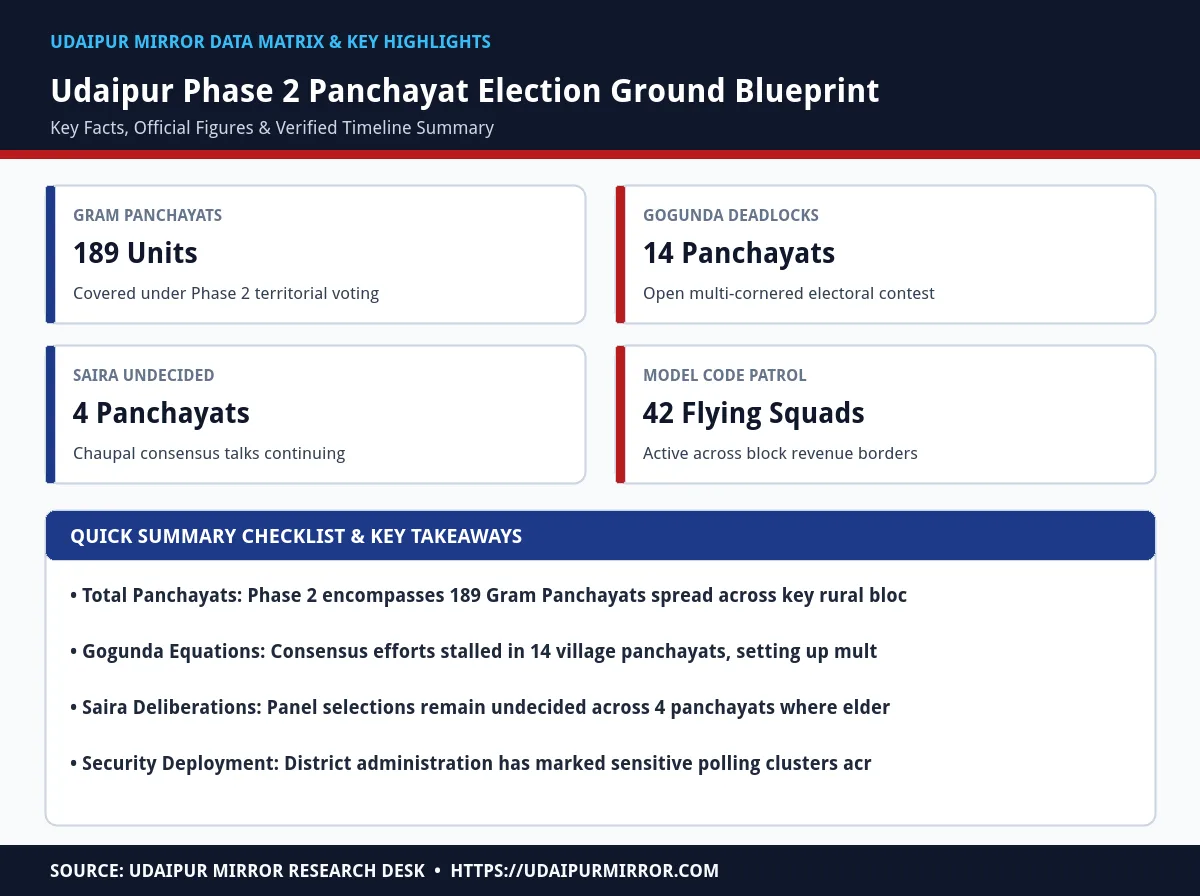
The table below summarizes the key operational blocks undergoing Phase 2 Gram Panchayat elections, highlighting contested panchayat tallies, areas undergoing consensus negotiations, and dominant election issues raised by village chaupals.
| Panchayat Samiti | Phase 2 Panchayats | Impasse / Open Seats | Dominant Campaign Focus |
|---|---|---|---|
| Gogunda | 38 | 14 Panchayats | Forest land regularisation, pasture preservation, rural link roads |
| Saira | 29 | 4 Panchayats | Irrigation lift channels, primary health sub-centre staff shortages |
| Mavli | 41 | 6 Panchayats | Canal water allocation, dairy collection subsidies, school upgrades |
| Bhindar | 32 | 5 Panchayats | Drinking water pipeline grid, cooperative mandi access roads |
| Badgaon | 24 | 3 Panchayats | Periphery urbanisation friction, drainage lines, streetlight maintenance |
| Girwa | 25 | 2 Panchayats | Industrial belt road damage, tap water supply to tribal hamlets |
In Gogunda Panchayat Samiti, election observers report that 14 Gram Panchayats remain locked in stalemate where no sole consensus nominee could be selected by community panchayats. As a result, direct three-way and four-way contests are inevitable between heavyweight village families. Similarly, in Saira Panchayat Samiti, 4 Gram Panchayats have failed to arrive at an agreed panel, with multiple contenders refusing to withdraw their claims.
In villages where unanimous selection (Nirvirodh Chayan) succeeds, state incentives are often cited as motivation, but grassroots ambition routinely overrides peer pressure. Aspirants are setting up dynamic campaign teams utilizing social media broadcasts alongside door-to-door visits in distant phalas and hamlets across hilly terrain.
“Our teams are maintaining stringent oversight on community banquets and illicit distribution channels to guarantee absolute adherence to the model code.” — Office of the District Election Officer (Panchayats), Udaipur Collectorate
Beyond community considerations, civic grievances are dominating village debate platforms. In peri-urban villages adjacent to Udaipur Municipal Corporation limits—such as Kaladwas, Savina rural extensions, and Badgaon—residents have openly voiced anger over delayed Public Health Engineering Department (PHED) pipeline integrations. In Kaladwas (Ward 43), overhead reservoirs constructed over two years ago remain disconnected from feeder lines, forcing tanker dependency.
Compounding public anger, unpaved utility trenches cut for water lines across Savina and damaged transformers are fueling questions during candidate door-to-door rounds. Voters are frequently demanding immediate assurances on infrastructural delivery, particularly during widespread regional disruptions like the scheduled Udaipur power cut today that caught suburban markets and peri-urban farm tube-wells off guard.
“Candidates promise high-tech development, but our lane has remained dug up for months after pipe laying while stray cattle wander through dark alleys.” — Pushkar Meghwal, Former Ward Panch, Kaladwas
The Udaipur district administration and police department have enacted strict logistical arrangements to manage Phase 2 polling. Given that several panchayats in southern Mewar traverse dense Aravalli ranges, quick-response teams (QRT) and wireless command posts have been instituted in high-risk zones. Ballot paper printing protocols, EVM functional checks, and polling team dispatch schedules are currently being monitored directly from the Collectorate war room.
Returning officers have been directed to strictly review affidavits regarding educational standards, asset declarations, and criminal antecedents. Flying squads are executing spot checks across countryside liquor vends, private guest houses, and community halls to prevent voter inducement.
“Zonal magistrates hold magisterial powers to take preemptive preventive action against trouble-mongers across polling sectors.” — Senior Administrative Official, Udaipur Collectorate
A total of 189 Gram Panchayats across Udaipur district are slated for polling in Phase 2 of the rural local body elections.
Gogunda has reported 14 Gram Panchayats without consensus candidates, while Saira has 4 Gram Panchayats where multiple factions remain locked in electoral contests.
No, Sarpanch and Ward Panch elections are fought on free electoral symbols allotted by the State Election Commission, although major political parties actively back affiliated contenders.
Voters are emphasizing drinking water connectivity from overhead reservoirs, restoration of dug-up roads, reliable rural electricity supply, and management of stray cattle.
Add Udaipur Mirror as a preferred source on Google to see more of our travel guides in your AI overviews.



[…] Towards $4,120 as Iran Conflict and Federal Reserve Outlook Remain in Focus 1 hour ago ⚡ News Udaipur Sarpanch Contenders List Phase 2: Race Intensifies Across 189 Gram Panchayats with Con… News Udaipur Power Cut Tomorrow: 7-Hour Electricity Outage in 50 Localities on October 22 4 hours […]