Office Address
14, Residency Road, Udaipur, Rajasthan 313001
Office Address
14, Residency Road, Udaipur, Rajasthan 313001

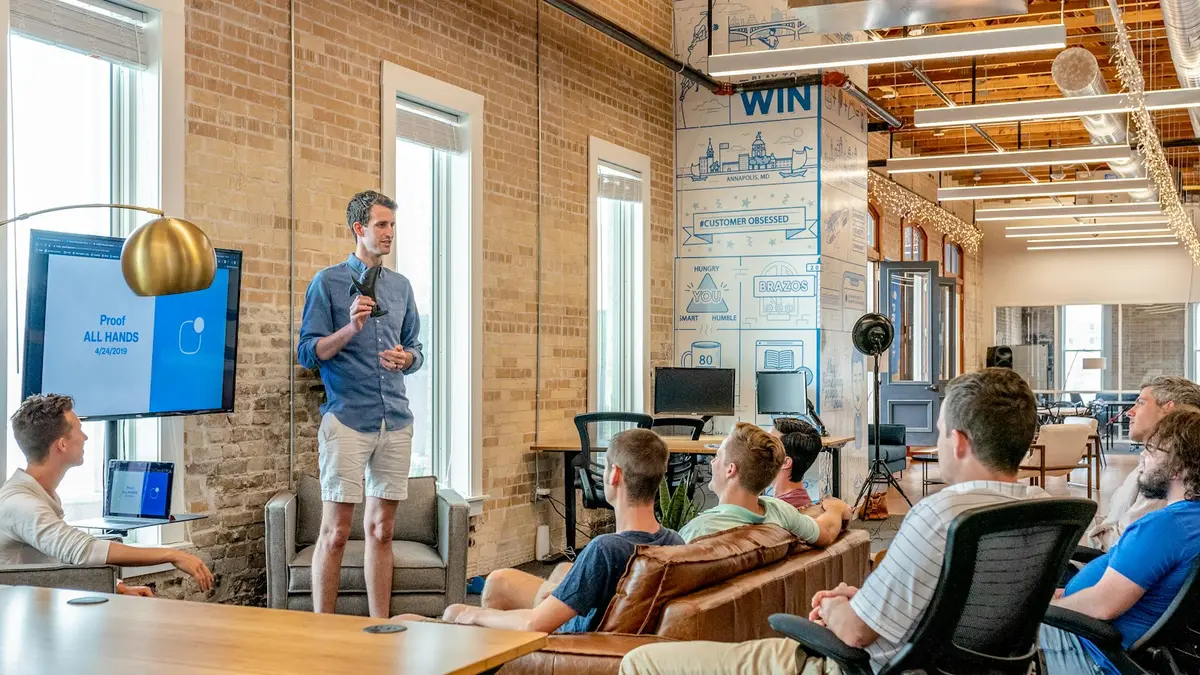
NEW DELHI: NEW DELHI — As capital inflows reach unprecedented highs across institutional venture funds and state-backed vehicles, india funding deeptech market demand has become the central debate dominating India’s startup ecosystem. While millions in venture capital are successfully injected into advanced artificial intelligence, quantum computing, aerospace, and advanced manufacturing ventures, policymakers and venture capitalists are staring down a critical bottleneck: building world-class technology in research labs is only half the battle, but securing reliable, risk-tolerant domestic enterprise buyers willing to pilot and procure indigenous hardware and software remains a formidable structural hurdle for early-stage founders.
⚡ Quick Highlights: India Funding Deeptech: Commercialization & Market Challenges
The narrative surrounding India’s startup ecosystem has undergone a radical transformation. While consumer-facing internet plays once dominated venture funding discussions, the spotlight has decisively shifted toward intellectual property-heavy, capital-intensive engineering solutions. However, this influx of capital has laid bare a profound structural mismatch: venture capitalists are eager to fund early-stage breakthroughs, but Indian legacy enterprises remain remarkably risk-averse when it comes to procuring unproven, homegrown technology.
Unlike Western markets where venture clients and agile corporate venture capital (CVC) arms actively pilot unproven technologies, Indian enterprises often prefer established, legacy foreign vendors. This dynamic creates a dangerous limbo where startups secure seed and Series A funding, only to stall during Series B and C due to a lack of recurring revenue from enterprise customers. Broader macroeconomic discussions, such as those surrounding Trump’s Midterm Poll Setback Won’t Derail India-US Trade Talks: Official, underscore how global trade dynamics further complicate local procurement strategies for export-oriented deeptech firms.
Furthermore, deeptech cycles are inherently longer than traditional software-as-a-service (SaaS) models. Founders cannot rely on quick iteration loops when developing silicon chips, quantum algorithms, or advanced composite materials. Without a predictable domestic buyer base, brilliant research risks remaining confined to academic labs or migrating entirely to foreign jurisdictions where commercial validation is faster and more receptive. (Also read: Trump's Midterm Poll Setback Won't Derail India-US Trade Talks: Official).
“We have no shortage of brilliant engineering minds or early-stage capital. The real existential question for Indian deeptech is whether our corporate giants will take a calculated risk on homegrown innovation before capital runs dry.” — Senior Venture Capital Partner, Bengaluru
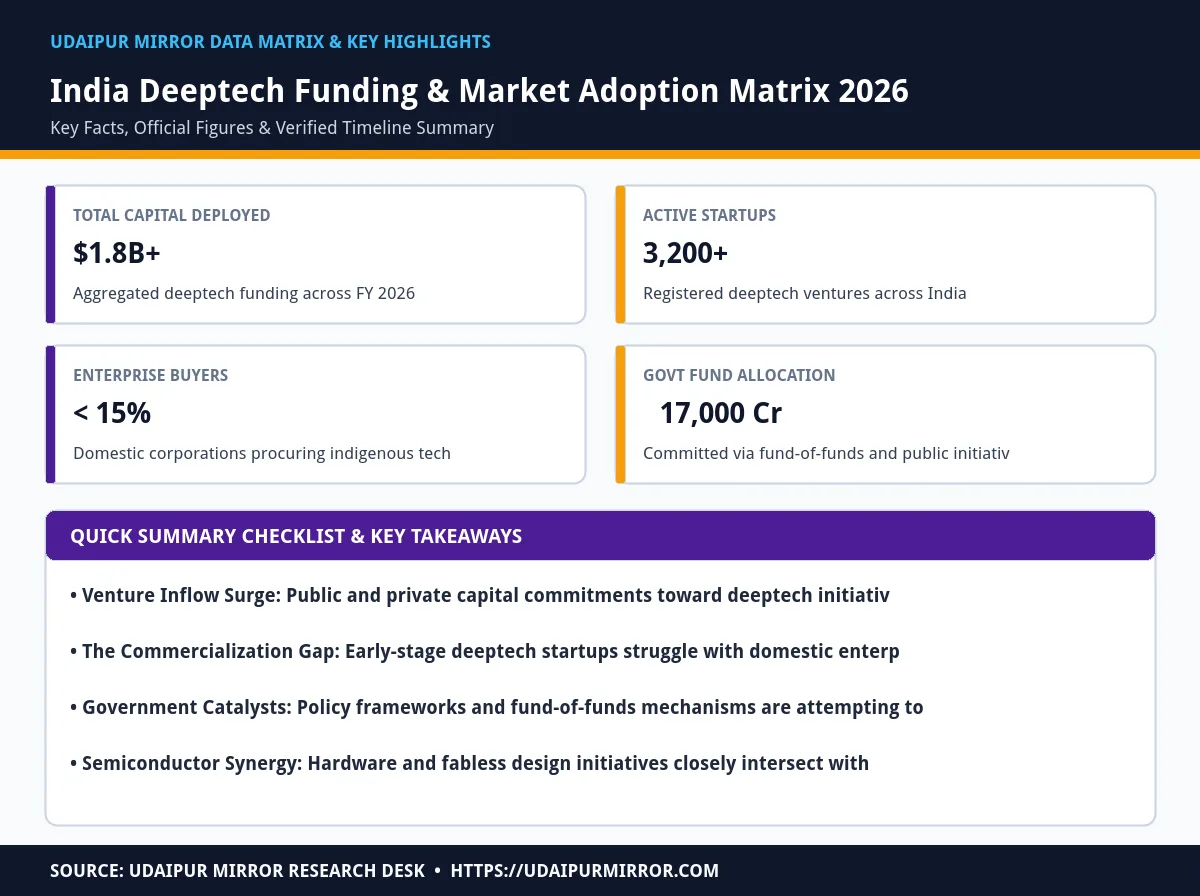
A comparative analysis of capital availability and enterprise market readiness across key deeptech pillars in India’s evolving tech landscape.
| Technology Sector | Funding Momentum | Primary Investors | Domestic Buyer Readiness | Commercial Outlook |
|---|---|---|---|---|
| Semiconductors & VLSI | Very High (₹127,500 Cr Push) | State Funds, VC Consortia | Moderate (Automotive/Telecom) | Strong long-term industrial demand |
| AI & Enterprise SaaS | High | Global VCs, Corporate Angels | High (IT & Fintech sectors) | Rapid enterprise adoption |
| SpaceTech & Aerospace | Moderate-High | In-Space, Specialized VCs | Low (Primarily ISRO/Govt) | Transitioning to commercial satellites |
| Clean Energy & Storage | High ($1.5B Grid Push) | Green Funds, Infrastructure VCs | Moderate (Utilities & EV OEMs) | Scaling rapidly with net-zero goals |
| Robotics & Drones | Moderate | Agri & Industrial Angels | Low-Moderate | Dependent on regulatory clearances |
Recognizing that private enterprise hesitation could choke the deeptech revolution, government agencies and public-sector undertakings (PSUs) are increasingly stepping in as anchor buyers. By guaranteeing initial pilot orders, government bodies—particularly in defense, space, and telecommunications—are providing the crucial referenceability that startups need to unlock private sector trust.
In parallel, national initiatives like the massive semiconductor push, detailed in reports on India’s ₹127500 Crore Semiconductor Push: Can Semicon 2.0 Overcome Decades of Missed Opportunities?, aim to build foundational ecosystems where fabless designers and material scientists have immediate access to domestic fabrication facilities and enterprise testing grounds.
Yet, relying solely on government contracts is not a sustainable long-term model for a thriving commercial market. Startups must build robust go-to-market strategies that appeal to private conglomerates. This requires shifting corporate culture from passive technology consumers to active co-developers of next-generation intellectual property.
“Public procurement must act as the primary launchpad, but true market maturity arrives only when private conglomerates embed Indian deeptech into their global supply chains.” — Deeptech Incubator Director, IIT Delhi
Faced with a hesitant domestic enterprise market, an increasing number of Indian deeptech founders are adopting a global-first go-to-market strategy. By bypassing local validation entirely, these startups are taking their intellectual property directly to US, European, and Southeast Asian markets where enterprise buyers are more accustomed to taking risks on early-stage deeptech suppliers.
This export-oriented approach brings its own set of challenges, including high compliance costs, international patent filings, and the necessity of establishing overseas sales offices before achieving domestic scale. Nevertheless, for artificial intelligence, robotics, and SaaS-driven deeptech companies, international revenue streams have proven to be the financial lifeline that keeps R&D centers fully operational in India.
Corporate earnings and industrial trends—such as those highlighted in analyses on Siemens Q2 FY27 Results and Annu Projects Solar Contract Stock Insights—demonstrate that industrial giants are beginning to allocate budgets toward decarbonization and advanced automation, offering a glimmer of hope for domestic industrial tech adoption.
“If the domestic market will not buy what we build, we will build it in India, test it in global labs, and sell it to the world. Innovation respects no borders.” — Co-founder, AI & Robotics Startup
Solving the deeptech commercialization riddle requires a concerted, multi-stakeholder approach. Venture capital firms must adjust their return expectations, extending fund lifecycles to accommodate the protracted gestation periods of hard tech. Simultaneously, Indian corporations must modernize their vendor onboarding criteria to accommodate innovative startups without compromising security or operational stability.
Ultimately, India’s ambition to transition from an IT services hub to a global product nation hinges on answering this exact question: who will buy what it builds? As regulatory frameworks mature and founders demonstrate undeniable technological superiority, the commercial dam is expected to break, opening the floodgates for widespread enterprise adoption across the subcontinent.
“The transition from services to deeptech products is the defining economic challenge of this decade. We must succeed not just in funding the labs, but in sustaining the market.” — Policy Analyst, Tech Venture Ecosystem
The primary challenge is the commercialization gap—specifically, a lack of risk-tolerant domestic enterprise buyers willing to procure and pilot unproven indigenous hardware, AI, and advanced engineering innovations.
Government initiatives include fund-of-funds mechanisms (such as the NPS Bharat Fund allocations), specialized incubation centers, and public-sector undertaking (PSU) procurement programs that act as anchor buyers.
Due to hesitation among domestic legacy enterprises to adopt unproven local tech, many deeptech startups adopt a global-first strategy, selling directly to North American and European enterprise buyers.
Deeptech cycles require 5 to 10 years of heavy capital expenditure in R&D and physical prototyping, whereas traditional SaaS startups can iterate software rapidly with minimal upfront capital.
Add Udaipur Mirror as a preferred source on Google to see more of our travel guides in your AI overviews.