Office Address
14, Residency Road, Udaipur, Rajasthan 313001
Office Address
14, Residency Road, Udaipur, Rajasthan 313001


MUMBAI: MUMBAI — As domestic equity benchmarks record substantial shifts, it stocks set for more gains has become the core subject of debate across financial capitals. Market strategist Sharad Avasthi has shared insightful perspectives on major IT giants including Infosys, Tata Consultancy Services (TCS), Wipro, and Tech Mahindra. This renewed optimism follows a massive ₹4 lakh crore sectoral rally and robust Foreign Institutional Investor (FII) net buying worth over ₹6,500 crore, suggesting that India’s premier technology outsourcing companies are finally finding a stable footing after months of macroeconomic uncertainty.
⚡ Quick Highlights: IT Stocks Set For More Gains? Expert View On TCS & Infosys
The recent ₹4 lakh crore surge in market capitalization has injected a much-needed wave of enthusiasm among equity investors. For over a year, technology stocks faced severe headwinds due to discretionary spending cuts by Western enterprises, volatile interest rate cycles, and cautious client budgeting. However, recent quarterly indicators and commentary from industry leaders suggest that the worst of the downturn may be in the rearview mirror. As institutional portfolios rebalance, technology counters are witnessing aggressive accumulation.
Adding to this positive momentum, robust Foreign Institutional Investor (FII) buying exceeding ₹6,500 crore has validated the sector’s recovery thesis. Global funds, which had previously underweight Indian software exporters, are now realigning their portfolios to capture potential upside in digital transformation and cloud modernization mandates. Meanwhile, as broader market sectors evolve, digital consumer ecosystems continue to expand rapidly—much like how digital commerce platforms are aggressively disrupting traditional retail and service delivery models across urban India.
“The structural strength of Indian IT companies remains unmatched globally. As deal pipelines convert into revenue, the current rally reflects growing confidence in long-term earnings visibility.” — Sharad Avasthi, Market Strategist
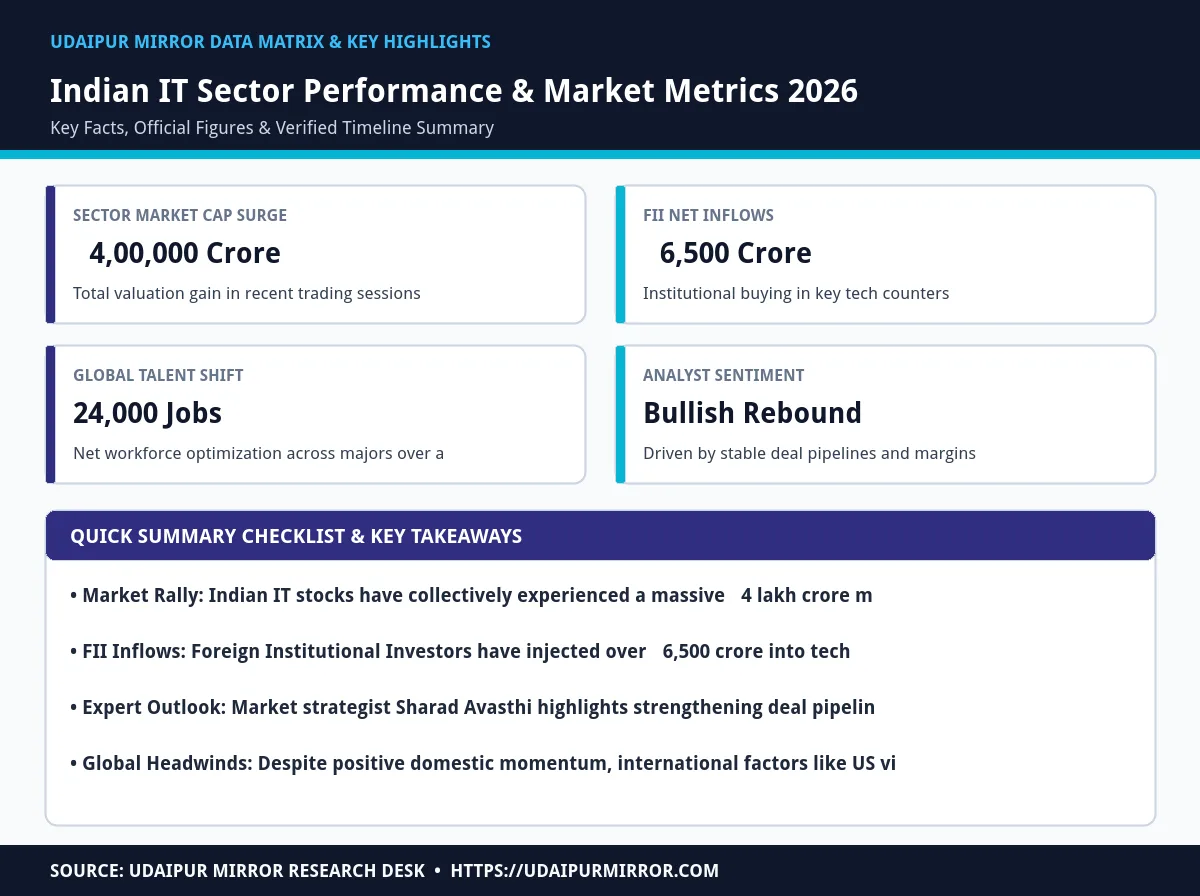
A comprehensive comparative breakdown of India’s leading technology services providers, highlighting their current market positioning, recent valuation trends, and expert growth projections for late 2026.
| Company Name | Primary Focus | Market Sentiment | Key Growth Driver |
|---|---|---|---|
| Tata Consultancy Services (TCS) | Enterprise IT & Cloud | Positive / Accumulate | Large-scale digital transformation deals |
| Infosys | Digital Services & AI | Strong Outperformer | Accelerated adoption of proprietary AI platforms |
| Wipro | Consulting & Infrastructure | Cautiously Optimistic | Margin improvement & targeted acquisitions |
| Tech Mahindra | Telecom & Engineering R&D | Recovery Phase | 5G infrastructure rollout & enterprise networks |
Market expert Sharad Avasthi’s detailed breakdown of front-line IT stocks provides clarity for retail and institutional investors navigating the current market environment. According to Avasthi, TCS and Infosys continue to serve as defensive pillars with resilient cash flows and high-margin deal wins, making them prime candidates for sustained outperformance. Wipro and Tech Mahindra, on the other hand, offer attractive turnaround plays as their operational restructuring and cost-optimization initiatives begin to bear fruit.
While evaluating these traditional tech giants, market watchers are also keeping a close eye on emerging technology listings and capital market movements. The strong appetite for tech-enabled businesses is evident across the broader financial ecosystem, reminiscent of how recent public offerings like the telecom and digital services IPOs captured massive institutional and retail demand on Day 1, demonstrating enduring investor liquidity in the tech domain.
“Investors should adopt a selective, bottom-up approach. While Tier-1 players offer stability, certain mid-tier and restructured large-caps present high-beta opportunities for the upcoming quarters.” — Sharad Avasthi
Even as stock valuations rebound, the operational landscape of India’s IT and engineering services sector is undergoing a profound structural transformation. Recent industry data reveals that software majors have cumulatively reduced their headcount by approximately 24,000 jobs over the past year. This strategic adjustment reflects a broader shift toward automation, generative artificial intelligence integration, and heightened productivity per employee rather than sheer headcount expansion.
Companies are increasingly relying on advanced artificial intelligence tools to handle routine coding, testing, and maintenance tasks. This technological leap allows firms to scale revenues without a linear increase in workforce size. While this creates short-term anxieties regarding fresh engineering campus hiring, it fundamentally enhances operating margins and profitability—a key metric that institutional investors closely monitor when evaluating medium-term stock appreciation potential. (Also read: Jio Platforms IPO Subscribed 3.03 Times on Day 1: QIB Demand Surges 9x as GMP Hits Rs 261).
No evaluation of Indian IT stocks is complete without examining external regulatory and macroeconomic risks. Recent developments in the United States, such as the temporary freeze on PERM labor certifications impacting several tech firms, introduce operational friction regarding the permanent hiring and deployment of foreign nationals. Such regulatory hurdles necessitate agile workforce planning and greater reliance on local hiring within Western markets.
Despite these overseas hurdles, Indian IT enterprises have successfully weathered similar regulatory storms in the past. Their robust distributed delivery model, combined with deep domain expertise across banking, healthcare, retail, and manufacturing, ensures that core client relationships remain insulated from short-term policy turbulence.
As the market weighs whether IT stocks are set for more gains, financial advisors recommend a disciplined, staggered investment strategy. Investors should avoid chasing short-term momentum blindly and instead focus on companies with strong balance sheets, consistent dividend payouts, and clear roadmaps for artificial intelligence monetization. The transition from legacy outsourcing to high-value digital consulting will likely separate the market leaders from the laggards in the coming financial year.
Ultimately, the current market recovery underscores the enduring strength of India’s technology sector. With institutional capital flowing back and operational efficiencies paying off, disciplined investors who position themselves wisely across established large-caps and nimble turnaround candidates stand to benefit as the sectoral upswing matures.
Yes, Indian IT stocks have recently witnessed a massive ₹4 lakh crore sectoral rally accompanied by over ₹6,500 crore in FII net buying, signaling a strong market comeback.
Sharad Avasthi maintains a positive outlook on frontline IT giants like Infosys and TCS, citing strong deal pipelines, resilient cash flows, and margin stabilization.
The reduction in workforce is part of a strategic shift toward automation, generative AI integration, and improved operational productivity rather than labor-intensive scaling.
Recent US measures, including the PERM labor certification freeze, restrict permanent hiring of foreign nationals, prompting Indian tech firms to rely more heavily on local hiring in Western markets.
Add Udaipur Mirror as a preferred source on Google to see more of our travel guides in your AI overviews.