Office Address
14, Residency Road, Udaipur, Rajasthan 313001
Office Address
14, Residency Road, Udaipur, Rajasthan 313001


NEW DELHI: NEW DELHI — As global geopolitics undergoes a fundamental realignment, the diplomatic architecture underpinning india-poland ties has entered a transformative phase. Grounded in a rich history of mutual respect and shared democratic values, New Delhi and Warsaw are increasingly looking beyond traditional trade boundaries to forge robust partnerships in advanced manufacturing, digital infrastructure, and renewable energy. This strategic convergence comes at a critical juncture when international markets are recalibrating supply chains to enhance economic resilience. For Indian investors and policymakers alike, the renewed focus on Central European markets offers unprecedented avenues for bilateral collaboration, creating a balanced counterweight to broader macroeconomic uncertainties that have recently impacted domestic equities, such as the downturn witnessed in Top 10 Firms Lose Rs 1.56 Trillion In Market Value; HDFC Bank, Bajaj Finance Lead Decline.
⚡ Quick Highlights: India-Poland Ties: New Avenues in Strategic & Economic Growth
The diplomatic ties between India and Poland date back formally to 1954, though cultural and academic exchanges stretch much further back in time. During challenging historical periods, Poland maintained steady diplomatic and economic engagement with New Delhi, establishing a bedrock of trust that has survived numerous global realignments. Today, as both nations navigate a complex multipolar world, this historical goodwill serves as an invaluable asset. Policymakers in both capitals recognize that contemporary geopolitical stability requires not just diplomatic dialogue, but deep-seated economic interdependencies.
Furthermore, Warsaw’s strategic geographical position within Central Europe makes it an indispensable gateway for Indian enterprises seeking broader market access across the European Union. Conversely, India’s expansive domestic market and robust startup ecosystem present Polish firms with lucrative avenues for diversification and technological collaboration. (Also read: IT Sector Q2 Results Preview: TCS, HCL, Infosys, Wipro To See Muted Quarter).
“Our historical friendship provides a resilient foundation upon which we are building advanced economic, technological, and defense partnerships for the 21st century.” — Senior Ministry of External Affairs Official
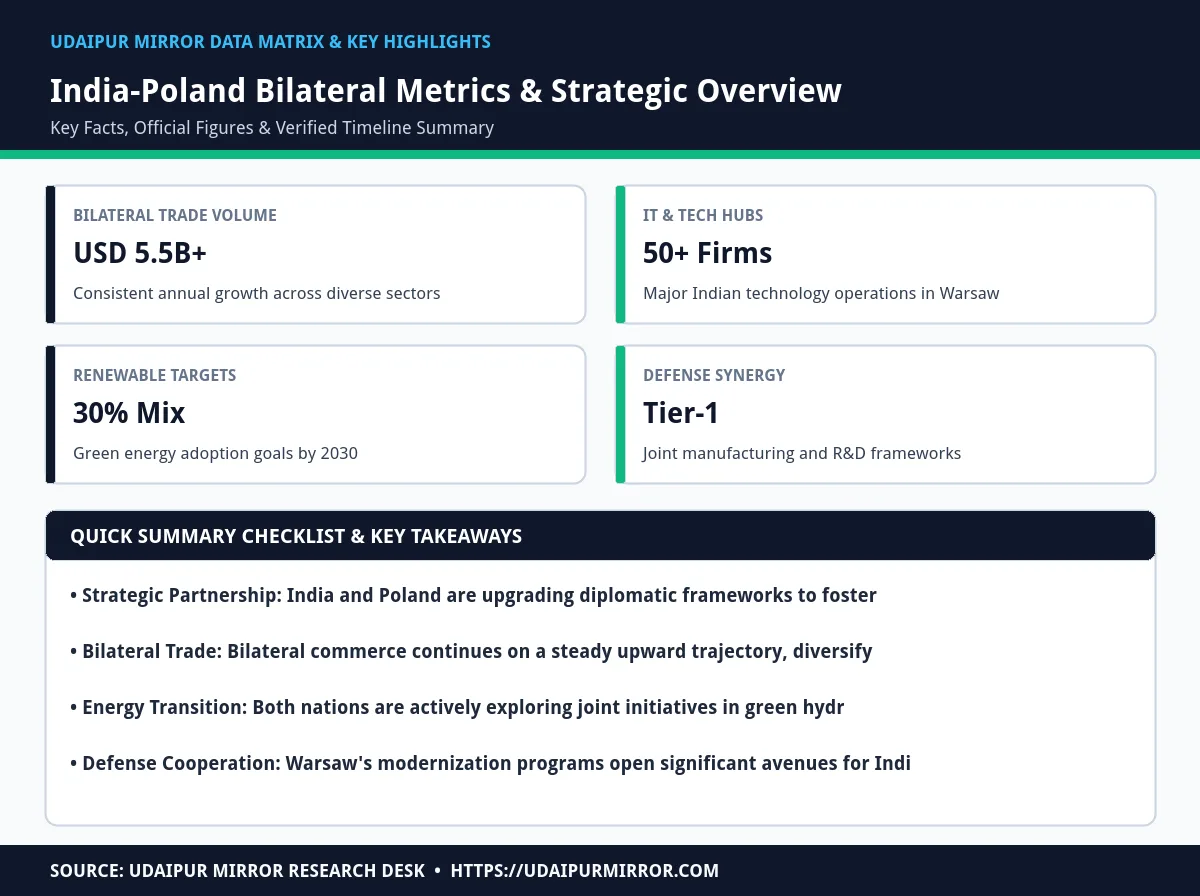
The multi-dimensional partnership between New Delhi and Warsaw spans several critical sectors, driving mutual economic growth and technological exchange across diverse industrial landscapes.
| Sector | Focus Area | Current Status | Future Outlook |
|---|---|---|---|
| Information Technology | Software & Engineering | Established hubs in Warsaw & Krakow | High expansion backed by IT Sector Q2 Results Preview trends |
| Green Energy | Solar & Wind Integration | Bilateral R&D agreements signed | Massive investments expected in smart grids |
| Defense & Aerospace | Equipment Modernization | Joint defense committee active | Co-production of tactical hardware |
| Agriculture & Food | Agri-Tech & Processing | Export protocols streamlined | Cold-chain infrastructure integration |
| Higher Education | Student & Faculty Exchange | Growing university partnerships | Increased STEM research fellowships |
Economic engagement between India and Poland has witnessed remarkable diversification over the past decade. While bilateral trade historically centered around traditional commodities, recent years have seen a massive surge in high-value sectors such as pharmaceutical exports, automobile components, and digital engineering services. Indian conglomerates have established substantial manufacturing and shared service facilities across Polish industrial zones, creating thousands of local jobs and cementing long-term commercial confidence.
Simultaneously, Poland’s competitive manufacturing sector and advanced engineering capabilities align seamlessly with India’s ‘Make in India’ initiative. As global supply chains undergo structural shifts to mitigate concentration risks, both nations are actively working to streamline trade barriers, reduce regulatory friction, and facilitate smoother capital flows between financial institutions.
“Bilateral trade figures reflect a maturing economic partnership that is increasingly resistant to external macroeconomic shocks.” — Bilateral Trade Council Representative
The technological axis between New Delhi and Warsaw has become one of the most dynamic components of their bilateral relationship. Leading Indian IT enterprises have set up expansive software development centers in Polish cities, utilizing the country’s highly skilled technical talent pool. This digital synergy enhances software delivery capabilities across Europe while simultaneously fostering collaborative research in artificial intelligence, cybersecurity, and cloud computing infrastructure.
In parallel, the imperative of climate action has propelled green energy to the forefront of bilateral agendas. Both countries face unique decarbonization challenges and are actively investing in renewable generation capacity, grid modernization, and green hydrogen technologies. Collaborative ventures in clean energy research are expected to accelerate as both nations prepare for upcoming global climate summits and transition milestones. (Also read: Top 10 Firms Lose Rs 1.56 Trillion In Market Value; HDFC Bank, Bajaj Finance Lead Decline).
“Technology and green transition are the twin engines driving our future cooperation, offering scalable solutions for global sustainability.” — Joint Technological Taskforce Lead
Beyond commerce and technology, strategic defense collaboration has emerged as a cornerstone of modern india-poland ties. With Poland undergoing significant military modernization and capability enhancement, Indian defense manufacturing companies—bolstered by indigenous technological advancements—are increasingly viewed as reliable, cost-effective partners. Joint military exercises, defense industrial dialogues, and counter-terrorism cooperation further solidify this security partnership.
On multilateral platforms, both nations share a commitment to upholding a rules-based international order, maritime security, and multilateralism. Their coordinated stances on regional stability in Europe and the Indo-Pacific underscore a shared strategic worldview that values national sovereignty, territorial integrity, and peaceful dispute resolution.
“Our defense partnership is built on shared security perceptions and a mutual desire to enhance strategic autonomy through robust domestic manufacturing.” — Defense Analyst, New Delhi
The core focus areas include information technology, green energy transition, advanced manufacturing, defense cooperation, and academic exchanges.
Poland’s central geographical location within Europe and its EU membership make it an ideal logistical and commercial hub for Indian companies expanding into Western and Central European markets.
Leading Indian IT firms have established major software development and engineering centers in Polish cities like Warsaw and Krakow, employing local talent and driving digital transformation across Europe.
Yes, both nations are actively cooperating in green hydrogen research, smart grid development, and solar energy infrastructure to meet ambitious climate targets.
Add Udaipur Mirror as a preferred source on Google to see more of our travel guides in your AI overviews.