Office Address
14, Residency Road, Udaipur, Rajasthan 313001
Office Address
14, Residency Road, Udaipur, Rajasthan 313001


JAIPUR: JAIPUR — In a major milestone for corporate sustainability and telecom infrastructure, Indus Towers solar power deployment has officially scaled to 300 MW across 50,000 telecom sites. Announced on Wednesday, November 4, 2026, this strategic green transition highlights Rajasthan’s pivotal role as India’s leading renewable energy hub. By shifting vast numbers of remote and urban communication towers to photovoltaic energy, the initiative drastically cuts down diesel dependence while stabilizing power costs for critical digital infrastructure across western India.
⚡ Quick Highlights: Indus Towers Adds 300 MW Solar Power Across 50k Sites
The integration of renewable energy into telecom infrastructure represents a paradigm shift in how digital connectivity is powered. Traditionally reliant on diesel generators during grid outages, telecom towers account for substantial fuel consumption, particularly in remote regions of Rajasthan. With this deployment, Indus Towers has demonstrated that green energy can be scaled effectively across vast geographies. Beyond environmental benefits, the project ensures uninterrupted network availability during peak summer months when grid fluctuations are most severe.
As citizens across the state benefit from stable telecom networks, infrastructural developments continue on multiple fronts. For instance, residents managing utility schedules often monitor local advisories, similar to how local communities track Udaipur power cut maintenance notices to plan their daily commercial activities around grid upgrades.
“Transitioning tens of thousands of telecom sites to solar power is a monumental step toward sustainable digital connectivity and lower carbon footprints.” — State Energy Analyst, Jaipur
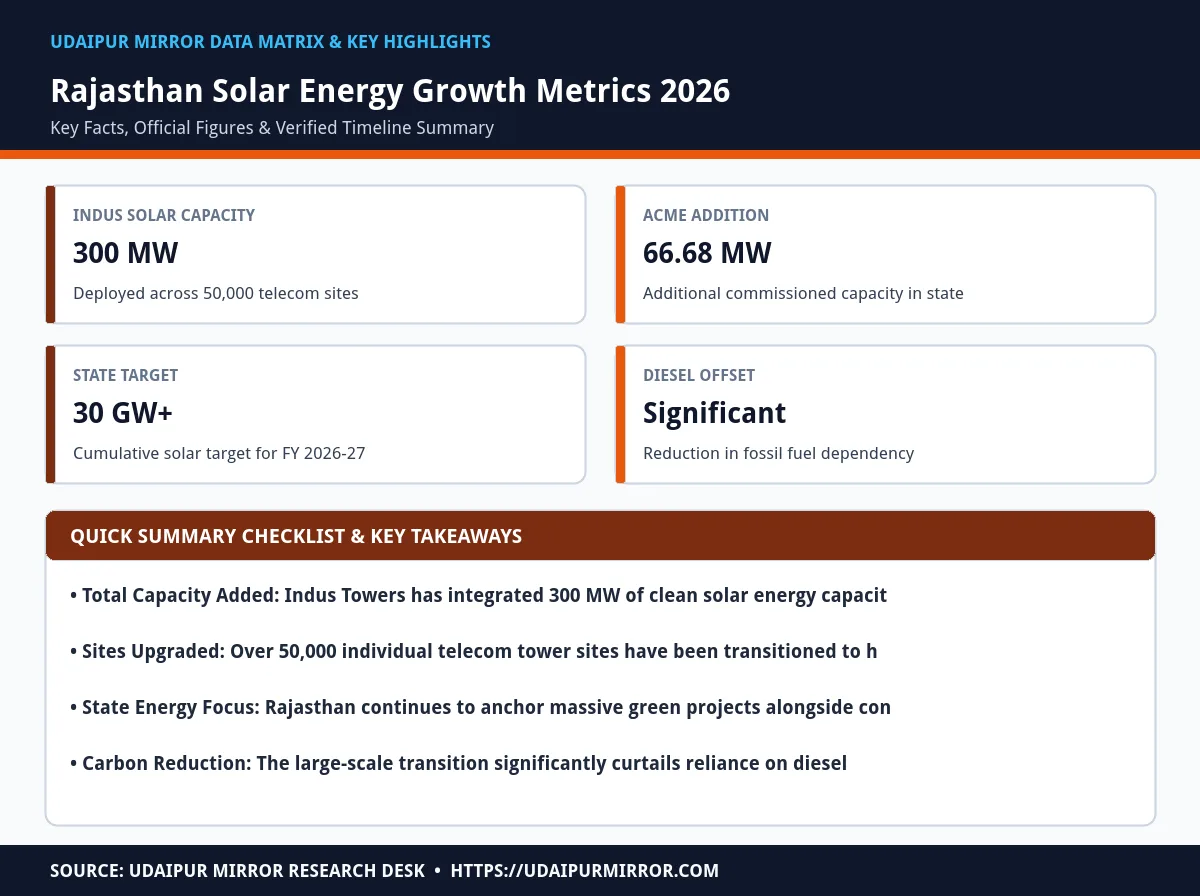
Rajasthan’s vast arid expanses and high solar irradiance make it the primary destination for large-scale photovoltaic deployments. The table below illustrates the distribution of major solar and green infrastructure additions across key districts as of November 2026.
| District | Project Type | Capacity Added | Primary Utility / Beneficiary |
|---|---|---|---|
| Jaipur | Telecom Green Towers | 85 MW Equivalent | Indus Towers & Regional Operators |
| Jodhpur | Utility & Commercial Solar | 120 MW | ACME Solar & State Grid |
| Jaisalmer | Large-Scale PV Farms | 95 MW | Independent Power Producers |
| Bikaner | Hybrid Solar Installations | 70 MW | Private Green Energy Developers |
| Udaipur | Urban Rooftop & Telecom | 45 MW | Local Grid & Tower Infrastructure |
The announcement by Indus Towers follows closely on the heels of other major renewable milestones in the region. Most notably, ACME Solar recently commissioned an additional 66.68 MW of capacity within Rajasthan, further solidifying the state’s status as India’s premier solar powerhouse. Energy experts note that Rajasthan’s favorable topography, abundant sunlight, and proactive state government policies have created an ideal ecosystem for green investments.
Financial prudence and long-term planning remain central to households and enterprises adapting to these shifts. Just as institutional investors evaluate green portfolios, everyday citizens routinely assess their financial security, mirroring long-term savings discussions such as understanding the average 401(k) balance by age for retirement planning in changing economic climates.
“Rajasthan is uniquely positioned to meet future energy demands through a balanced mix of utility-scale solar farms and decentralized rooftop installations.” — Renewable Energy Board Member
The widespread adoption of solar power by commercial enterprises and telecom operators delivers profound socio-economic dividends for Rajasthan. By decentralizing power generation and reducing stress on municipal grids, rural communities experience fewer voltage drops and more reliable electricity supplies. Furthermore, the green energy sector continues to generate thousands of specialized engineering and maintenance jobs across tier-2 and tier-3 cities.
Environmental analysts point out that eliminating thousands of liters of diesel combustion daily translates into cleaner air quality across fragile desert ecosystems. As state authorities continue to review major infrastructure projects alongside central initiatives, green compliance is rapidly becoming a core metric for corporate governance across India. (Also read: Average 401(k) Balance by Age: What You Need to Save From 20s to Retirement).
“Green energy adoption is no longer just an environmental goal; it is a fundamental pillar of economic resilience and operational efficiency.” — Environmental Policy Researcher
Indus Towers has successfully added 300 MW of solar power capacity across its network.
The solar power deployment spans across 50,000 telecom sites, primarily in regions including Rajasthan.
Rajasthan offers high solar irradiance, vast stretches of uncultivated land, and supportive state policies that encourage large-scale renewable investments.
It significantly reduces dependence on expensive and polluting diesel generators, lowers operating costs, and ensures stable power delivery in remote areas.
Add Udaipur Mirror as a preferred source on Google to see more of our travel guides in your AI overviews.






[…] Sitharaman Challenges Rahul Gandhi to Debate SIR and EVMs in Parliament 4 seconds ago ⚡ Articles Indus Towers Adds 300 MW Solar Power Across 50,000 Sites to Bolster Rajasthan Green Energy… Shreenathji Darshan Nathdwara Govardhan Puja 2026: Date, Sacred Legend, Pushtimarg Traditions and […]