Office Address
14, Residency Road, Udaipur, Rajasthan 313001
Office Address
14, Residency Road, Udaipur, Rajasthan 313001


NAGDA, UDAIPUR: Nestled quietly on the tranquil banks of Baghela Lake just 22 kilometers from Udaipur, the historic saas bahu temples nagda stand as magnificent testaments to Mewar’s glorious medieval past. Officially known as the Sahasra Bahu temples, this 10th-century architectural marvel draws history buffs, spiritual seekers, and architectural enthusiasts from across the globe who wish to witness the pinnacle of the classical Maru-Gurjara temple-building tradition.
⚡ Quick Highlights: Saas Bahu Temples Nagda Guide 2026: Timings, History & Tickets
The popular local nomenclature of these 10th-century shrines as the ‘Saas-Bahu’ (Mother-in-law and Daughter-in-law) temples is a fascinating linguistic and cultural evolution. Originally consecrated as the Sahasra Bahu temples—dedicating the sacred space to Lord Vishnu, who is described as having a thousand arms (*Sahasra-Bahu*)—the complex underwent a phonetic transformation over centuries of oral folklore. Local villagers and vernacular speakers gradually shortened the grand Sanskrit descriptor into the much more colloquial and relatable ‘Saas-Bahu’ moniker.
While popular folklore often spins imaginative tales about a mother-in-law and daughter-in-law commissioning two separate contrasting shrines, epigraphical evidence and architectural studies confirm that both structures were commissioned simultaneously by King Mahadeva of the Guhila dynasty in the late 10th century. The larger shrine honors Vishnu in his cosmic form, while the smaller adjacent temple serves as its architectural counterpart, creating a harmonious dual complex that continues to inspire awe. For spiritual travelers exploring the region, discovering such heritage sites offers a profound look into Mewar’s rich past, much like visiting other sacred retreats such as the Gupteshwar Mahadev Udaipur Guide which highlights ancient mountain and cave shrines.
“The linguistic shift from Sahasra-Bahu to Saas-Bahu reflects how ancient monuments absorb local folklore while retaining their core sacred identity.” — Senior Mewar Heritage Historian
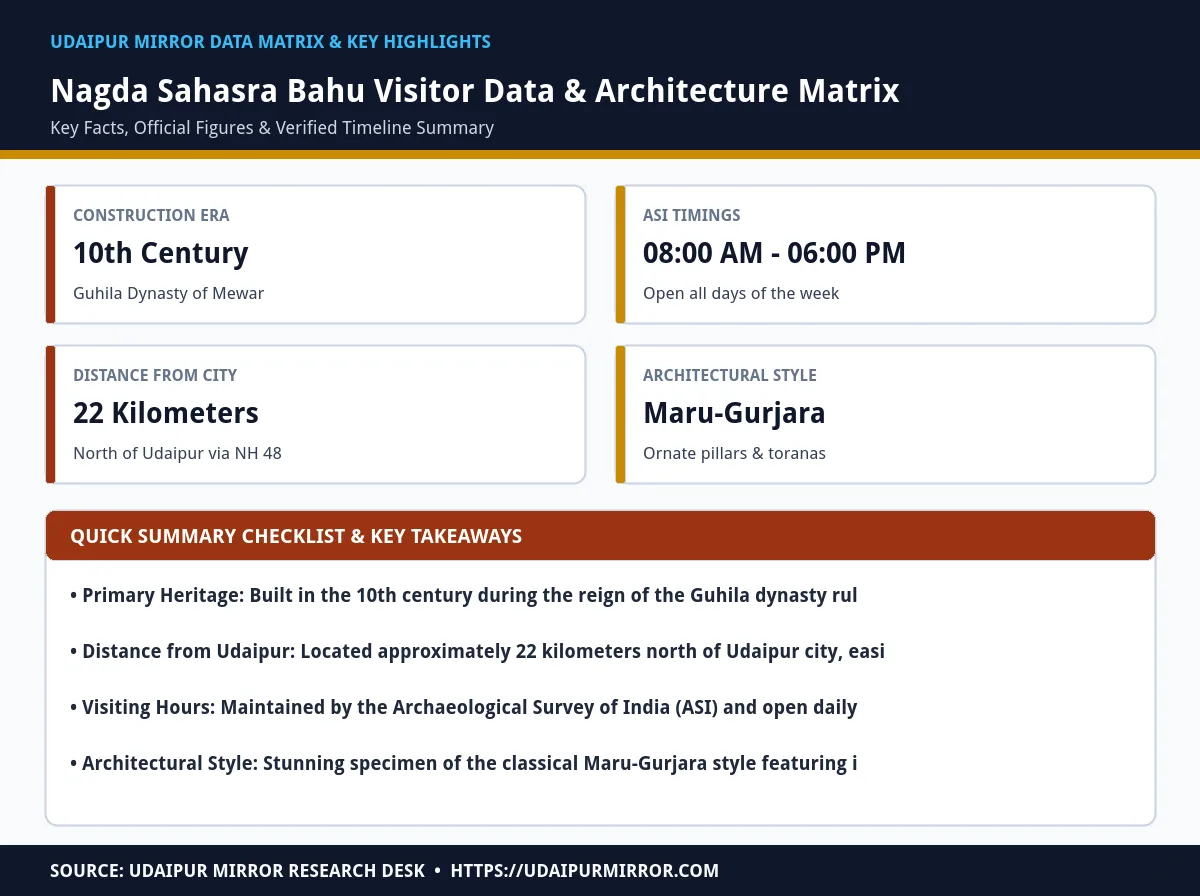
Planning your heritage excursion to the historic site requires practical knowledge of schedules, ticket costs, and connectivity. Review the structured visitor matrix below before embarking on your journey from Udaipur.
| Parameter | Details & Specifications | Visitor Guidelines | Applicable Fees |
|---|---|---|---|
| Temple Name | Sahasra Bahu (Saas-Bahu) Temples | Maintained as protected monument | None |
| Visiting Hours | 08:00 AM to 06:00 PM | Open daily throughout the year | Included in entry |
| Entry Ticket | Nominal ASI Monument Fee | ₹25 for Indian citizens, ₹300 for foreigners | Paid at gate |
| Best Time to Visit | October to March (Winter months) | Ideal for photography and exploration | Free access |
| Travel Distance | 22 km from Udaipur city center | Accessible via taxi, auto, or personal car | Varies by transport |
Architecturally, the Nagda twin temples represent an absolute masterpiece of the classical Maru-Gurjara architectural style, which flourished in western India under various royal dynasties. The structures showcase sophisticated multi-layered masonry, exquisite vertical projections, and a breathtaking abundance of sculptural detailing that covers nearly every square inch of the exterior walls and interior columns.
The complex features magnificently sculpted *torana* gateway arches adorned with celestial figures, floral scrolls, and miniature shrines. The open *mandapa* pillars are marvels of engineering and artistic design, featuring lathe-turned bell motifs and intricate brackets depicting divine musicians and dancers. Visitors can also explore other prominent regional pilgrimage landmarks during their tour, such as the famous sacred site detailed in the Charbhuja Ji Temple Garhbor Guide which showcases similar classical architectural grandeur.
“Every pillar and bracket at Nagda tells a silent story of master stonemasons who transformed cold rock into living poetry.” — ASI Conservation Architect
Stepping inside the main sanctum reveals one of the most stunning features of the Saas-Bahu temples: the intricately carved ceiling panels. These domed ceilings are composed of concentric rings of stone blocks, delicately interlocked without mortar, displaying marvelous geometric patterns and deeply symbolic iconography. Prominent panels depict the Hindu triumvirate—Brahma the creator, Shiva the destroyer, and Vishnu the preserver—surrounded by celestial nymphs (*apsaras*) and flying vidyadharas.
Furthermore, the outer walls and plinth bands function as a stone canvas narrating episodes from the great epic *Ramayana*. Panels vividly depict Rama’s exile, encounters in the forest, and tactical episodes from the epic war in Lanka. The precision of these low-relief sculptures highlights the advanced anatomical understanding and narrative mastery of 10th-century Mewari artisans. (Also read: Charbhuja Ji Temple Garhbor Guide 2026: Darshan Timings, History & Jaljhulani Fair).
“The corbelled dome ceilings at Nagda are engineering miracles that capture the cosmos in stone.” — Ancient Indian Art Historian
The Saas-Bahu temples at Nagda are meticulously preserved as a protected national monument by the Archaeological Survey of India (ASI). The site is open to the public every day of the week from 08:00 AM to 06:00 PM, giving travelers ample time to enjoy the changing angles of sunlight across the yellow sandstone architecture.
Entry tickets are nominally priced at ₹25 for Indian citizens and ₹300 for foreign nationals, with free entry permitted for children below 15 years of age. To make the most of your excursion, combine your visit to Nagda with a divine darshan at the neighboring Eklingji Temple located just a few kilometers away, completing a spiritually rewarding heritage circuit in northern Mewar.
“A morning visit between 8 AM and 10 AM offers the best natural lighting for architectural photography at Nagda.” — Heritage Tourism Expert
The temples are maintained by the ASI and are open to visitors every day from 08:00 AM to 06:00 PM.
The ASI entry ticket is ₹25 for Indian citizens and ₹300 for foreign nationals. Children under 15 enter free.
They were originally named ‘Sahasra-Bahu’ (describing Vishnu with a thousand arms). Over centuries, local folklore and oral pronunciation transformed the name into ‘Saas-Bahu’.
Yes, Nagda is located just a few kilometers from Eklingji, making it convenient to combine both spiritual sites into a single morning trip from Udaipur.
Add Udaipur Mirror as a preferred source on Google to see more of our travel guides in your AI overviews.