Office Address
14, Residency Road, Udaipur, Rajasthan 313001
Office Address
14, Residency Road, Udaipur, Rajasthan 313001

NEW DELHI: NEW DELHI — Union Minister for Commerce and Industry Piyush Goyal held high-level discussions with senior leadership from Skoda Auto Volkswagen India to deliberate on accelerating skoda auto ev manufacturing, expanding domestic component supply chains, and positioning India as an export powerhouse for sustainable clean mobility solutions.
⚡ Quick Highlights: Goyal & Skoda Auto Discuss EV Manufacturing & Localisation in India
In a decisive push toward sustainable transportation, Union Minister Piyush Goyal met with top executives of Skoda Auto Volkswagen India to map out the future of electric vehicle production in the country. The deliberations underscored the government’s commitment to transforming India into a global manufacturing epicenter. As market dynamics shift rapidly, industry leaders are aggressively scaling up infrastructure to meet surging consumer demand across urban and semi-urban centers.
The strategic dialogue highlighted the necessity of building robust supply chains that can withstand global headwinds. Market observers point out that robust sales performance across brands—such as Tata Motors Keeps Mahindra in Rearview as EV Sales Drive Passenger Vehicle Lead—demonstrates the massive appetite for electric passenger vehicles in India today.
“Deep localization of electric vehicle components is no longer optional; it is the cornerstone of making sustainable mobility accessible to every Indian household.” — Automotive Industry Analyst
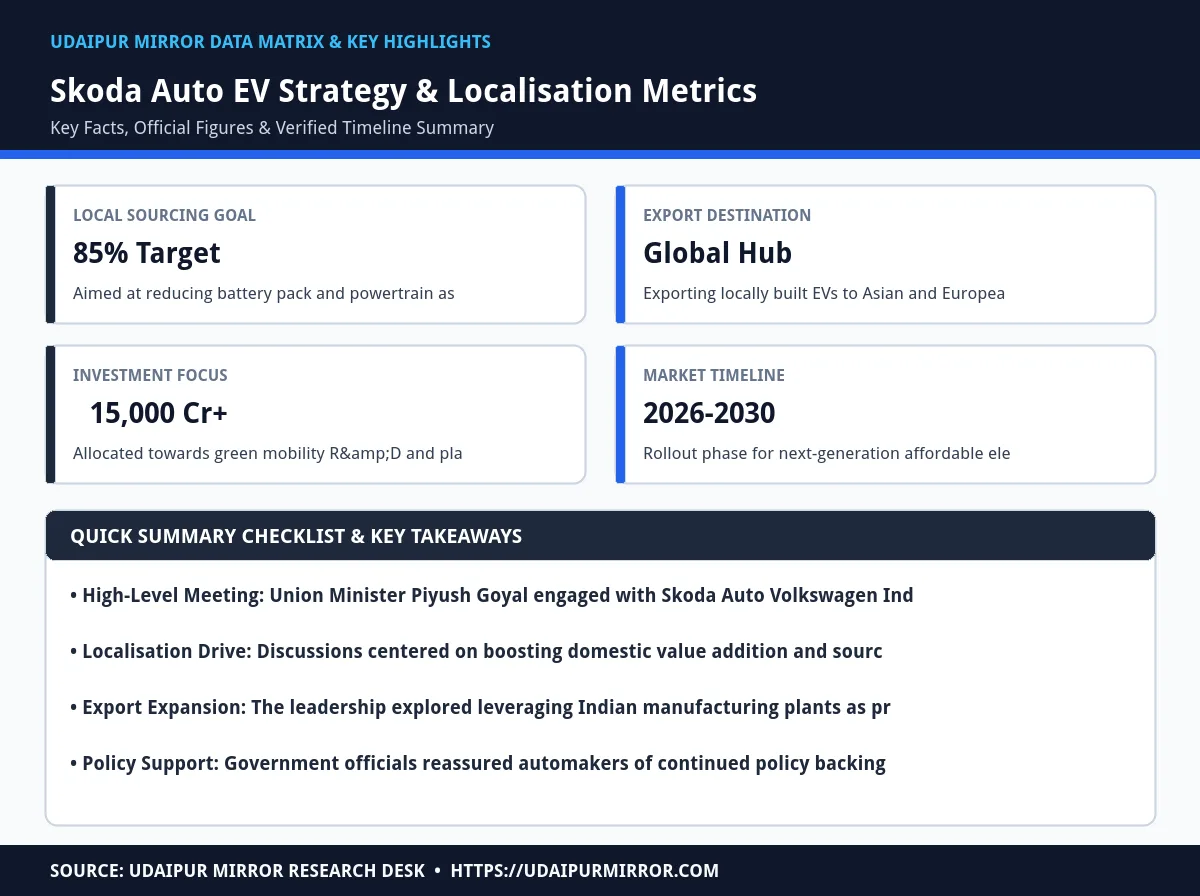
A detailed breakdown of strategic focus areas, localization targets, and projected manufacturing outputs discussed during the ministerial meeting.
| Focus Area | Strategic Objective | Localisation Target | Projected Timeline |
|---|---|---|---|
| Battery Assembly | In-house cell and pack integration | 75% Domestic | 2026-2027 |
| Powertrain Development | Cost-effective electric motors | 80% Domestic | 2027 |
| Export Operations | Supplying right-hand and left-hand drive EVs | Global Reach | Ongoing |
| Supply Chain | Tier-1 vendor ecosystem integration | 90% Domestic | 2028 |
| R&D Infrastructure | Testing facilities in Maharashtra & Pune | 100% In-house | Active |
A core focus of the meeting between Goyal and Skoda Auto executives was the critical need to deepen component localization. Importing critical parts has historically impacted profit margins and final retail pricing. By fostering domestic vendor ecosystems for battery management systems, power electronics, and thermal management units, automakers aim to achieve aggressive cost parity with internal combustion engine counterparts.
Furthermore, enhanced domestic manufacturing complements broader segment trends where competitors like MG Tomahawk EV Sales Triple As Electric Vehicles Dominate Brand Portfolio In India, signaling a nationwide consumer pivot toward electrified personal transport.
“Our partnership with Indian suppliers ensures that world-class electric vehicles are engineered with local resilience and cost-efficiency at their core.” — Skoda Auto Volkswagen India Leadership
Beyond serving the domestic market, the discussions emphasized positioning India as a primary export hub. Skoda Auto Volkswagen India’s manufacturing facilities are slated to increase shipments of India-engineered electric and hybrid models to international markets across Southeast Asia, the Middle East, and parts of Europe.
This export-oriented approach aligns seamlessly with ongoing product pipelines, such as the upcoming line-up detailed in 10 New Electric Cars Launching in India Over Next Year: From Hyundai IONIQ P to BYD Seal 07, proving that Indian manufacturing plants are equipped to meet stringent global quality and safety benchmarks.
“Made-in-India electric vehicles are proving their mettle on global stages, combining German engineering standards with Indian manufacturing agility.” — Senior Export Strategy Consultant
While manufacturing outlooks remain exceptionally bullish, industry bodies have raised valid concerns regarding dealer network sustainability. Recent reports highlight that retail partners often face tight operational margins during initial EV transition phases. Addressing these financial viability metrics is vital to ensuring that dealership networks remain enthusiastic and well-equipped to support EV buyers with after-sales service and charging guidance.
Collaborative dialogues between government ministries and automotive giants are expected to formulate supportive frameworks that balance manufacturer investments with retail dealer profitability, ensuring a frictionless consumer buying experience.
“Sustainable dealership ecosystems are the backbone of EV adoption; protecting retail margins ensures long-term market confidence.” — Automobile Retail Federation Representative
The meeting focused on accelerating electric vehicle manufacturing, deepening local component sourcing, and expanding India-based export operations.
Deep localization helps reduce reliance on imported battery packs and powertrains, lowering production costs and making EVs more affordable for retail buyers.
Yes, the discussions emphasized leveraging Indian manufacturing plants as export hubs to supply electric and hybrid vehicles to international markets.
It reinforces government backing for green mobility, encourages robust supplier ecosystems, and accelerates the transition toward sustainable mass-market transport.
Add Udaipur Mirror as a preferred source on Google to see more of our travel guides in your AI overviews.