Office Address
14, Residency Road, Udaipur, Rajasthan 313001
Office Address
14, Residency Road, Udaipur, Rajasthan 313001


UDAIPUR: UDAIPUR — Deep within the culinary annals of the royal kitchens of Mewar lies a dish that elevates humble peasant ingredients into a majestic culinary masterpiece. The royal govind gatta of mewar stands apart from standard Rajasthani preparations by replacing plain gram flour logs with decadent, luxury-stuffed dumplings that reflect the opulent banquets hosted by the Maharanas of Udaipur. Unlike everyday gatta curry found across the state, this celebratory version demands meticulous craftsmanship, marrying sweet khoya with crunchy dry fruits, encased in a velvety, onion-free yogurt gravy fragrant with whole aromatic spices.
⚡ Quick Highlights: Royal Govind Gatta of Mewar: Palace Recipe & Mawa Dumplings
The history of Govind Gatta is deeply intertwined with the royal court of Udaipur. Unlike the arid desert regions of western Rajasthan where water scarcity dictated dry, long-shelf-life culinary creations, the fertile valleys of Mewar allowed royal bawarchis (master chefs) to experiment with dairy-rich ingredients. Khoya, fresh cream, and pure ghee were staples in the royal household, used to temper fiery desert spices and create harmonious, balanced flavor profiles.
When historic state banquets hosted visiting dignitaries and neighboring royals, ordinary dishes were deemed insufficient. The royal chefs engineered Govind Gatta by taking the traditional gram flour gatta and transforming it into a surprise-filled delicacy. Cutting into the dumpling revealed a rich core of sweetened mawa and crushed nuts, a culinary magic trick that delighted guests. Travelers exploring historic trails around Jaisamand Lake and Dhebar Dam often encountered similar royal hospitality where dairy and dry fruits dominated local feasts.
“In the royal kitchens of Udaipur, food was not merely sustenance; it was an expression of art, statecraft, and deep cultural heritage.” — Mewar Culinary Historian
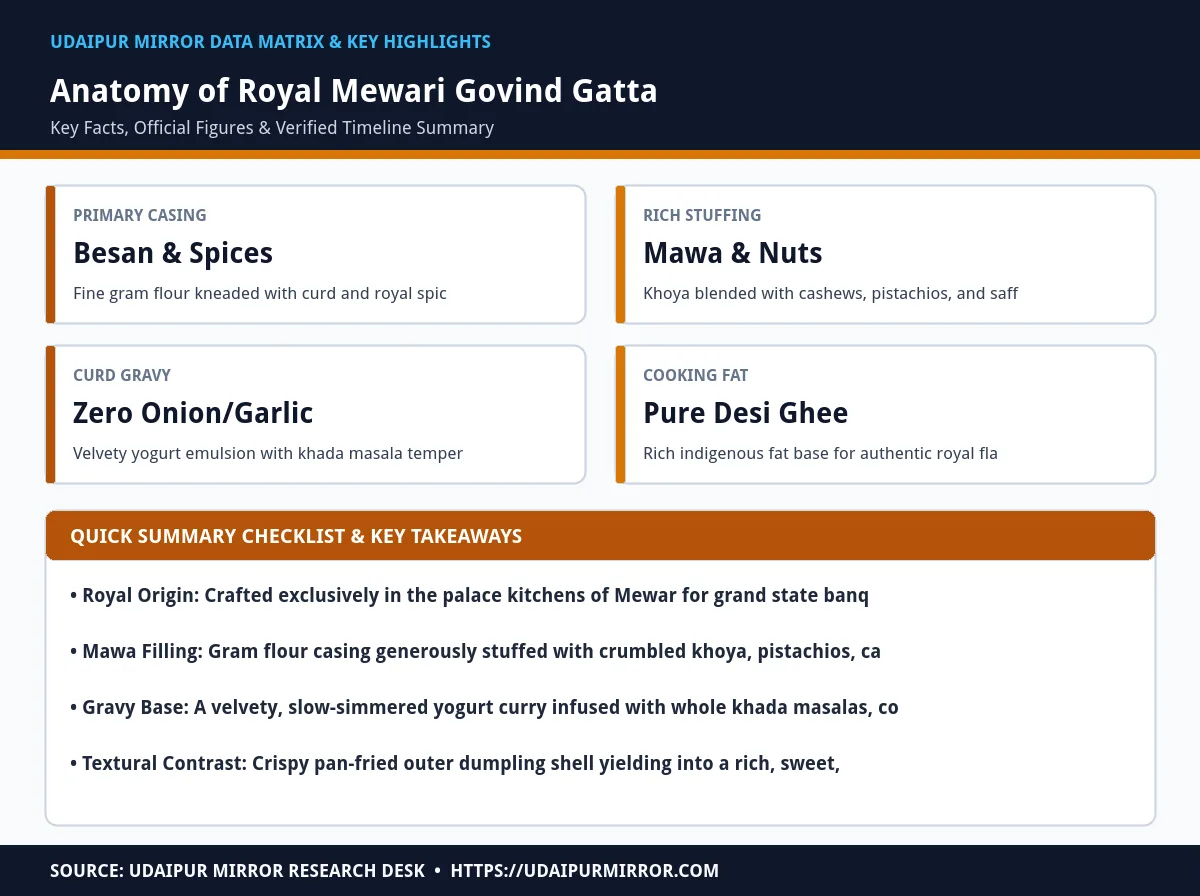
While everyday Rajasthani gatta utilizes simple boiled besan logs sliced into rounds, the royal Mewari version is a labor-intensive delicacy characterized by distinct textural and flavor profiles tailored for aristocratic palates.
| Culinary Attribute | Ordinary Rajasthani Gatta | Royal Mewari Govind Gatta | Primary Purpose |
|---|---|---|---|
| Filling / Stuffing | None (solid plain besan dough) | Crumbled mawa, pistachios, cashews | Adds richness and luxurious texture |
| Gravy Foundation | Tomato-onion or thin curd base | Thick, velvety yogurt without onion/garlic | Preserves traditional temple and palace style |
| Cooking Technique | Boiled directly in water or thin gravy | Stuffed, lightly pan-fried in ghee, then simmered | Ensures structural integrity and crispness |
| Spice Profile | Pungent garlic and onion heavy | Subtle khada masala, fennel, and saffron | Highlights delicate sweetness of mawa |
| Occasion & Heritage | Daily household meal across Rajasthan | State banquets of Mewar maharanas | Celebratory and seasonal royal fare |
To the untrained eye, all gatta curries might appear similar, but culinary purists recognize a vast divide between street-style gattas and the royal variant. Standard Rajasthani gatta involves mixing besan with water, carom seeds, and chili powder, rolling it into cylindrical logs, boiling them, and slicing them into bite-sized pieces for a tangy tomato-onion gravy.
Conversely, Govind Gatta requires flattening seasoned besan dough into palm-sized discs, placing a precise dollop of rich mawa-nut filling in the center, sealing the edges securely, and gently poaching or pan-frying them in desi A2 bilona cow ghee. This stuffing creates a stunning contrast: the savory, spiced outer gram flour shell gives way to a decadent, sweet-and-nutty center that balances the tanginess of the yogurt curry.
“The genius of Govind Gatta lies in the sudden burst of rich mawa and saffron within a savory, spiced curd curry.” — Master Chef, Udaipur Heritage Kitchens
Traditional Mewari palace cooking—heavily influenced by Vaishnavite traditions prevalent in temples across Udaipur—frequently avoided root vegetables like onions and garlic. Instead of relying on alliums to build body and aroma in the gravy, Mewari chefs mastered the delicate art of emulsifying full-fat yogurt with whole khada masalas and aromatic spice powders.
The gravy begins with a tempering of cloves, green cardamom, cinnamon sticks, bay leaves, and cumin seeds crackling in hot ghee. Whisked sour curd is introduced slowly over low heat, accompanied by continuous stirring to prevent curdling. Coriander powder, turmeric, and Kashmiri red chili powder are folded in, creating a rich orange-hued velvet sauce that coats the back of a ladle. The stuffed gattas are gently submerged into this simmering gravy just before serving, absorbing the complex aromatics without losing their structural integrity. (Also read: Jaisamand Lake & Dhebar Dam Udaipur Guide 2026: Boating & Royal History).
“Eliminating onion and garlic forces the chef to extract deep flavors purely from whole spices, slow-churned curd, and unadulterated ghee.” — Traditional Mewari Cook
Recreating this royal delicacy at home requires patience and precision. Begin by preparing the dough: sift fine gram flour (besan), add a pinch of salt, carom seeds (ajwain), red chili powder, and a tablespoon of ghee. Bind into a stiff dough using minimal water. For the filling, combine crumbled unsweetened mawa, finely chopped cashews, pistachios, raisins, a pinch of cardamom powder, and saffron strands.
Divide the besan dough into equal portions, flatten each into a disc, place a spoonful of the mawa filling in the center, and bring the edges together to seal completely into smooth oval dumplings. Poach these dumplings in boiling water for 10-12 minutes until they float, indicating they are cooked through. Remove, let them cool, and lightly pan-fry them in ghee until golden. Finally, prepare your yogurt gravy, gently drop in the stuffed gattas, simmer for five minutes, and garnish with fresh coriander and slivered almonds.
“Precision in sealing the gattas ensures the rich mawa stays locked inside where it belongs, enriching every single bite.” — Udaipur Culinary Institute Instructor
Royal Govind Gatta is a traditional celebration curry from Udaipur, featuring gram flour dumplings stuffed with sweet mawa, pistachios, and cashews, simmered in a rich, onion-free yogurt gravy.
Unlike ordinary gattas made of plain solid besan logs in a tomato-onion gravy, Govind Gatta features luxury mawa-and-nut stuffing, a velvety onion-free yogurt base, and a delicate blend of whole khada masalas.
Traditional Mewari royal and temple cuisine often avoided alliums like onion and garlic, relying instead on whole spices, slow-churned curd, and pure ghee to build deep, aromatic flavor profiles.
Yes. You can prepare and boil the stuffed gattas in advance, storing them refrigerated. Just before serving, pan-fry them lightly, warm the yogurt gravy, and simmer them together for a few minutes.
Add Udaipur Mirror as a preferred source on Google to see more of our travel guides in your AI overviews.






[…] | उच्च प्राथमिक शिक्षक भर्ती 6 hours ago ⚡ Articles Royal Govind Gatta of Mewar: Stuffed Mawa Dumplings, Rich Yogurt Gravy & Palace Origin… Articles Desi A2 Bilona Cow Ghee 2026: Traditional Curd Churning, Butyric Acid & […]