Office Address
14, Residency Road, Udaipur, Rajasthan 313001
Office Address
14, Residency Road, Udaipur, Rajasthan 313001

NEW DELHI: NEW DELHI — The mid-size SUV segment in India is witnessing an intense technological showdown as legacy names battle for supremacy with next-generation electrified powertrains. At the forefront of this evolution is the much-anticipated renault duster hybrid vs maruti suzuki victoris face-off, which sets new benchmarks for fuel efficiency, aggressive styling, and connected cabin features. Both utility vehicles target modern buyers seeking robust performance without compromising on eco-friendly metrics, making this clash one of the most critical automotive stories of late 2026.
⚡ Quick Highlights: Renault Duster Hybrid vs Maruti Victoris: Specs & Price
The design language adopted by both manufacturers reflects a bold departure from conventional boxy utility vehicles. The 2026 Renault Duster Hybrid retains its muscular heritage, featuring pronounced wheel arches, a sculpted clamshell bonnet, and a distinctive Y-shaped LED signature that gives it an imposing stance on highways. On the other hand, the Maruti Suzuki Victoris embraces a sleek, aerodynamic silhouette characterized by split LED headlamps, a piano-black cascading grille, and flush-fitting door handles that optimize aerodynamic efficiency.
Buyers transitioning from older hatchbacks or aging sedans will notice a dramatic elevation in road presence. For those contemplating an upgrade from legacy vehicles, you might find our guide on compact SUVs to buy when upgrading from your dependable Hyundai Santro quite insightful for dimensional comparisons. Both SUVs feature generous ground clearance exceeding 200mm, ensuring effortless passage over rough terrain and monsoon-flooded city streets across Rajasthan.
“The aesthetic direction of modern hybrid SUVs successfully merges rugged utility with futuristic aerodynamic styling.” — Chief Automotive Analyst, Udaipur Mirror
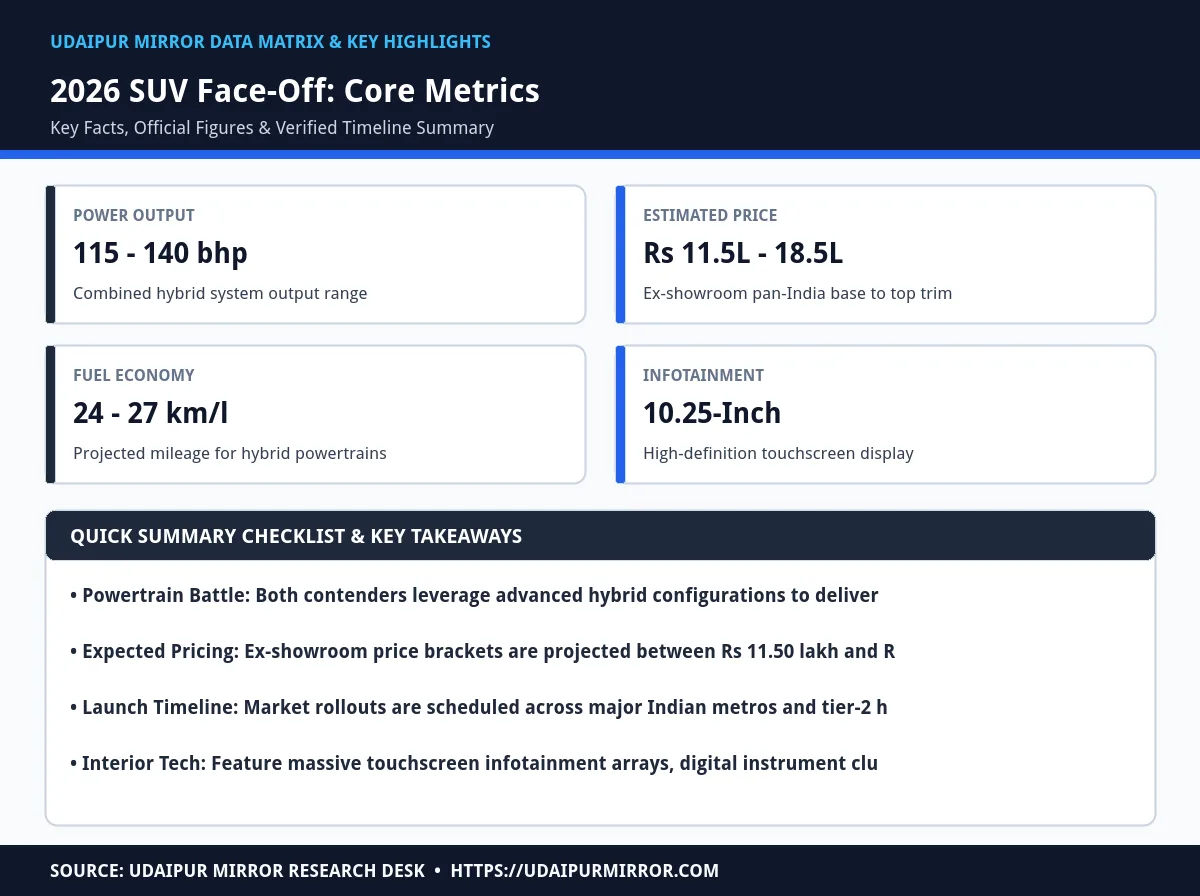
Review our structured technical matrix comparing engine options, transmission types, estimated ex-showroom pricing, and key comfort features across the respective lineups.
| Parameter | Renault Duster Hybrid (Base) | Renault Duster Hybrid (Top) | Maruti Suzuki Victoris (Base) | Maruti Suzuki Victoris (Top) |
|---|---|---|---|---|
| Engine Type | 1.5L Petrol + Mild-Hybrid | 1.6L Strong Hybrid E-Tech | 1.5L Smart Hybrid Petrol | 1.5L Intelligent Strong Hybrid |
| Transmission | 6-Speed Manual | Automatic Dedicated Hybrid | 5-Speed Manual / 6-Speed AT | e-CVT Automatic |
| Infotainment Screen | 8.0-Inch Touchscreen | 10.25-Inch HD Display | 7.0-Inch SmartPlay Unit | 10.1-Inch Floating SmartPlay |
| Safety Suite | Dual Airbags & ABS | Level-2 ADAS & 6 Airbags | Dual Airbags & Rear Sensors | Level-2 ADAS & 6 Airbags |
| Est. Ex-Showroom Price | Rs 11,50,000 | Rs 17,99,000 | Rs 11,20,000 | Rs 18,49,000 |
Step inside either cabin, and you are greeted by an eco-friendly yet premium ambiance utilizing sustainable dashboard materials, soft-touch leatherette elements, and ambient lighting strips. The Renault Duster Hybrid integrates a driver-focused cockpit anchored by a responsive 10.25-inch infotainment system supporting wireless Apple CarPlay and Android Auto. Meanwhile, the Maruti Suzuki Victoris emphasizes family-oriented ergonomics, offering ventilated front seats, panoramic sunroofs, and a massive 9-speaker premium audio setup.
While these internal combustion and hybrid architectures dominate the market today, future-focused buyers are also keeping an eye on upcoming pure-electric transitions. If you are tracking alternative EV rollouts in the broader ecosystem, refer to our recent briefing on the Hyundai Ioniq 1 EV debut expected in January 2027. Nevertheless, for immediate utility, the cabin packaging of both the Duster and Victoris provides ample legroom, dedicated rear AC vents, and multiple USB Type-C fast-charging ports for all occupants.
“Interior refinement in the mid-size segment has reached near-luxury standards, rivaling vehicles twice their price.” — Senior Product Specialist
Under the hood lies the most critical differentiator: the powertrain engineering. The Renault Duster Hybrid utilizes an innovative E-Tech multi-mode automatic gearbox paired with a responsive petrol engine and an electric motor, allowing the vehicle to operate on pure electric power for a significant portion of urban stop-and-go driving. This setup minimizes tailpipe emissions while offering instant torque delivery upon throttle input.
Conversely, the Maruti Suzuki Victoris deploys an intelligent strong-hybrid architecture tuned specifically for maximum mileage on congested Indian roads. By seamlessly switching between petrol and battery power, the Victoris achieves a certified fuel efficiency figure that easily crosses the 26 km/l mark. Both cars eliminate range anxiety entirely while offering substantial operating cost savings compared to traditional non-hybrid petrol equivalents. (Also read: 5 Compact SUVs to Buy When Upgrading From Your Dependable Hyundai Santro).
“Strong hybrid powertrains represent the ultimate pragmatic bridge toward complete vehicle electrification in India.” — Automotive Engineering Lead
Safety has taken center stage in 2026 vehicle assessments, and both manufacturers have equipped their flagship SUVs with comprehensive safety shields. Standard equipment across variants includes six airbags, electronic stability control (ESC), hill-hold assist, ISOFIX child seat anchors, and all-wheel disc brakes. Furthermore, top-tier trims of both models incorporate Level-2 ADAS features.
The ADAS suite features adaptive cruise control, lane-keep assist, autonomous emergency braking, blind-spot monitoring, and rear cross-traffic alert. These systems are specifically calibrated to handle erratic pedestrian movements and chaotic traffic conditions prevalent on Indian highways, significantly reducing driver fatigue during long cross-country journeys.
“Level-2 ADAS integration in sub-20 lakh SUVs democratizes high-end safety for everyday consumers.” — Road Safety Expert
When evaluating pricing, the expected ex-showroom brackets for both SUVs position them competitively against rivals like the Hyundai Creta, Kia Seltos, and Toyota Hyryder. The base variants start around Rs 11.20 lakh, while fully loaded strong-hybrid variants with ADAS hover near the Rs 18.50 lakh mark. Localized manufacturing ensures that Rajasthan on-road prices remain manageable after factoring in state road taxes and insurance.
Choosing between the two ultimately boils down to brand preference and driving dynamics. If you prioritize rugged styling, planted high-speed stability, and European driving dynamics, the Renault Duster Hybrid emerges as the preferred choice. If your primary goals are class-leading fuel economy, extensive service network reach, and family-focused comfort features, the Maruti Suzuki Victoris proves exceptionally difficult to beat.
“The 2026 SUV market rewards buyers with unprecedented technology and efficiency at competitive price points.” — Udaipur Mirror Editorial Board
The Renault Duster Hybrid is expected to launch with ex-showroom prices ranging from approximately Rs 11.50 lakh for base manual variants to Rs 17.99 lakh for top-tier strong hybrid trims.
Yes, the Maruti Suzuki Victoris offers an intelligent strong-hybrid powertrain paired with an e-CVT transmission, designed to deliver exceptional fuel economy exceeding 26 km/l.
Both SUVs come equipped with standard safety equipment including six airbags, electronic stability control, hill-hold assist, all-wheel disc brakes, and advanced Level-2 ADAS capabilities on higher trims.
Bookings are currently underway across authorized dealerships in India, with formal deliveries and test drives slated to commence throughout the festive and winter season of late 2026.
Add Udaipur Mirror as a preferred source on Google to see more of our travel guides in your AI overviews.