Office Address
14, Residency Road, Udaipur, Rajasthan 313001
Office Address
14, Residency Road, Udaipur, Rajasthan 313001


JAIPUR: The state government continues to prioritize child welfare and educational upliftment through the comprehensive rajasthan palanhar yojana 2026, managed actively by the Social Justice and Empowerment Department (SJED). Designed to support children who are orphaned, destitute, or from vulnerable family backgrounds, the scheme provides vital monthly cash transfers directly into bank accounts to cover basic living expenses, nutrition, and school requirements without imposing financial strain on guardian families. As administrative processes become increasingly streamlined online, citizens across districts can register eligible minors effortlessly.
⚡ Quick Highlights: Rajasthan Palanhar Yojana 2026: Eligibility & Online Form
The Rajasthan Palanhar Yojana is meticulously structured to extend a safety net to society’s most vulnerable children by appointing a relative or guardian as the ‘Palanhar’ (caretaker). The scheme specifically targets children who have lost both parents, children of widowed mothers, offspring of parents suffering from life-altering conditions like HIV or leprosy, and children whose parents possess severe physical disabilities. Beyond offering financial relief, the initiative ensures these children remain integrated into mainstream society with dignity.
While exploring community welfare updates, families often examine local heritage and medical milestones across the region. For instance, tourists frequently look up the Kankroli Dwarkadhish Mandir Guide 2026 for regional travel plans, while medical circles recently hailed advanced healthcare achievements like the Udaipur complex heart surgery saving a Salumber patient. However, the administrative core of state welfare remains firmly anchored in uplifting disadvantaged youth through structured financial assistance.
To qualify under the scheme, the annual income of the guardian family must remain within permissible state thresholds, and children must be residents of Rajasthan. Furthermore, regular upbringing and care by the designated guardian are mandatory conditions for receiving ongoing government support. (Also read: Kankroli Dwarkadhish Mandir Guide 2026: Darshan Timings, History & Rajsamand Lake View).
“Our primary objective is to ensure that no child in Rajasthan is deprived of basic education and care due to financial adversity or the loss of their parents.” — Social Justice and Empowerment Department Official
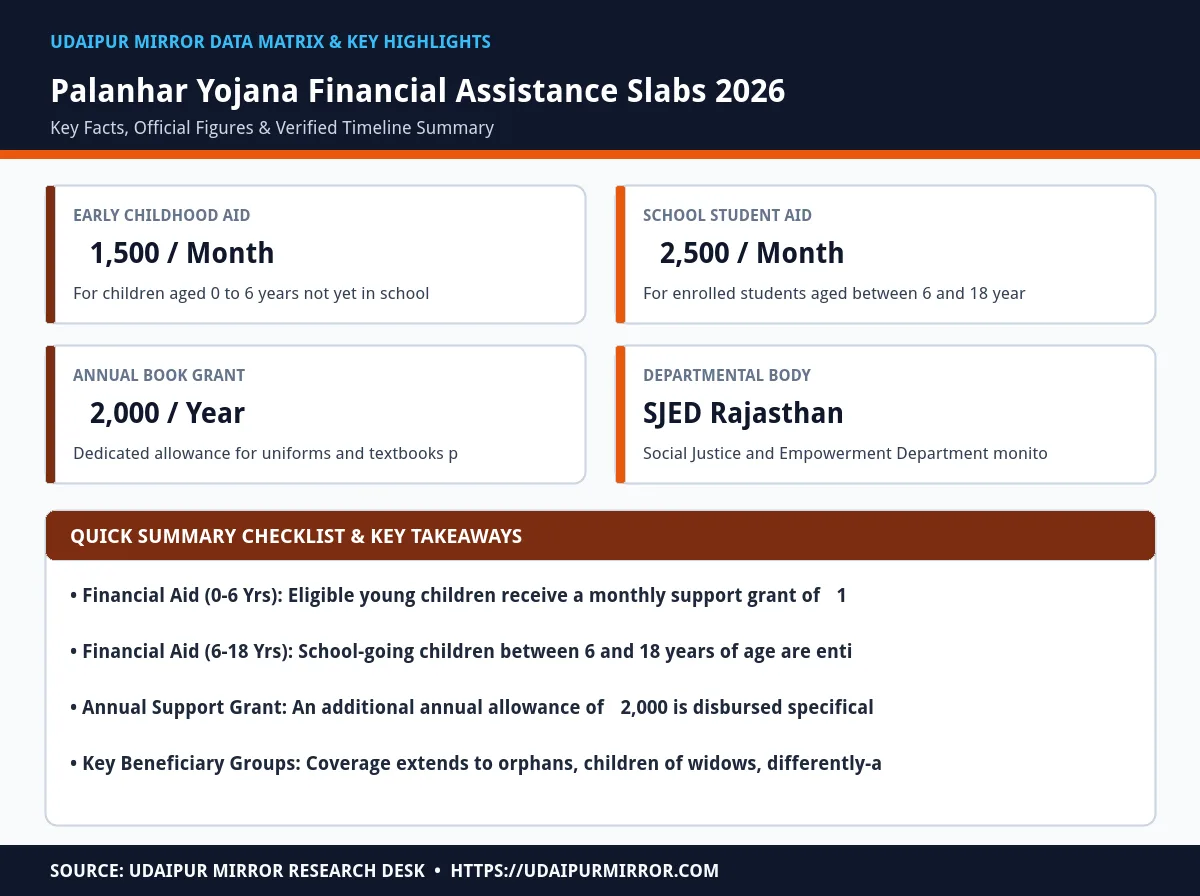
The table below outlines the categorized financial structures, age brackets, and annual support provisions established under the Rajasthan Palanhar Yojana 2026 guidelines for beneficiary families.
| Category Description | Age Group | Monthly Financial Aid | Annual Uniform/Book Grant |
|---|---|---|---|
| Orphan / Destitute Children | 0 to 6 Years | ₹1,500 | Nil |
| Orphan / Destitute Children | 6 to 18 Years | ₹2,500 | ₹2,000 |
| Children of Widows | 0 to 6 Years | ₹1,500 | Nil |
| Children of Widows | 6 to 18 Years | ₹2,500 | ₹2,000 |
| Children of Differently-Abled Parents | 6 to 18 Years | ₹2,500 | ₹2,000 |
| Children of HIV / Leprosy Patients | 6 to 18 Years | ₹2,500 | ₹2,000 |
Financial assistance under the scheme is disbursed directly through Direct Benefit Transfer (DBT) mechanisms into verified bank accounts, ensuring transparency and eliminating intermediaries. For young children between the ages of 0 and 6 years, who are yet to enter formal schooling, the state provides ₹1,500 per month to assist with nutrition, immunization, and primary care requirements.
Once children cross into the 6 to 18 age bracket and enroll in a recognized educational institution, the monthly assistance increases to ₹2,500. Additionally, to ease the financial burden associated with the academic calendar, an annual lump sum of ₹2,000 is credited for purchasing school uniforms, notebooks, and essential stationery items. This dual support structure ensures that educational expenses do not become a barrier to continuing school.
“Direct bank transfers guarantee that every rupee allocated for a child's education and welfare reaches the designated guardian without delay.” — State Welfare Board Spokesperson
A critical prerequisite for continuing the financial aid for children aged 6 years and above is the timely submission of school admission verification certificates. Guardians are required to present proof of enrollment and regular attendance from a recognized government or private school at the beginning of every academic session.
Failure to update school attendance records or dropouts can result in temporary suspension of monthly disbursements. The Social Justice and Empowerment Department conducts periodic audits through local district offices to verify that the assisted children are actively pursuing education and residing with their registered caretakers. (Also read: Udaipur Doctors Perform Complex 4-Hour Open Heart Surgery to Save 50-Year-Old Salumber Patient | उदयपुर में जटिल सर्जरी से मरीज की जान बचाई).
“Education is the cornerstone of the Palanhar Yojana; continuous school attendance verification protects the long-term future of our beneficiaries.” — District Social Welfare Officer
Applying for the Rajasthan Palanhar Yojana has been digitized to make the procedure transparent and accessible. Eligible guardians can submit applications online by visiting the official Social Justice and Empowerment Department (SJED) portal or through authorized e-Mitra kiosks across the state.
Applicants must keep necessary documents ready, including Aadhaar cards of the child and guardian, passport-size photographs, income certificate, death certificate of parents (if applicable), widow pension PPO (for widow categories), disability certificate, or medical records for illness-based categories, along with a bank passbook linked with Aadhaar for DBT transfers.
“Digital integration via the SJED portal ensures that families can apply from their local neighborhoods without navigating complex bureaucratic hurdles.” — E-Governance Cell Director
Children aged 0-6 years receive ₹1,500 per month, while school-going children aged 6-18 years receive ₹2,500 per month.
Yes, an annual allowance of ₹2,000 is provided specifically for school-going children to cover uniform and book expenses.
Eligible categories include orphans, children of widows, children of differently-abled parents, and children of parents suffering from HIV or leprosy.
Guardians can apply online through the official Rajasthan SJED portal or by visiting their nearest authorized e-Mitra kiosk with all required documents.
Add Udaipur Mirror as a preferred source on Google to see more of our travel guides in your AI overviews.