Office Address
14, Residency Road, Udaipur, Rajasthan 313001
Office Address
14, Residency Road, Udaipur, Rajasthan 313001


UDAIPUR: Navigating real estate development and property ownership in Mewar requires a precise understanding of statutory regulations, making rajasthan section 90a land conversion an essential legal mechanism for property owners, developers, and investors. Governed under Section 90A of the Rajasthan Land Revenue Act 1956, converting agricultural land for residential, commercial, or industrial purposes ensures clear legal titles and prevents unauthorized usage penalties. In districts like Udaipur, where rapid urban expansion has driven land demand, executing this transition through official channels is critical for securing municipal approvals, bank financing, and hassle-free construction permits. Citizens must also remain vigilant against administrative irregularities, similar to recent local probes where unlawful land dealings or public disputes—such as a recent tragic case involving family friction—highlight the absolute necessity of maintaining transparent, legally verified property records.
⚡ Quick Highlights: Rajasthan Section 90A Land Conversion Guide 2026
Before initiating any paperwork, applicants must satisfy strict statutory eligibility criteria established by the state government. The land in question must be recorded as agricultural holdings in the revenue records and must not fall within restricted categories such as forest land, water bodies, or government-reserved zones. Furthermore, the applicant must possess a clear, undisputed title, free from active litigation, stay orders, or pending revenue dues. Joint khatedars must submit notarized affidavits of consent from all co-owners to prevent subsequent legal challenges.
Property developers and individual landowners should also review master plan alignments managed by local urban improvement authorities. If a parcel intersects with proposed road widening, green belts, or civic infrastructure projects, conversion applications are systematically rejected. Ensuring alignment with the regional master plan protects investments and streamlines subsequent approvals, avoiding the types of unforeseen structural disruptions that often demand rapid administrative intervention, akin to how security agencies manage unexpected emergencies or critical infrastructure inquiries across regional jurisdictions.
“Clear title verification and unambiguous khatedari rights form the absolute foundation of any successful Section 90A conversion petition.” — Senior Revenue Legal Expert, Udaipur
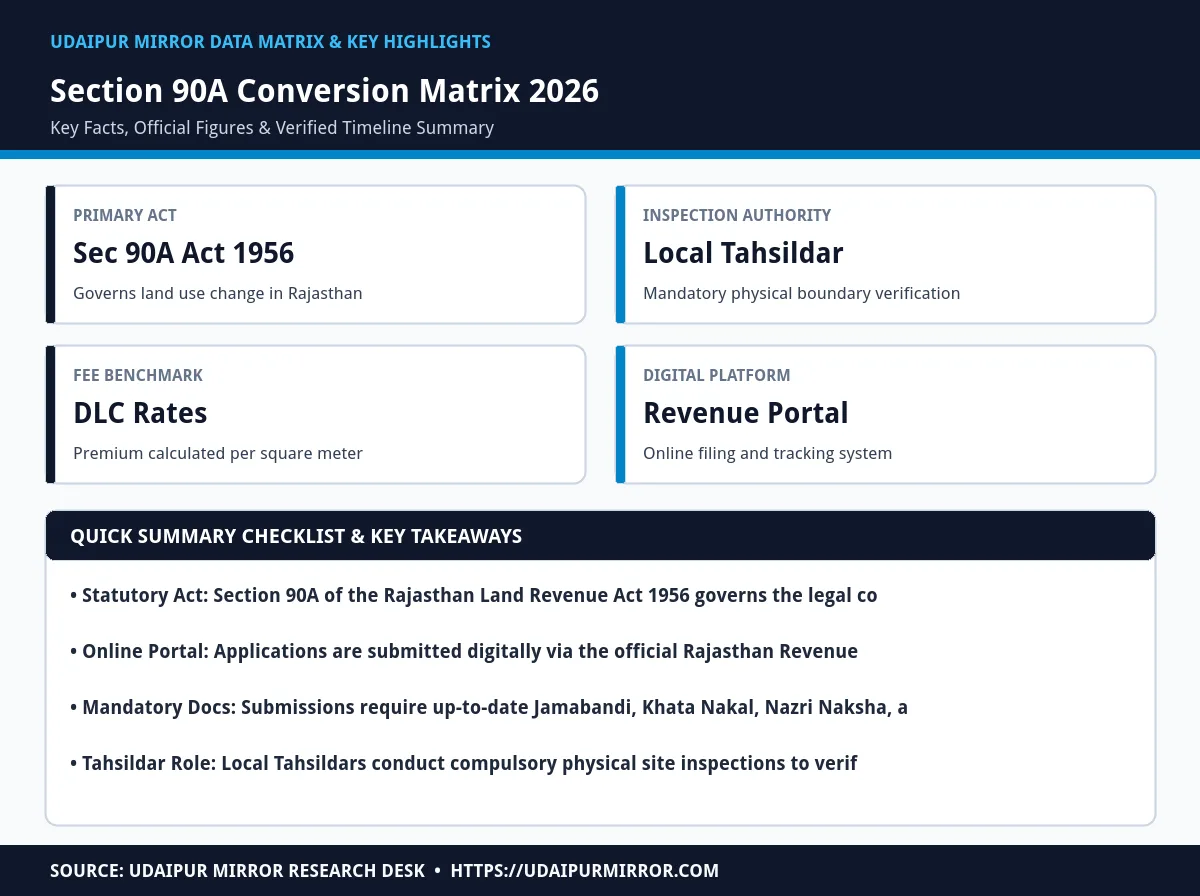
The following structured matrix details the sequential stages, administrative bodies involved, and documentation benchmarks required to successfully process land conversions across Udaipur and neighboring districts.
| Stage | Process Step | Responsible Authority | Key Deliverables |
|---|---|---|---|
| Phase 1 | Document Compilation | Property Owner / Advocate | Jamabandi, Khata Nakal, Nazri Naksha |
| Phase 2 | Online Application Filing | Revenue Board Portal | Digital Application Form & Fee Receipt |
| Phase 3 | Initial Scrutiny & Objections | Sub-Divisional Officer (SDO) | Notice Issuance & Public Objection Period |
| Phase 4 | Ground Verification | Tahsildar & Patwari | Inspection Report & Boundary Demarcation |
| Phase 5 | Premium Assessment | District Finance Committee | DLC-based Conversion Fee Calculation Memo |
| Phase 6 | Final Order & Mutation | Competent Authority / UDA | Section 90A Certificate & Revenue Mutation |
A meticulously prepared document dossier is the single most critical factor determining the speed of processing. Applicants must secure a contemporary Jamabandi (Record of Rights) reflecting current ownership, a Khata Nakal detailing parcel shares, and a precise Nazri Naksha (hand-drawn scaled map of the plot showing surrounding access roads and physical landmarks). Additionally, certified Cadastral maps obtained from the land records office are mandatory for digital uploading.
Discrepancies between physical boundaries on site and legacy revenue maps frequently stall conversion proceedings. Owners must engage licensed surveyors to reconcile actual ground measurements with official records before digital submission. Any mismatch between the Nazri Naksha and the settlement map triggers administrative queries, leading to avoidable delays and multiple rounds of re-verification by local patwaris.
“Accuracy in mapping and revenue entries eliminates bureaucratic friction and cuts down processing timelines significantly.” — District Land Records Directorate
The Government of Rajasthan has fully digitized the Section 90A application workflow, eliminating traditional offline bottlenecks. Applicants must register on the official Rajasthan Revenue Board or Udaipur Development Authority (UDA) web portals using secure credentials. Once logged in, users select the conversion module, input survey numbers, and upload scanned PDF copies of all mandatory documents, including Jamabandi and Nazri Naksha.
Following digital submission, an automated tracking number is generated, allowing applicants to monitor file movement across administrative desks. The system calculates preliminary processing fees, which must be paid securely online via net banking or integrated payment gateways. Real-time SMS and email alerts keep applicants informed whenever a file reaches the SDO, Tahsildar, or final sanctioning committee. (Also read: Explosion at Police Outpost in Ghaziabad’s Vasundhara Leaves One Injured As Probe Begins).
“Digital governance initiatives have brought remarkable transparency to land administration, enabling real-time tracking of every conversion file.” — E-Governance Bureau, Rajasthan
Once the digital application clears primary scrutiny, the Sub-Divisional Officer forwards the dossier to the local Tahsildar for rigorous ground verification. The Tahsildar, accompanied by the area Patwari, conducts a mandatory physical site inspection to verify boundaries, check for existing unauthorized structures, and ensure that right-of-way access roads are unencumbered. The inspection team files a comprehensive report verifying that the land matches all submitted blueprints.
Conversion charges—often referred to as premium—are calculated based on the prevailing District Level Committee (DLC) rates of the area, multiplied by the total square meterage and adjusted according to the intended use (residential, commercial, or institutional). Commercial conversions attract significantly higher multipliers compared to residential projects. Once the assessment is approved, the final demand note is issued to the applicant for payment.
“Physical verification by the Tahsildar ensures that ground realities strictly correspond to the submitted revenue records before fee assessment.” — Senior Revenue Inspector
Property buyers in Udaipur must exercise utmost diligence before purchasing plots or land parcels marketed as ‘converted’. Fraudulent or incomplete conversions can lead to severe legal complications, property demolition, or financial loss. Buyers should independently inspect the original Section 90A conversion certificate issued by the competent authority and cross-verify the unique order number directly on the state revenue portal.
Furthermore, purchasers must inspect updated Jamabandi entries to confirm that the mutation reflecting the land use change has been formally recorded in government registers. Consulting a qualified legal title advocate to review the chain of ownership and verify that all conversion charges were legitimately paid provides a robust safeguard against fraudulent transactions and contested property titles.
“Due diligence and independent portal verification are the ultimate defense for real estate buyers against fraudulent land titles.” — Udaipur Real Estate Regulatory Analyst
Section 90A provides the legal framework for converting agricultural land for non-agricultural purposes, such as residential, commercial, or industrial use, under government oversight.
Conversion charges are calculated based on the prevailing District Level Committee (DLC) rates for the specific location, multiplied by the total area in square meters and the designated land use category factor.
Key documents include an updated Jamabandi, Khata Nakal, Nazri Naksha (scaled site sketch), cadastral maps, identity proofs, and no-dues certificates.
Yes, buyers can verify conversion certificates and mutation entries by entering the unique application or order numbers on the official Rajasthan Revenue Board and UDA portals.
Add Udaipur Mirror as a preferred source on Google to see more of our travel guides in your AI overviews.