Office Address
14, Residency Road, Udaipur, Rajasthan 313001
Office Address
14, Residency Road, Udaipur, Rajasthan 313001


UDAIPUR: Nestled within the rugged, mineral-rich terrain of the Aravalli mountain ranges in Southern Rajasthan lies an ancient pharmacopeia that has sustained traditional healers for millennia. Modern wellness seekers are increasingly turning back to indigenous mewari medicinal herbs as clinical validation catches up with ancestral wisdom. From the resinous sap of wild shrubs to deep-rooted forest climbers, the flora of Mewar offers targeted therapeutic support for chronic inflammation, metabolic distress, and weakened immunity. For property owners managing rural estates or commercial agricultural lands, understanding local botanical ecosystems has become equally critical, echoing complexities seen in administrative frameworks such as the Rajasthan Section 90A Land Conversion Guide 2026.
⚡ Quick Highlights: Mewari Medicinal Herbs: Guggulu, Ashwagandha & Giloy Benefits
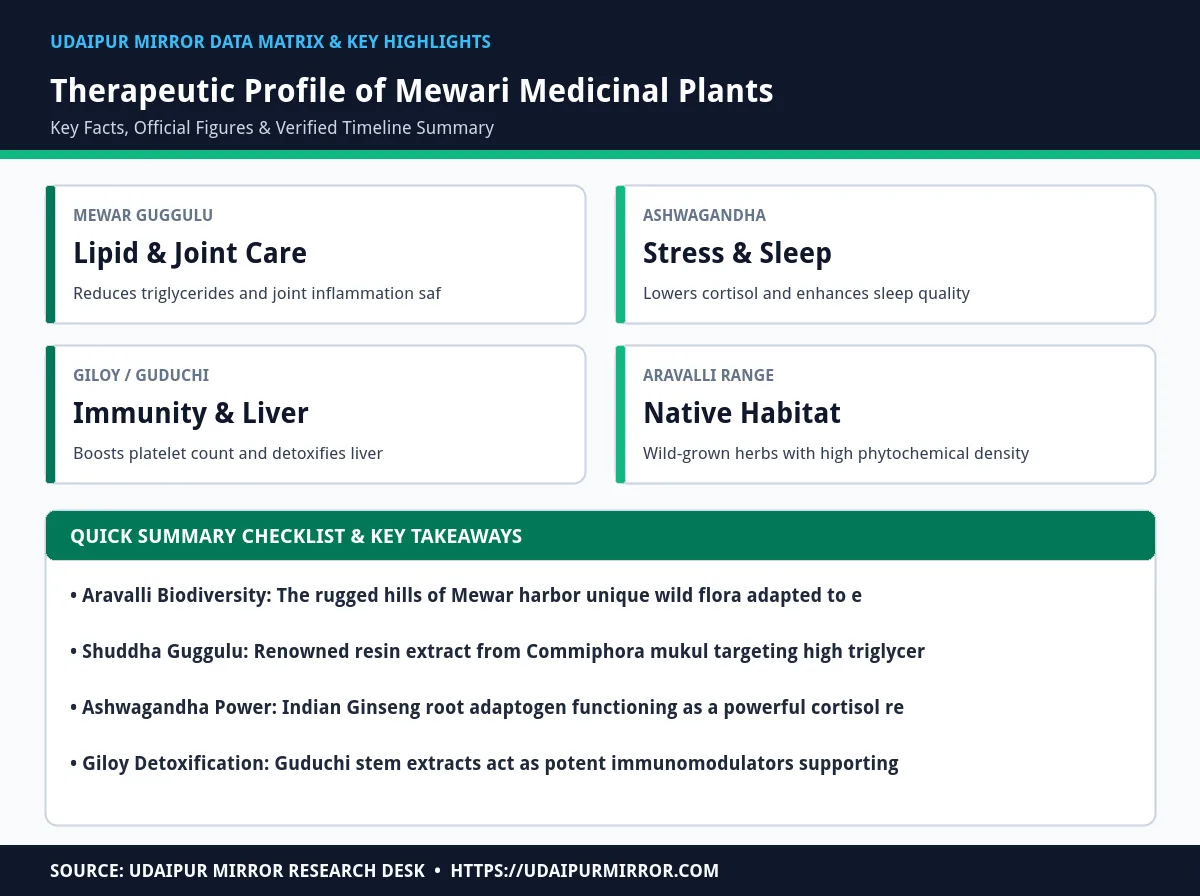
Native to the dry, rocky outcrops of the Aravalli hills, Commiphora mukul produces a sticky oleo-gum resin known historically as Guggulu. In traditional Mewari medicine, Shuddha Guggulu (purified resin) occupies a premier position for managing metabolic sluggishness and chronic inflammatory disorders. Modern pharmacological studies confirm that active sterones—specifically guggulsterones E and Z—play a vital role in upregulating hepatic LDL receptors, thereby promoting healthy cholesterol excretion and lowering serum triglycerides.
Beyond lipid management, Guggulu exhibits profound anti-arthritic properties. By inhibiting inflammatory pathways such as NF-kB and reducing pro-inflammatory cytokines, it alleviates stiffness in degenerative joint diseases. Traditional vaidyas often prescribe it alongside mineral formulations or bitter tonics to cleanse deep-seated ama (toxins) from joint capsules, improving mobility and reducing oxidative stress. (Also read: Rajasthan Section 90A Land Conversion Guide 2026: Process, Online Portal, Fees & Documents).
“The resin of the Aravalli Guggulu tree moves like a swift river through the channels of the body, scraping away accumulated blockages in both blood vessels and joints.” — Acharya Vachaspati, Senior Ayurvedic Vaidya
To maximize the therapeutic benefits of wild-harvested Aravalli flora while minimizing adverse side effects, practitioners must adhere strictly to standardized administration guidelines, recommended dosages, and traditional preparation vehicles (anupana).
| Botanical Name | Common Name | Primary Indication | Standard Daily Dosage | Recommended Vehicle |
|---|---|---|---|---|
| Commiphora mukul | Shuddha Guggulu | High Triglycerides & Arthritis | 500mg – 1000mg twice daily | Warm Water or Triphala decoction |
| Withania somnifera | Ashwagandha Root | Cortisol & Sleep Enhancement | 3g – 6g root powder daily | Warm Milk with Honey |
| Tinospora cordifolia | Giloy / Guduchi | Immunity & Liver Detox | 10ml – 20ml fresh juice or 500mg extract | Lukewarm Water or Honey |
Thriving in the semi-arid soil and intense sunlight of Southern Rajasthan, Withania somnifera—commonly known as Ashwagandha—develops robust root systems packed with withanolides. As a premier adaptogen, Ashwagandha acts directly on the hypothalamic-pituitary-adrenal (HPA) axis, modulating cortisol output during periods of acute or chronic psychological stress. For urban professionals and rural inhabitants alike, incorporating this root into daily routines helps combat nervous exhaustion and adrenal fatigue.
Furthermore, Ashwagandha is celebrated for its ability to restore healthy sleep architecture. Unlike synthetic sedatives that induce grogginess, traditional preparations calm the nervous system naturally, promoting deep, restorative sleep cycles. This restorative quality echoes the timeless comfort found in classic artistic mediums, much like how film enthusiasts cherish enduring cultural touchstones rather than superficial reboots, a sentiment mirrored when critics note I would rather see Maachis re-released than have a sequel: Chandrachur Singh.
“Ashwagandha confers the strength of a horse to a fatigued mind, grounding erratic nervous energy and nurturing peaceful slumber.” — Dr. Meena Sharma, Ethnobotanist
Climbing wild across forest trees in the Aravallis, Tinospora cordifolia is aptly named ‘Amrita’—the root of immortality. Giloy stems are powerhouse immunomodulators, widely utilized across Rajasthan during seasonal viral outbreaks to accelerate recovery, boost white blood cell efficiency, and support rapid platelet count restoration following vector-borne infections.
As a potent hepatoprotective agent, Giloy enhances liver enzyme function, purging metabolic waste and protecting hepatic tissue from oxidative damage caused by environmental toxins or heavy medications. Regular intake of fresh Giloy swasa (juice) or standardized extract revitalizes the entire digestive tract, balancing pitta and kapha doshas effectively. (Also read: I would rather see Maachis re-released than have a sequel: Chandrachur Singh).
“Giloy purifies the blood at its deepest dhatu level, restoring cellular vitality and fortifying the body's native defense barriers.” — Vaidya R. K. Dwivedi, Traditional Practitioner
The efficacy of Aravalli medicinal herbs depends heavily on ethical wildcrafting and traditional processing techniques. Over-harvesting threatens native populations, making sustainable cultivation and community-led conservation programs essential across Udaipur and surrounding districts. Vaidyas emphasize that raw herbs must undergo proper shodhana (detoxification and purification) to remove raw irritants before they are compounded into powders, churnas, or decoctions.
Preparation vehicles, known as Anupana, dictate how efficiently active phytochemicals cross cell membranes. Pairing Ashwagandha with warm organic milk enhances fat-soluble absorption, while Guggulu works best when taken with warm water or Triphala tea to target deep tissue blockages. Respecting these classical delivery methods ensures maximum therapeutic yield without compromising physiological safety.
“True healing happens when wild intelligence from the Aravalli hills meets the precise craftsmanship of classical Ayurvedic formulation.” — Dr. Hemant Joshi, Ayurvedic Pharmacologist
Shuddha Guggulu helps reduce high triglycerides, improves overall lipid balance, and significantly alleviates joint inflammation and stiffness associated with arthritis.
Ashwagandha acts as an adaptogen that regulates cortisol production in the HPA axis, reducing anxiety and promoting deep, restorative sleep cycles without morning grogginess.
Yes, Guduchi (Giloy) is a powerful immunomodulator known to accelerate white blood cell activity and assist in rapid platelet count recovery during chronic and viral fevers.
The standard therapeutic dosage is 3 to 6 grams of pure root powder daily, ideally consumed with warm milk and a touch of honey as an anupana.
Add Udaipur Mirror as a preferred source on Google to see more of our travel guides in your AI overviews.