Office Address
14, Residency Road, Udaipur, Rajasthan 313001
Office Address
14, Residency Road, Udaipur, Rajasthan 313001

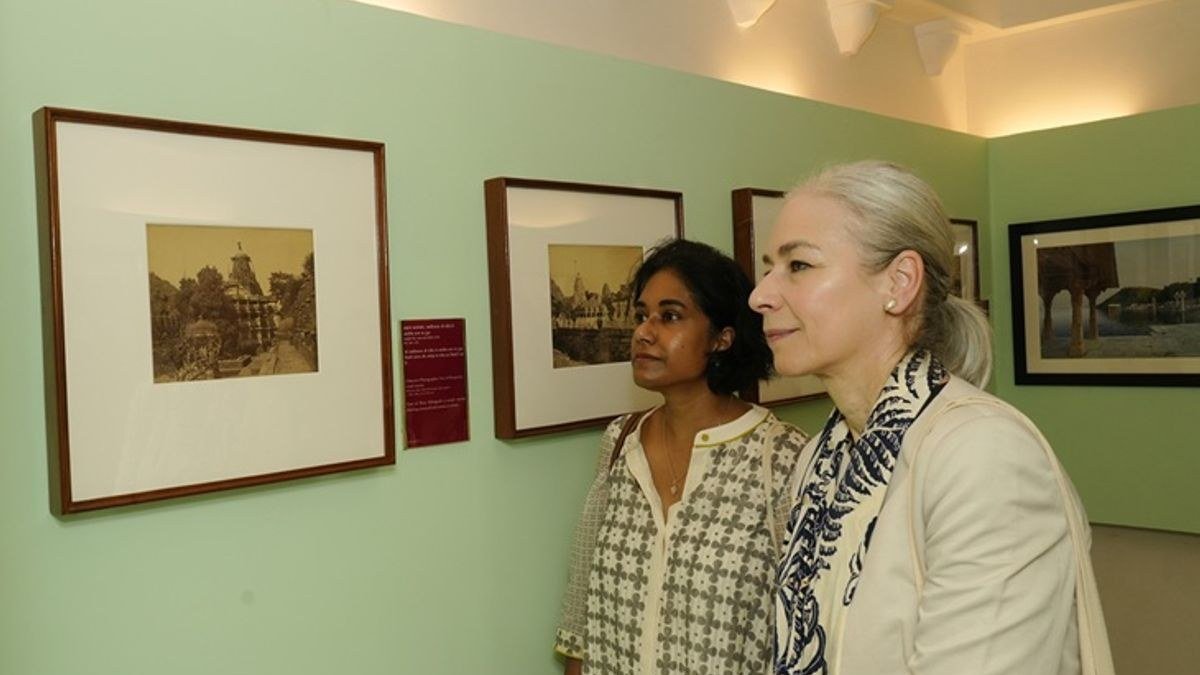
In a momentous cultural milestone for international heritage preservation, the Udaipur City Palace Museum inaugurated the landmark international exhibition titled ‘Early Photography and Archaeology in Western India: The Udaipur Chapter’ on Thursday. The prestigious exhibition unveils an extraordinary collection of rare, 19th-century photographs captured between the 1850s and 1890s, offering unprecedented visual access to the architectural and cultural evolution of Mewar and Western India.
Organized at the Fateh Niwas Gallery inside the historic Zanana Mahal, this exhibition represents a groundbreaking trilateral collaboration uniting three globally renowned cultural institutions: The British Library (London), Chhatrapati Shivaji Maharaj Vastu Sangrahalaya (CSMVS, Mumbai), and the Maharana of Mewar Charitable Foundation (MMCF, Udaipur).
Speaking at the inaugural ceremony, Dr. Lakshyaraj Singh Mewar, Chairman and Managing Trustee of the Maharana of Mewar Charitable Foundation (MMCF), underscored the deep cultural resonance of the archival showcase. He noted that the exhibition embodies a living tradition of safeguarding generational memory and architectural heritage.
“These rare photographs represent far more than historical artifacts—they embody the collective memory and living soul of Mewar,” stated Dr. Lakshyaraj Singh Mewar. “They intimately connect modern generations with the visionary rulers, sacred spaces, and vibrant societal traditions that defined our regional identity. Preserving and sharing this visual history reinforces Udaipur’s standing as a beacon of living heritage.”
Echoing these sentiments, Dr. Jeremy Silver, Interim Chief Executive of the British Library, highlighted the transformative power of cross-border institutional cooperation. “Collaborations of this caliber allow world-class archives to reach diverse local audiences, fostering deeper appreciation for shared cultural histories,” remarked Dr. Silver.
Sabyasachi Mukherjee, Director General of CSMVS Mumbai, described the venture as a model benchmark for institutional synergy, demonstrating how shared photographic archives bridge scholarly research and public engagement.
The curated exhibition presents a panoramic archaeological survey of Western India as documented during the formative decades of photography. Visitors can explore early photographic records of globally celebrated rock-cut caves and sacred complexes, including:
| Exhibition Feature | Details & Specifications |
|---|---|
| Exhibition Title | Early Photography and Archaeology in Western India: The Udaipur Chapter |
| Archival Era | 1850s to 1890s (19th-Century Rare Original Prints & Negatives) |
| Venue | Fateh Niwas Gallery, Zanana Mahal, City Palace Museum, Udaipur |
| Partner Institutions | The British Library (London), CSMVS (Mumbai), MMCF City Palace Museum |
| Public Access Window | Open Daily for Visitors until 31 March 2027 |
A compelling dimension explored in the exhibition is Mewar’s remarkably early engagement with optical and photographic technology. Historical records reveal that as early as 1818, optical instruments such as the Camera Obscura were present in the royal court of Udaipur.
In his monumental treatise Travels in Western India, British political agent Colonel James Tod recorded demonstrating the optical Camera Obscura to Kunwar Amar Singh during the reign of Maharana Bhim Singh. Decades later, during the reigns of Maharana Swaroop Singh and Maharana Sajjan Singh, photography became institutionalized within the royal court.
Local court artists, Indian practitioners, and visiting European photographers were commissioned to document royal durbars, state banquets, visiting dignitaries, and city architecture. These meticulous visual records continue to provide historians with indispensable documentary evidence of urban and dynastic transformations.
Running through March 31, 2027, the exhibition adds significant scholarly and cultural depth to Udaipur’s tourism calendar. Travelers visiting the City Palace will experience not only royal regalia but also the very images that introduced Mewar’s majesty to the world over a century ago. Discover more cultural events in our Art & Design section, explore key heritage landmarks in Udaipur tourism, and follow live Udaipur breaking news.
The exhibition is titled ‘Early Photography and Archaeology in Western India: The Udaipur Chapter’, showcasing rare historical photographs from 1850 to 1890.
The exhibition is a joint initiative organized by The British Library (London), Chhatrapati Shivaji Maharaj Vastu Sangrahalaya (CSMVS, Mumbai), and the City Palace Museum under the Maharana of Mewar Charitable Foundation (MMCF).
It is hosted at the Fateh Niwas Gallery inside the Zanana Mahal at the City Palace Museum in Udaipur and will remain open to visitors until March 31, 2027.
The collection showcases 19th-century views of Ajanta Caves, Ellora, Nashik, Hampi, and Somnath, along with exclusive photographs of Udaipur’s City Palace, royal durbars, lakes, and city gates.
Optical devices like the Camera Obscura were documented in the Mewar royal court as early as 1818, as recorded by Colonel James Tod during the reign of Maharana Bhim Singh.
Add Udaipur Mirror as a preferred source on Google to see more of our travel guides in your AI overviews.





[…] Udaipur continues to witness unprecedented domestic and international visitor growth across luxury and midscale tiers. This growth is supported by an expanding cultural calendar and high-profile exhibitions, such as the recently inaugurated showcase covered in our report on how the Udaipur City Palace Museum Unveils Landmark British Library Photography Exhibition Showcasing 19th-C…. […]