Office Address
14, Residency Road, Udaipur, Rajasthan 313001
Office Address
14, Residency Road, Udaipur, Rajasthan 313001

BEIJING: In what was envisioned as a landmark turnaround move for German automotive giant Volkswagen AG, the company’s joint EV platform project with Chinese startup Xpeng Inc. is encountering complex operational frictions, integration delays, and fierce market headwinds across Mainland China. Implementing a revamped volkswagen china ev strategy xpeng alliance was supposed to rapidly bridge the software and battery tech gap against local rivals like BYD and NIO, but slow joint decision-making processes and differing software architecture cultures are complicating rollout schedules in 2026.
⚡ Quick Highlights: Volkswagen China EV Strategy with Xpeng Faces Friction
At the core of the friction surrounding Volkswagen’s strategy in China is a fundamental mismatch in product development philosophy. Traditional German automotive engineering relies on rigid 48-month vehicle lifecycles with multi-stage quality gates controlled from Wolfsburg. Conversely, Chinese electric vehicle startups like Xpeng operate on agile 18-month software-led cycles where features are continuously updated over-the-air (OTA) after release.
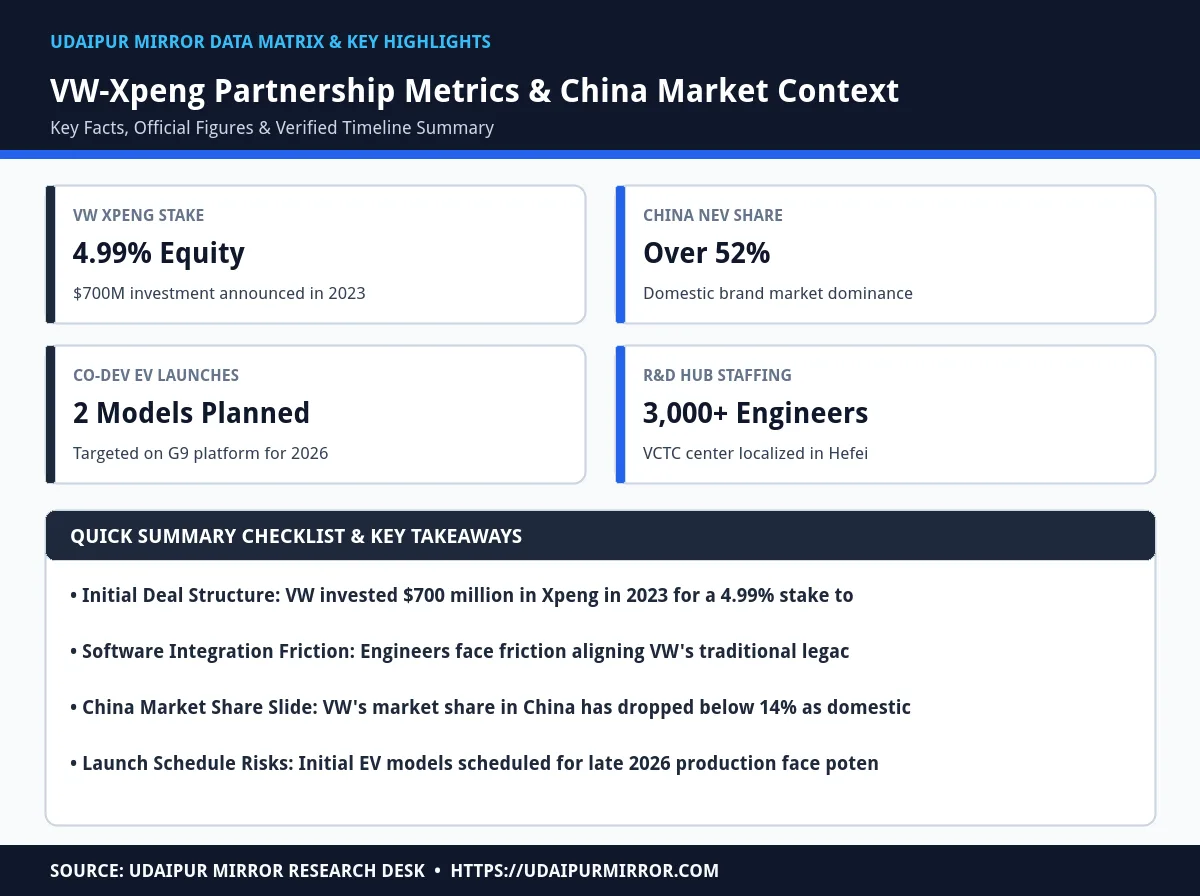
To bridge this gap, Volkswagen established the Volkswagen China Technology Company (VCTC) in Hefei, employing over 3,000 localized engineers. However, internal reports indicate that aligning legacy component validation rules with Xpeng’s fast-moving software-defined vehicle (SDV) framework has generated significant friction between European managers and local software teams. As seen in global market pivots where legacy brands adjust sales models, such as how Hyundai Dealerships Pivot to Gen Z Buyers in India with Tech Outlets and EV Financing, bridge strategies require rapid cultural realignment to capture younger, tech-focused buyers before agility bottlenecks derail market entry.
“In China, software defines the car, not legacy mechanical hardware. Adapting Wolfsburg's governance to Xpeng's rapid software updates has proven far more complex than purchasing an equity stake.” — Senior Asia-Pacific Mobility Industry Analyst
The technical collaboration between Volkswagen and Xpeng aims to combine German manufacturing engineering with Chinese digital software agility. The table below details how the alliance compares against primary market competitors in vehicle architecture, software integration, development speed, and price positioning.
| Metric / Dimension | VW-Xpeng Joint Alliance | BYD Auto | Tesla China |
|---|---|---|---|
| Primary EV Platform | Xpeng Edward / VW CEA Zonal Platform | e-Platform 3.0 Evo Architecture | Tesla Custom Unibody Platform |
| Smart Cockpit OS | XOS Tianji / Localized VW Software | DiLink 5.0 Smart Ecosystem | Full Self-Driving / Custom Linux OS |
| Targeted R&D Lead Time | 24–30 Months (Revised) | 18–22 Months | 24–28 Months |
| Battery Tech Strategy | CALB / CATL LFP Chemistry | FinDreams Blade LFP Battery | CATL LFP / LG Energy 2170 Cells |
| Mid-Size SUV Price Range | ¥200,000 – ¥260,000 (Expected) | ¥160,000 – ¥230,000 | ¥249,900 – ¥319,900 |
| Autonomous Driving Suite | Xpeng XNGP High-Speed & Urban ADAS | God’s Eye High-Level ADAS | FSD Supervised (Beta Market) |
Volkswagen’s reliance on Xpeng comes at a critical juncture for foreign automakers in Mainland China. Once the undisputed leader of China’s automotive market with over 20% total share, Volkswagen’s footprint has contracted as sales of internal combustion engine (ICE) vehicles decline rapidly. New Energy Vehicles (NEVs), including plug-in hybrids and battery electric cars, now account for well over half of all new passenger car sales in major Chinese metropolises.
While VW’s standalone ID. series electric vehicles achieved moderate sales volumes, they struggled against price-slashing domestic competitors like BYD, Leapmotor, and Geely. Chinese consumers increasingly treat cars as extended mobile devices, demanding ultra-responsive touchscreens, advanced voice assistants, and urban autonomous driving suites—areas where domestic makers maintain a distinct localized advantage over legacy European platforms.
“The window for legacy automakers to establish viable EV software platforms in China is closing fast. Every quarter of delay forfeits market share to domestic rivals.” — Beijing Automotive Research Group Report

A central pillar of the VW-Xpeng partnership was the co-development of the China Electrical Architecture (CEA)—a centralized zonal electronic control architecture designed to replace dozens of individual electronic control units (ECUs). The system was engineered to reduce electronics costs by up to 40% while enabling seamless OTA updates across the entire vehicle network.
However, practical execution has encountered hurdles in retrofitting legacy Volkswagen chassis components and safety hardware into Xpeng’s domain controllers. Engineering teams have spent months resolving bus speed latency issues and software driver incompatibilities between European-sourced microcontrollers and Chinese computing chips. Electric mobility transitions require strict cost management and clear value positioning, similar to domestic EV shifts detailed in Two New Affordable Electric Cars Confirmed for Launch in December 2026: Range, Specs, and Price in Rajasthan.
The slow traction of the Xpeng partnership highlights a strategic dilemma facing European car manufacturers globally. For decades, Volkswagen, BMW, and Mercedes-Benz used China as a primary profit driver to fund global R&D. Now, as the Chinese market turns decisively electric and software-driven, western carmakers face the prospect of spending heavily on localized partnerships while losing overall market control.
If Volkswagen cannot streamline its Xpeng joint venture to produce cost-competitive, tech-rich EVs by late 2026, it risks being relegated to a secondary player in the world’s largest automotive market. Furthermore, any failure of this ‘In China, For China’ strategy could force Wolfsburg to write off billions in localized investments and recalibrate its global EV transition timelines.
Volkswagen partnered with Xpeng in 2023, acquiring a 4.99% equity stake for $700 million, to leverage Xpeng’s advanced EV platform, smart cockpit software, and autonomous driving technology to accelerate its electric vehicle rollouts in China.
The alliance is encountering operational friction due to differences between Volkswagen’s traditional legacy vehicle engineering protocols and Xpeng’s rapid software iteration schedules, along with high competition from domestic Chinese EV makers.
The partnership is co-developing two mid-sized, B-segment electric SUVs tailored specifically for Chinese consumers, built on Xpeng’s G9 platform architecture and the co-developed China Electrical Architecture (CEA).
It highlights the intense difficulty legacy foreign automakers face in maintaining market share in China, demonstrating that purchasing software tech from local partners requires significant organizational and technical integration to succeed.
Add Udaipur Mirror as a preferred source on Google to see more of our travel guides in your AI overviews.