Office Address
14, Residency Road, Udaipur, Rajasthan 313001
Office Address
14, Residency Road, Udaipur, Rajasthan 313001


MUMBAI / NEW DELHI: International bullion markets are experiencing a notable paradigm shift as
⚡ Quick Highlights: Global Gold Prices Lose Appeal Due to Interest Rate Pressures
The recent downward trajectory in global gold valuations underscores a classic economic principle: when central banks keep interest rates elevated to tame inflation, non-yielding assets lose their luster. Investors demanding higher returns find attractive yields in government bonds and fixed-income securities, bypassing traditional safe-haven bullion. Analysts note that structural shifts in global monetary policy are forcing a comprehensive re-evaluation of institutional portfolios worldwide.
As retail investors also grapple with consumer sentiment pressures and tightening credit conditions, physical gold purchases have slowed noticeably in key hubs across Asia and Europe. Meanwhile, for a broader perspective on how corporate performance interacts with shifting market dynamics, investors frequently analyze sectors like IT Stocks Q2 Results Analysis to gauge overall risk appetite and institutional investment flows.
“High real interest rates create a formidable barrier for gold bulls, shifting institutional capital toward yield-bearing instruments.” — Global Macro Strategist, Wall Street Desk
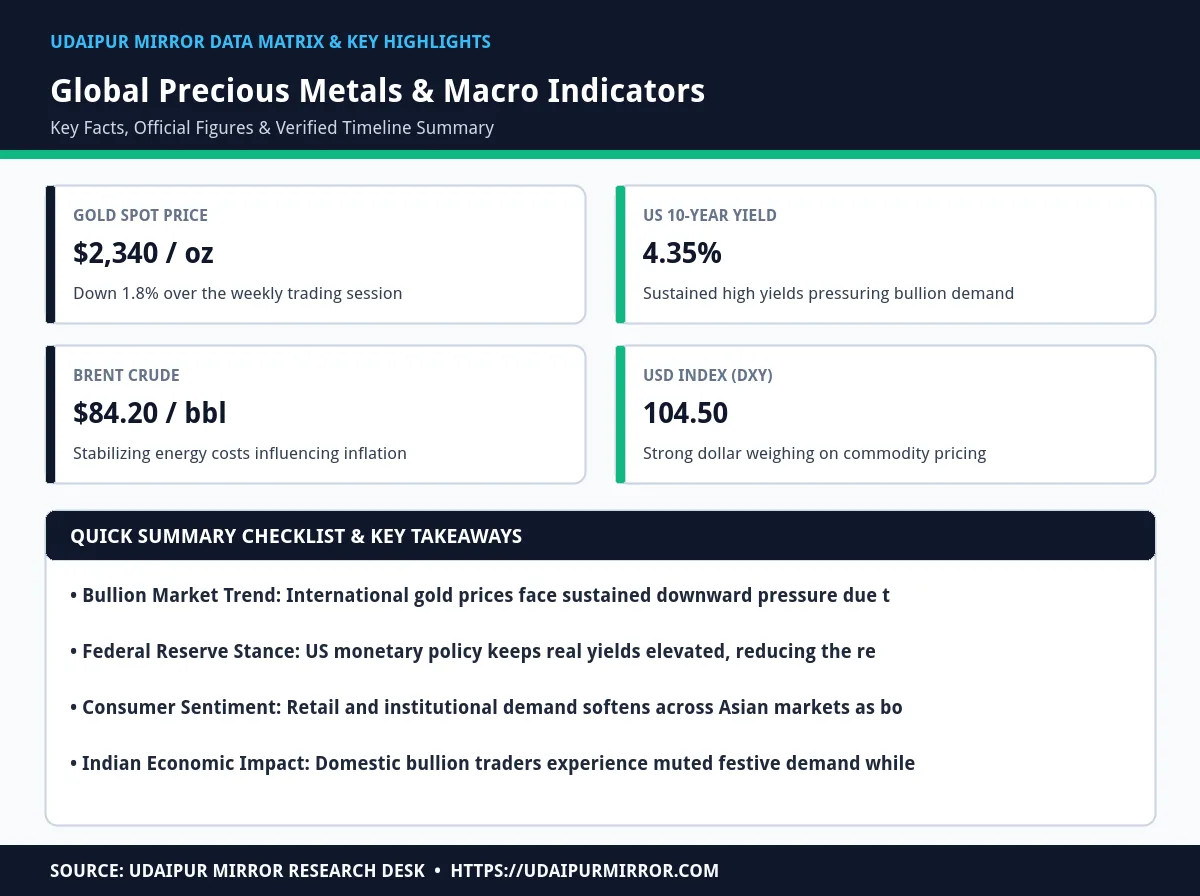
The following matrix outlines the key performance metrics across global precious metals, major currency indices, and benchmark bond yields as of late October 2026. Understanding these indicators is crucial for assessing broader macroeconomic shifts and their spillover effects into domestic markets.
| Asset Class | Current Level | Weekly Change | Market Impact |
|---|---|---|---|
| Spot Gold | $2,340.50 / oz | -1.8% | Bearish due to high yields |
| US 10Y Yield | 4.35% | +4 bps | Strong downward pull on gold |
| US Dollar Index | 104.50 | +0.6% | Increased holding cost for bullion |
| Brent Crude | $84.20 / bbl | -1.2% | Easing inflationary pressures |
| S&P 500 Index | 5,780.20 | +0.4% | Capital rotation into equities |
For Indian retail investors and macroeconomic planners, developments in international commodity markets carry immediate domestic implications. While lower global gold prices can theoretically ease import bill pressures, domestic retail demand often moves inversely to global trends due to cultural affinity and currency depreciation factors. Furthermore, stable macroeconomic foundations are essential when comparing regional economic indicators, such as analyses seen in discussions surrounding Is Bangladesh Per Capita Income Higher Than India, which provide deeper context on South Asian growth metrics.
Indian jewelry manufacturers and institutional bullion importers are closely monitoring foreign exchange rates, particularly the rupee-dollar parity, to time their procurement strategies effectively ahead of upcoming festive and wedding seasons.
“Domestic bullion markets remain resilient, cushioned by robust local consumer demand despite international price corrections.” — Senior Commodities Analyst, Mumbai
Financial advisors recommend that investors maintain a diversified portfolio rather than reacting impulsively to short-term commodity price swings. While gold remains an essential long-term hedge against systemic financial risks, balancing allocations across equities, fixed income, and alternative assets is crucial during periods of aggressive monetary tightening.
As global central banks signal potential future pivots contingent on incoming inflation and employment data, market participants must remain agile, keeping a close watch on weekly macroeconomic releases and geopolitical developments. (Also read: Is Bangladesh Per Capita Income Higher Than India? Facts, IMF Data & Real Comparison Explained | भारत बनाम बांग्लादेश प्रति व्यक्ति आय).
“Diversification remains the cornerstone of wealth preservation in an era of unpredictable interest rate cycles.” — Chief Investment Officer, Private Wealth Management
Global gold prices are facing downward pressure primarily due to elevated interest rates set by central banks, which increase bond yields and raise the opportunity cost of holding non-yielding assets like bullion.
Higher interest rates strengthen the US dollar and boost Treasury yields, making safe-haven assets like gold less attractive to institutional and retail investors seeking fixed returns.
While international price corrections can help moderate India’s import bills and trade deficit, domestic retail buyers frequently view lower prices as an opportune time to accumulate physical gold.
Financial experts recommend maintaining a balanced and diversified portfolio rather than exiting gold entirely, as it continues to serve as an effective long-term hedge against systemic volatility.
Add Udaipur Mirror as a preferred source on Google to see more of our travel guides in your AI overviews.






[…] Tech, Innovation Could Boost Indo-UAE Trade to $200b by 2032: Indian Diplomat 2 seconds ago ⚡ Business Global Gold Prices Lose Appeal Amid Rising Interest Rate Pressures and Central Bank Shifts… Apps IT Stocks Q2 Results Analysis: Infosys vs TCS vs Wipro vs HCL vs TechM in AI Race 1 minute […]