Office Address
14, Residency Road, Udaipur, Rajasthan 313001
Office Address
14, Residency Road, Udaipur, Rajasthan 313001


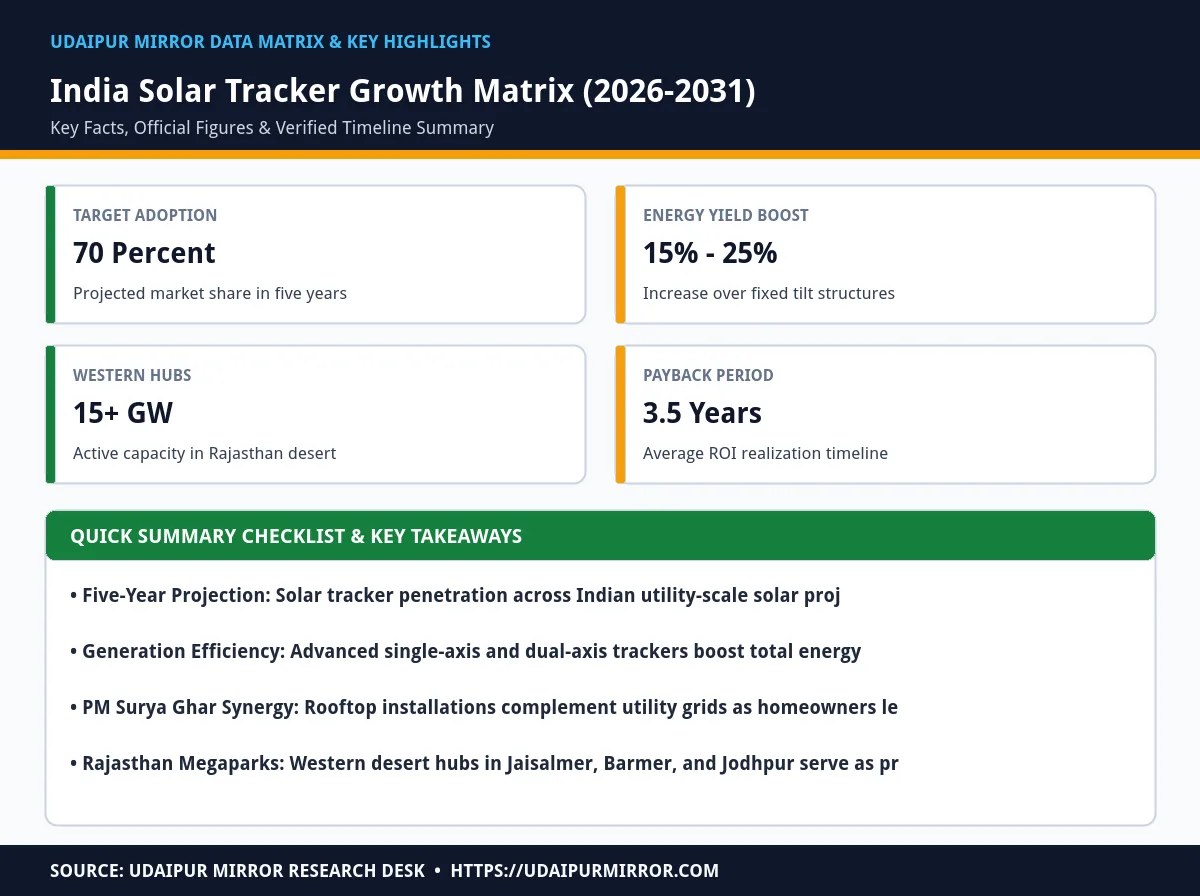
NEW DELHI / UDAIPUR: As India accelerates its ambitious renewable energy targets heading toward late 2026, industry experts highlight a transformative shift in utility-scale installations. Recent assessments reveal that solar tracker adoption in india is projected to capture up to 70% of the ground-mounted photovoltaic market over the next five years. This technological leap promises to maximize energy generation per acre, fundamentally altering how massive solar parks in western Rajasthan and beyond capture photovoltaic radiation throughout the day.
⚡ Quick Highlights: Solar Tracker Adoption in India to Reach 70% in 5 Years
For over a decade, fixed-tilt mounting structures dominated India’s solar landscape due to their lower initial capital expenditure and simpler maintenance requirements. However, as land acquisition costs rise and grid operators demand higher generation predictability, developers are turning to intelligent tracking systems. Recent expert discussions underscore that solar tracker adoption in india is transitioning from a niche preference to a mainstream standard, supported by local automation engineering and robust hardware resilience.
Single-axis trackers, which follow the sun from east to west throughout the day, have become particularly popular in flat terrain regions such as the Thar Desert in Rajasthan. By continuously adjusting panel angles to match solar elevation, these systems extract maximum irradiance. In parallel, broader macroeconomic trends continue to influence the sector, with global oil markets brace for further weakness towards year-end, reinforcing the economic imperative for aggressive domestic renewable integration.
“Solar trackers are no longer a luxury feature for experimental farms; they are becoming the foundational baseline for maximizing kilowatt-hour output per square meter in utility projects.” — Renewable Energy Technology Analyst
While utility-scale projects utilize advanced solar trackers, residential consumers across Rajasthan benefit immensely from standardized rooftop solar tiers under central and state frameworks. Review the benchmark costs, direct subsidies, and estimated monthly savings below:
| System Capacity | Benchmark Cost (INR) | Central Subsidy (INR) | Est. Monthly Savings (INR) | Payback Period (Years) |
|---|---|---|---|---|
| 1 kW System | ₹60,000 | ₹30,000 | ₹1,200 – ₹1,500 | 3.2 Years |
| 2 kW System | ₹1,20,000 | ₹60,000 | ₹2,500 – ₹3,000 | 3.0 Years |
| 3 kW System | ₹1,80,000 | ₹78,000 | ₹4,000 – ₹4,800 | 2.8 Years |
| 5 kW System | ₹3,000,00 | ₹78,000 (Capped) | ₹6,500 – ₹7,500 | 3.5 Years |
While utility-scale mega projects grab headlines with advanced tracking hardware, residential and commercial rooftop adoption is experiencing an unprecedented boom across states like Rajasthan. Homeowners integrating rooftop arrays under national frameworks benefit from streamlined DISCOM approvals (JVVNL, AVVNL, and JdVVNL) and seamless net metering guidelines. This decentralization eases pressure on high-voltage transmission networks while empowering urban and rural households alike.
Furthermore, corporate clean energy portfolios are expanding rapidly. Industry leaders note that Tata Power appoints Sanjay Banga as CEO amid strong Q2 profit jump, reflecting robust investor confidence and commercial appetite for large-scale solar and hybrid green assets across the nation.
“The fusion of utility-scale tracking farms and localized rooftop generation creates a balanced, resilient grid capable of handling peak demand without fossil fuel reliance.” — Green Tech Infrastructure Strategist
Solar trackers follow the sun’s path across the sky, increasing energy yield by 15% to 25% compared to static fixed-tilt structures.
It drives massive domestic demand for precision actuators, slew drives, and smart electronic controllers, boosting local manufacturing under the Make in India initiative.
No, solar trackers are primarily designed for utility-scale ground-mounted solar farms due to their structural footprint, weight, and mechanical complexity.
Modern tracking systems feature automated wind-stow capabilities that lock panels in a horizontal position during severe dust storms or high winds to prevent structural damage.
Add Udaipur Mirror as a preferred source on Google to see more of our travel guides in your AI overviews.